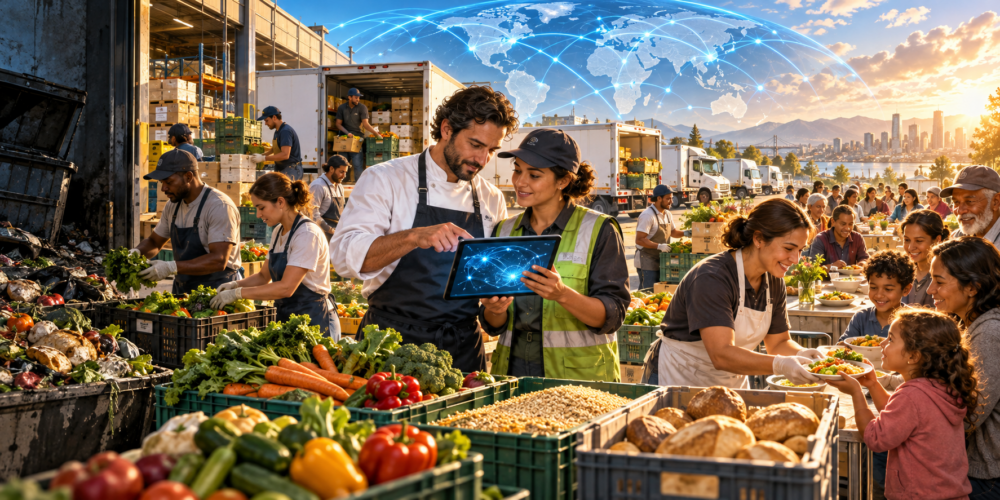
Photo illustration- Human compassion, supported by artificial intelligence: reducing food waste, improving deliveries and helping more families eat.
From commercial kitchens to emergency food deliveries, artificial intelligence is helping people protect precious food—and make limited resources go further.
By: Ya Libnan – Article 20 in YL series “How AI is helping humanity”
Every day, the world throws away food while families struggle to put a meal on the table.
The scale is staggering. According to the United Nations Environment Programme, households wasted more than one billion meals every day in 2022. The same announcement estimated the global economic toll of food loss and waste at roughly $1 trillion. Behind those figures are squandered harvests, wasted water, unnecessary expenses and missed opportunities to nourish people.
Artificial intelligence is beginning to help tackle this enormous failure.
Its contribution starts with something surprisingly ordinary: understanding what ends up in the kitchen bin.
Winnow, a company providing AI technology to commercial kitchens, uses cameras, scales and software to identify discarded food and measure its cost. That information helps kitchen teams recognize patterns and adjust purchasing, preparation and portions. Chefs gain a clearer picture of where good food—and money—is being lost.
Consider a large kitchen preparing meals for hundreds of people. Repeatedly cooking too much of one dish can create substantial waste over a year. Knowing precisely what is discarded gives the chef a practical basis for changing tomorrow’s production.
Small improvements, repeated across thousands of kitchens, become significant.
Winnow reports that its customers now save more than $100 million annually, preventing food waste equivalent to approximately 70 million meals a year. These are company-reported results. They measure waste avoided, rather than meals donated to hungry families—but they demonstrate that AI can help preserve food and reduce costs at substantial scale.
The company’s stated ambition is to help the hospitality industry save $1 billion in food costs every year. That remains a goal, rather than an accomplishment already achieved. Nevertheless, the results so far offer a practical foundation for expansion.
The humanitarian application is equally important.
At the World Food Programme, an AI tool called SCOUT supports decisions about purchasing and moving food. In Western Africa, better planning of sorghum sourcing and delivery generated $2 million in savings during 2024, according to WFP’s annual performance report.
Across its broader collection of planning tools, WFP reports approximately $12 million in savings in 2025, enabling it to reach an additional 800,000 people with food assistance. That achievement reflects several technologies working together, including AI, alongside humanitarian expertise.
For a family receiving assistance, the value of better planning is immediate: food arrives when it is needed.
Preventing waste and relieving hunger require different, connected actions. Food saved in a hotel kitchen does not automatically reach a displaced child. Safe redistribution requires collection, refrigeration, transport and trusted local organizations. Emergency assistance also requires funding and access to communities.
AI can strengthen these efforts. People must organize and deliver them.
Human judgment remains central. Chefs decide how to change menus. Humanitarian workers assess needs and arrange deliveries. In WFP’s AI-assisted registration checks, staff review possible duplicate records and make the final decisions.
The next step should be to expand proven systems and measure whether they preserve more food, lower costs and improve access to nutritious meals. Governments, food businesses and humanitarian organizations have good reason to cooperate.
A trillion-dollar problem deserves serious ambition. The results already emerging show where progress is possible.
Every meal preserved represents the work of farmers, drivers and cooks. Every additional family reached gives that efficiency a human meaning.
Helping humanity feed itself is among the most valuable purposes we can give artificial intelligence.
Other Ya Libnan articles in the series : How AI is helping humanity
While families sleep, AI helps firefighters spot the first signs of danger
AI is helping scientists identify children most at risk from Ebola
AI is helping make our roads Safer—and protecting precious lives
AI helped recover $1 Billion in check fraud—Protecting America’s taxpayers
When disaster strikes, AI helps rescuers find where help is needed most
AI is helping save millions of liters of water every day
Six weeks, remarkable progress: How AI and teachers helped students learn in Nigeria
AI is helping scientists see Pancreatic cancer before it becomes visible
AI can help invent tomorrow’s medicines—and build pharmaceutical independence
AI is helping find the people the world’s deadliest infectious disease leaves behind
AI helped doctors find 29% more breast cancers—In a trial of over 105,000 women
AI helped a man with ALS speak nearly two million words
When every minute matters: How AI is helping doctors save Sepsis patients
AI is helping save eyesight before it is lost
AI is helping scientists invent new weapons against superbugs
AI has given scientists a new map of life. Analysis
When AI gives families time to escape a flood
Two patients show how AI can help save precious time
How Artificial Intelligence is already improving our lives, Analysis
