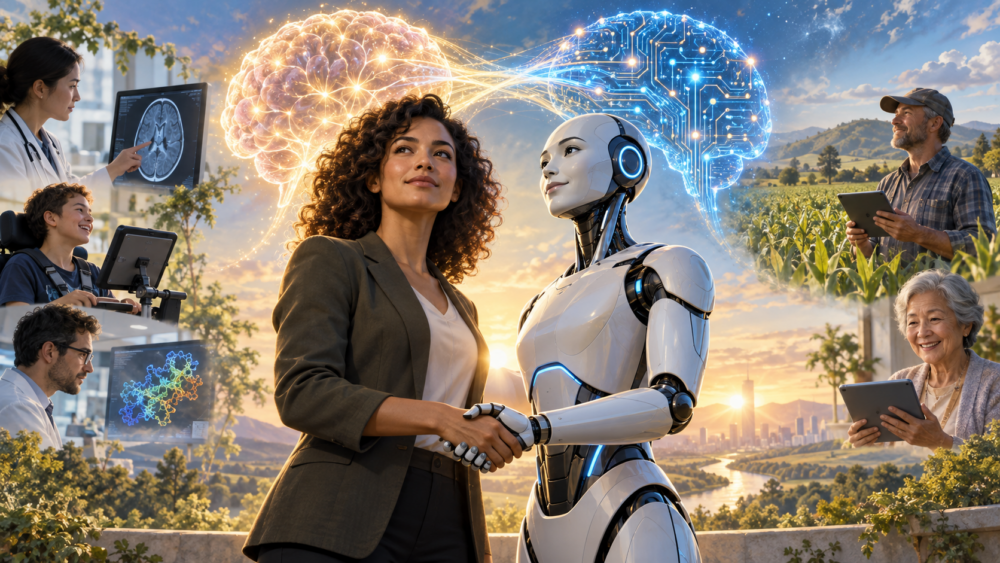
Photo illustration -Human intelligence provides the purpose, judgment and responsibility. Artificial intelligence expands what humanity can achieve.
An early warning near a California neighborhood shows how artificial intelligence and human courage can work together to protect communities.
By: Ya Libnan – Article 19 in YL series “How AI is helping humanity”
At 5:19 a.m. on September 11, 2023, an artificial intelligence system detected signs of a possible fire near Grass Valley, California, and alerted firefighters.
The first 911 call did not arrive until 6:01 a.m.—42 minutes later. By then, firefighters were already at the scene. They kept the fire to less than a quarter of an acre, according to the University of California San Diego. The incident was near a residential area.
Forty-two minutes. For a family getting ready for work or school, that may seem ordinary. For firefighters confronting a developing wildfire, it can represent a precious opportunity to intervene.
We cannot know what this particular fire would have become without that warning. But we can recognize what happened: technology detected danger, people responded, and the fire remained small.
That is a story worth telling.
The system belongs to a partnership involving UC San Diego’s ALERTCalifornia program, CAL FIRE, and technology company DigitalPath. It uses AI to examine camera images for potential fires. When it identifies something suspicious, it alerts trained personnel, who assess the information and determine the response.
The division of responsibility matters. A computer can flag a possible threat. Human beings verify it, weigh the circumstances, and send the crews who do the dangerous work.
For those concerned about humanity losing control of artificial intelligence, this offers a practical example of the partnership we should encourage. AI helps people see sooner. People remain responsible for what happens next.
And the Grass Valley incident was part of a much larger effort.
According to ALERTCalifornia, its AI platform detected more than 1,200 fires during its first season and beat 911 reporting more than 30 percent of the time. It was used in all 21 CAL FIRE dispatch centers. The program reports particular value in detecting possible fires at night and in remote locations.
Behind those statistics is a straightforward public benefit: an additional opportunity to discover trouble before someone nearby notices it and reaches for a telephone.
A family should not have to smell smoke before help starts moving.
By February 2026, ALERTCalifornia’s wider monitoring network included more than 1,200 cameras and sensor arrays. Its information supports emergency managers preparing for disasters, responding to them, and assessing their aftermath.
Nevertheless, responsible enthusiasm requires honesty. Early detection cannot guarantee that every fire will be contained. An alert must reach people who have the training, equipment, and capacity to respond. The strongest technology still needs a strong public safety system behind it.
Investment in AI should therefore accompany investment in firefighters, communications, preparedness, and community protection.
The lesson extends beyond California. Governments considering similar systems should ask concrete questions: How reliably does the technology detect danger? How quickly are alerts checked? Does earlier warning improve the response? Public confidence should rest on demonstrated results.
Success can also be difficult to appreciate because prevention rarely produces dramatic pictures. A small fire extinguished early may never reach the evening news. There may be no televised evacuation, no destroyed street, and no family standing beside the remains of a home.
Yet an uneventful morning can be precisely the outcome public safety workers hope to deliver.
Our discussion of AI needs room for these quiet achievements. Alongside legitimate questions about its risks, we should examine the useful work it already performs.
Near Grass Valley, the sequence was simple and powerful: AI raised an alarm. Firefighters answered it. A fire was contained.
While families sleep, an early warning can help the people who protect them get there sooner.
Other Ya Libnan articles in the series : How AI is helping humanity
AI is helping scientists identify children most at risk from Ebola
AI is helping make our roads Safer—and protecting precious lives
AI helped recover $1 Billion in check fraud—Protecting America’s taxpayers
When disaster strikes, AI helps rescuers find where help is needed most
AI is helping save millions of liters of water every day
Six weeks, remarkable progress: How AI and teachers helped students learn in Nigeria
AI is helping scientists see Pancreatic cancer before it becomes visible
AI can help invent tomorrow’s medicines—and build pharmaceutical independence
AI is helping find the people the world’s deadliest infectious disease leaves behind
AI helped doctors find 29% more breast cancers—In a trial of over 105,000 women
AI helped a man with ALS speak nearly two million words
When every minute matters: How AI is helping doctors save Sepsis patients
AI is helping save eyesight before it is lost
AI is helping scientists invent new weapons against superbugs
AI has given scientists a new map of life. Analysis
When AI gives families time to escape a flood
Two patients show how AI can help save precious time
How Artificial Intelligence is already improving our lives, Analysis
