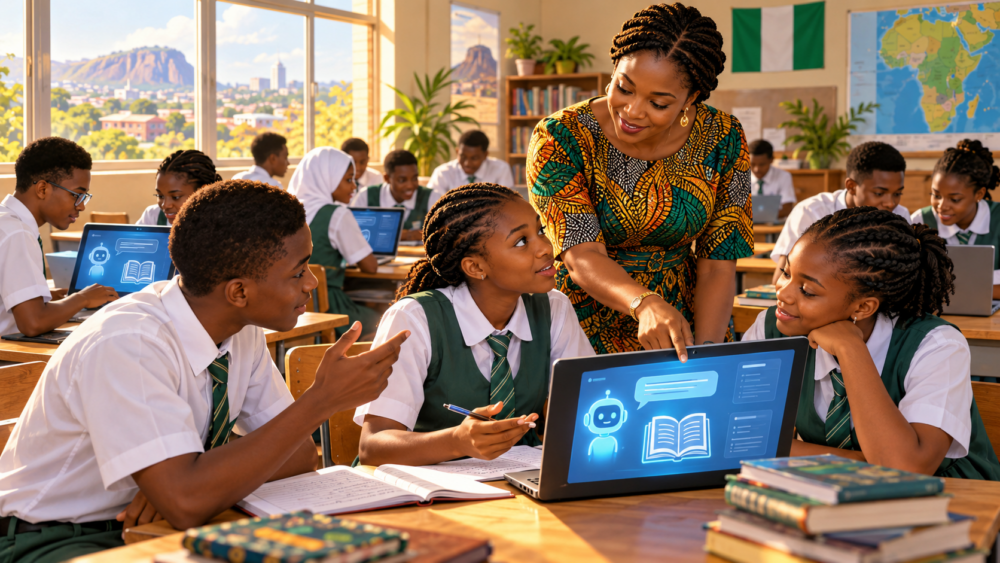
Photo illustration – Teachers guide. AI supports. Students flourish. Together, they can open the door to a brighter future.
An experiment in Nigerian public schools shows how teacher-guided AI tutoring can accelerate learning—and offer a promising path toward greater educational opportunity.
By: Ya Libnan – Article 13 in our series about how AI is helping humanity:Analysis
What if students struggling to learn could receive patient, individual help whenever they needed another explanation?
For families who can afford private tutoring, that opportunity already exists. For many others, it remains out of reach.
An experiment in Edo State, Nigeria, offers a hopeful glimpse of how artificial intelligence could help narrow that gap—with teachers guiding the way.
In a six-week after-school program, public secondary-school students used AI tutoring alongside structured lessons and teacher support. A randomized evaluation found substantial learning gains compared with students receiving their usual education.
World Bank researchers estimated that the gains were comparable to roughly one and a half to two years of typical learning progress in similar settings. This comparison describes improvements in assessed skills; it does not mean students completed two years of school curriculum in six weeks. blogs.worldbank.org
Even with that distinction, the result deserves attention.
A teacher, a student and a new learning tool
The program took place during June and July 2024. Students used Microsoft Copilot, powered by GPT-4, as a virtual tutor, with English as the main subject.
Teachers introduced the lesson topics. Students then worked with the AI on activities such as grammar and writing, receiving explanations and feedback as they practiced. blogs.worldbank.org
The approach addressed a familiar classroom challenge: students learn at different speeds.
One student may understand an explanation immediately. Another may need a simpler example. A third may understand the idea but struggle to put it into words.
A responsive tutor can offer another explanation, invite a follow-up question and let a student practice again. With a teacher overseeing the process, AI can help provide more of that individual attention.
The partnership behind the progress
Students attended the sessions twice a week for six weeks. Teachers guided their interactions, helped them identify incorrect AI responses and encouraged reasoning rather than shortcuts.
The researchers were explicit about what the evaluation established: the gains came from the complete program, including curriculum alignment, structured prompts, teacher support, peer learning and AI. The study could not isolate the chatbot’s contribution from those other elements. blogs.worldbank.org
That finding fits the most constructive vision of AI in education.
Teachers bring judgment, encouragement and an understanding of their students. AI can add explanations, practice and feedback. Thoughtful instructional design brings those strengths together.
The goal should be to give teachers more capacity to help every child.
Students described the difference
The human experience behind the findings is just as compelling.
Imagboghowan Anointed, a student at Imaguero College in Benin City, told the World Bank that the program helped improve communication with teachers, friends and family, along with pronunciation, writing, spelling and vocabulary.
A teacher at the same school, Okhide Eugene, described AI as an assistant teacher, with human teachers supervising the students’ work. blogs.worldbank.org
These are skills that matter beyond an examination. Clearer communication can help a young person participate in class, express an idea and approach future opportunities with greater confidence.
Turning a promising experiment into wider opportunity
The Nigeria program offers encouraging evidence, but expanding it requires practical work.
Schools need electricity, reliable internet, computers and trained teachers. Researchers also need to establish whether the learning gains endure and whether similar programs work across other subjects and larger populations. The World Bank identifies these as important remaining questions. blogs.worldbank.org
Governments and education partners should build on this evidence through carefully evaluated programs. They should measure what students learn, support teachers and ensure that children in less wealthy communities can participate.
Otherwise, a technology with the potential to expand opportunity could remain concentrated among those who already have the most resources.
Helping humanity begins with helping people learn
Education shapes what a person can do with the rest of their life.
A student who becomes a stronger reader, a clearer writer or a more confident communicator gains tools that can serve them for decades.
That is why this story belongs in any serious discussion of how AI can help humanity. Its value is visible in students practicing, asking questions and making progress—and in teachers finding new ways to support them.
The lesson from Edo State is hopeful: when human guidance and artificial intelligence work together, meaningful progress is possible.
Teachers guide. AI supports. Students flourish. Together, they can open the door to a brighter future.
Other Ya Libnan articles in the series
AI is helping scientists see Pancreatic cancer before it becomes visible
AI can help invent tomorrow’s medicines—and build pharmaceutical independence
AI is helping find the people the world’s deadliest infectious disease leaves behind
AI helped doctors find 29% more breast cancers—In a trial of over 105,000 women
AI helped a man with ALS speak nearly two million words
When every minute matters: How AI is helping doctors save Sepsis patients
AI is helping save eyesight before it is lost
AI is helping scientists invent new weapons against superbugs
AI has given scientists a new map of life. Analysis
When AI gives families time to escape a flood
Two patients show how AI can help save precious time
How Artificial Intelligence is already improving our lives, Analysis
Editor’s note: I am very grateful to the people of the EDO state. I had an office in Lagos about 50 years ago and my Ebo driver Richard from EDO saved my life. Between 1976 and 1978 the police in Nigeria was kidnapping foreign executives and was demanding ransom for releasing them . My driver Richard refused to open the car door and windows when we were stopped by the Police , because he knew what they are up to when they started using the gun to force open the door and windows he sped away
