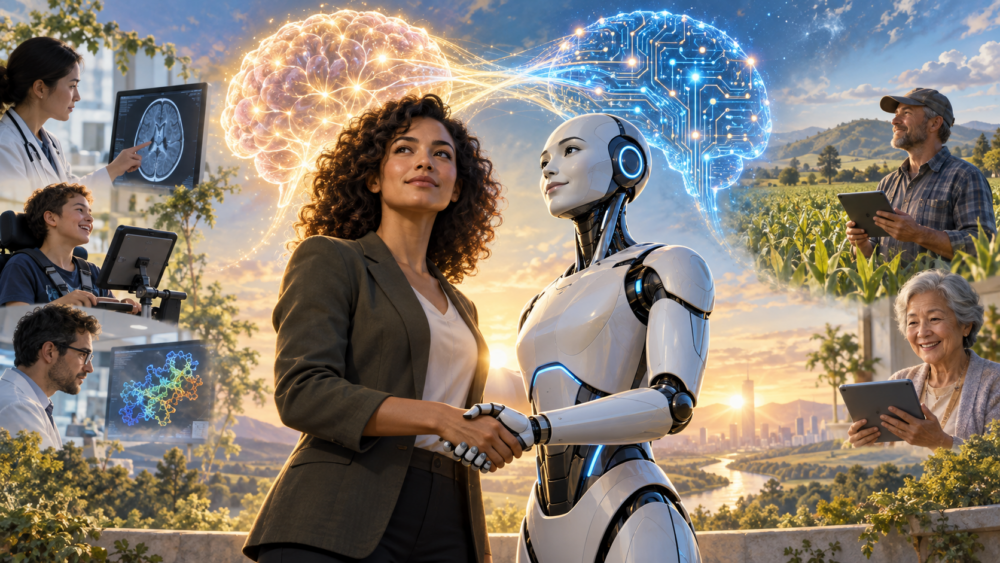
Photo illustration -Human intelligence provides the purpose, judgment and responsibility. Artificial intelligence expands what humanity can achieve.
A major Swedish trial shows how human expertise and artificial intelligence can work together to detect more breast cancers while substantially reducing the workload of reading mammograms.
By: Ya Libnan – Article 9 in our series about how AI is helping humanity:Analysis
Behind every breast cancer diagnosis is a person whose life suddenly changes—and a family hoping that the disease was found in time.
That is what makes a major Swedish study of artificial intelligence so important. Researchers tested AI-supported mammography in routine screening involving more than 105,000 women. They found more cancers, including more invasive cancers, while substantially reducing the number of readings radiologists needed to perform.
This was a randomized clinical trial with actual patients. Its results give us a concrete reason to see AI as a valuable partner in medicine.
The study, called MASAI—Mammography Screening with Artificial Intelligence—compared two approaches. One group received standard screening, with two radiologists reading the mammograms. The other received AI-supported screening.
The AI assessed examinations, helped direct them to one or two radiologist readings and highlighted suspicious findings. Doctors remained responsible for the decisions.
Results published in The Lancet Digital Health in 2025 showed a cancer-detection rate 29% higher in the AI-supported group. The researchers detected 338 cancers among approximately 53,000 women in that group, compared with 262 among a similarly sized group receiving standard screening.
The difference included 53 more invasive cancers. The additional invasive cancers were mainly small and had not spread to lymph nodes.
For patients and their families, the potential significance is clear: an opportunity to identify disease earlier and begin the next steps in care.
The improvement did not come with a statistically significant increase in false-positive rates. Meanwhile, the workload measured by the number of screening readings fell by 44.2%.
These are two gains that matter together. AI helped doctors identify more cancers while reducing a demanding part of their work.
The researchers then followed participants to examine cancers diagnosed between screening rounds—an important test of whether the apparent improvement would hold up over time.
Their follow-up, published in The Lancet in January 2026, found higher screening sensitivity with AI support: 80.5%, compared with 73.8% under standard screening. Specificity was the same in both groups.
The rate of cancers diagnosed between screening rounds was numerically lower with AI, but the difference was not statistically significant. The study established that the AI-supported approach was not worse on that primary measure within its predefined margin. It did not establish a reduction in breast cancer deaths.
That distinction strengthens the story’s credibility. We do not need to turn a promising result into a claim the researchers have not proved.
The demonstrated achievement is already substantial: a large randomized trial found better cancer detection with considerably fewer screening readings.
This is the human–AI partnership our series has been advocating. Researchers designed the trial. Women participated. Radiologists applied their expertise. AI helped identify suspicious patterns and organize the reading process.
The result belonged to the partnership.
Health systems should examine how to bring such benefits to more patients, with validation in their own populations and continued monitoring. A tool that works well in one screening program must be assessed carefully when introduced elsewhere.
We often measure AI progress by the sophistication of a model or the value of a technology company. Here is another measure: whether a doctor has a better chance of finding a woman’s cancer during screening.
For the family waiting for answers, that is progress with human meaning.
AI’s promise becomes real when it helps people do something that matters. Helping doctors find more breast cancers is a powerful example.
Other Ya Libnan articles in the series
AI helped a man with ALS speak nearly two million words
When every minute matters: How AI is helping doctors save Sepsis patients
AI is helping save eyesight before it is lost
AI is helping scientists invent new weapons against superbugs
AI has given scientists a new map of life. Analysis
When AI gives families time to escape a flood
Two patients show how AI can help save precious time
How Artificial Intelligence is already improving our lives, Analysis
Sources:
- 2025 randomized trial results: https://doi.org/10.1016/S2589-7500(24)00267-X
- 2026 follow-up: https://pubmed.ncbi.nlm.nih.gov/41620232/
