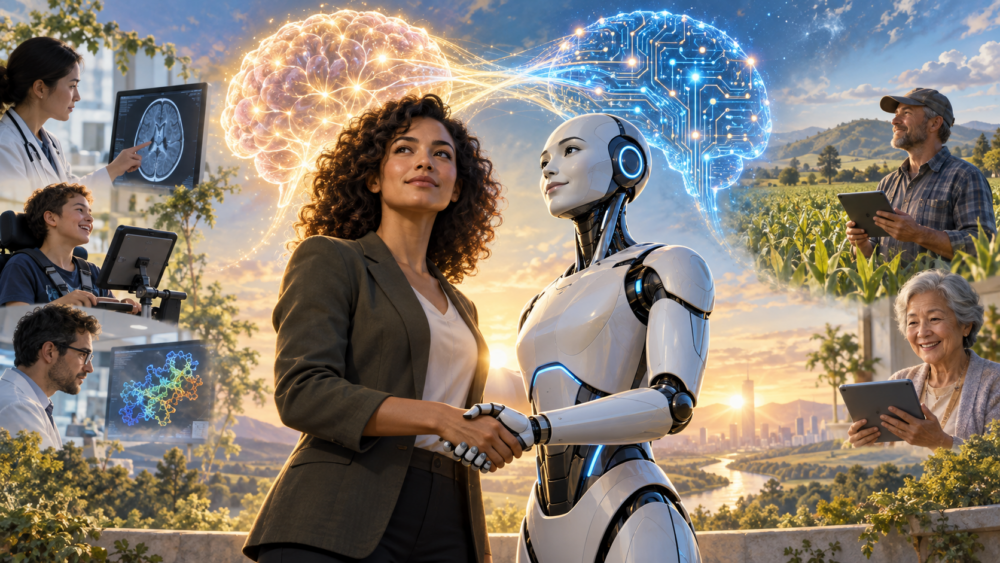
Photo illustration -Human intelligence provides the purpose, judgment and responsibility. Artificial intelligence expands what humanity can achieve.
An experimental brain implant helped Casey Harrell reconnect with his family, keep working and take part in everyday life. His story shows what AI can achieve when it serves a human need.
By: Ya Libnan – Article 8 in our series about how AI is helping humanity:Analysis
Imagine having a thought you want to share with your daughter, but being unable to make your voice carry it. Imagine still having your humor, your memories and your opinions while a disease makes your speech almost impossible for others to understand.
That is the cruel separation that amyotrophic lateral sclerosis, or ALS, can impose. Casey Harrell, a father living with the disease, knows it firsthand. Now he can communicate with his family, friends and colleagues through an experimental brain-computer interface developed by researchers at UC Davis and their collaborators. Artificial intelligence helps translate signals associated with his attempts to speak into words on a screen. A computer can then say those words aloud in a digital version of his own voice, created from recordings made before ALS damaged his speech.
This is not a laboratory demonstration lasting a few minutes. In a study published in June 2026, the researchers reported that Harrell had used the system at home for more than 3,800 hours over nearly two years. He communicated more than 183,000 sentences and close to two million words. His average pace reached 56 words a minute. He used the system to talk in person, make video calls, send messages, browse the web and continue working.
Think about two million words. They are questions at the dinner table, decisions at work, messages to friends and conversations a family can have again. The number is impressive because each word belongs to a person who had something to say.
Harrell has described the joy of seeing his wife’s reaction when she hears a voice that brings back memories. His daughter, he said, does not really remember what he sounded like before his speech declined. The technology lets him share that part of himself with her. That is the heart of this story: AI has helped a father remain present in his child’s life in a way that his illness threatened to take away.
The system also puts our usual arguments about artificial intelligence in perspective. AI did not invent Harrell’s thoughts or decide what he should tell his daughter. He formed the words. Scientists and clinicians built and tested the interface. His family and caregivers helped make home use possible. The algorithms helped carry his intentions across a barrier his muscles could no longer overcome. Here, human judgment remains in charge and AI gives it a voice.
The achievement deserves both excitement and honesty. This is an investigational implanted device, tested in a clinical trial, and Harrell’s experience cannot yet be promised to every person with ALS. NIH says researchers need to study more participants and make the system smaller and easier to use. In everyday use, Harrell still needed a way to review and correct what the system produced. Those limits matter. They do not diminish what he has already done with it.
Readers have asked for a story that shows a real, profound benefit from AI. Here it is: a man facing the loss of speech has spoken nearly two million words from his home. He can tell his family what he thinks, take part in his work and remind his daughter what his voice sounded like.
We often measure technology by how much faster it makes a task. Perhaps the better measure is how much of a human life it helps someone reclaim. Casey Harrell’s story offers an answer that needs no exaggeration.
Other Ya Libnan articles in the series
When every minute matters: How AI is helping doctors save Sepsis patients
AI is helping save eyesight before it is lost
AI is helping scientists invent new weapons against superbugs
AI has given scientists a new map of life. Analysis
When AI gives families time to escape a flood
Two patients show how AI can help save precious time
How Artificial Intelligence is already improving our lives, Analysis
