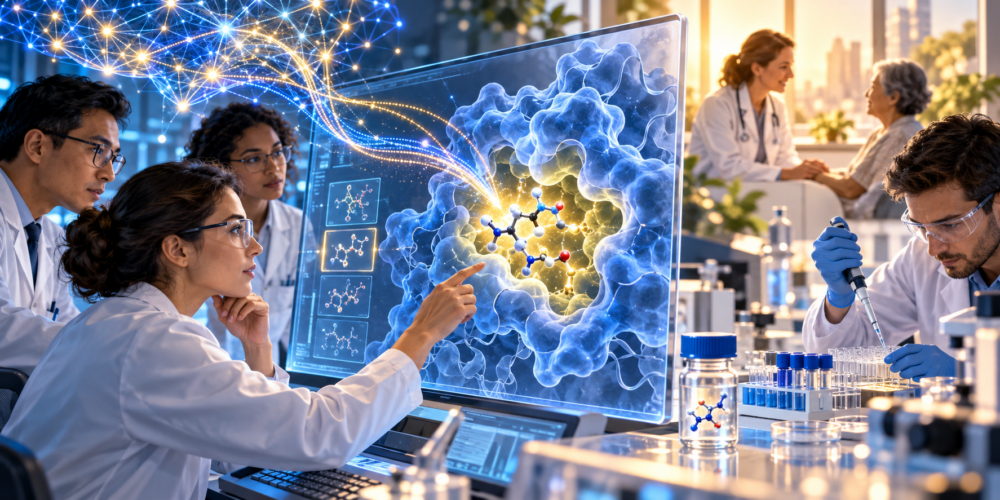
Photo illustration- Investing in AI, research and pharmaceutical manufacturing today can protect tomorrow’s patients from dependence and blackmail.
AI-assisted drug discovery offers an opportunity to strengthen pharmaceutical independence. Western countries should invest now—before dependence on essential medicines becomes a source of political leverage.
By: Ya Libnan – Article 11 in our series about how AI is helping humanity:Analysis
A country can endure a delayed shipment of consumer goods. A patient waiting for essential medicine may have no such luxury.
That is why pharmaceutical independence deserves a place alongside energy security, food security and national defense. The ability to discover, test and manufacture medicines is more than a commercial advantage. It is the ability to protect people when international relations deteriorate.
Artificial intelligence offers a powerful tool for building that ability.
The lesson from critical minerals
China’s use of export restrictions on critical minerals has demonstrated how access to important industrial materials can become entangled in geopolitical confrontation. In December 2024, Beijing announced restrictions prohibiting exports of gallium, germanium and antimony to the United States. Whatever subsequent negotiations change, that episode illustrates the vulnerability created when essential supplies are concentrated in one country.
Now imagine a confrontation affecting medicines or the ingredients needed to manufacture them.
Patients cannot put cancer, diabetes or heart disease on hold while governments negotiate. Even the possibility of such pressure should encourage governments and pharmaceutical companies to build alternatives before a crisis occurs.
This is a warning about a potential danger, not a claim that China has imposed a comparable blanket restriction on medicines. Nor does buying a Chinese-developed drug automatically create dependence: licensing rights, manufacturing arrangements and alternative suppliers matter.
The strategic question is straightforward: can we continue supplying patients if a major foreign source becomes unavailable?
AI is producing candidates worth taking seriously
AI-assisted drug discovery has progressed beyond impressive computer demonstrations. Some candidates have reached human trials and produced findings that justify further development.
One example is rentosertib, an experimental treatment for idiopathic pulmonary fibrosis, a serious disease that scars the lungs. Insilico Medicine used AI to identify a biological target and generative AI to design a molecule intended to act on it.
A randomized Phase 2a trial published in Nature Medicine involved 71 patients treated over 12 weeks. It produced encouraging findings, including a lung-function signal warranting further investigation. Its small size and short duration mean it cannot establish lasting benefit or long-term safety. In September 2026, Insilico announced that the first patient had been dosed in its Phase 3 trial.
That is a meaningful milestone: an AI-designed molecule is being tested in people with a serious illness.
Another example is zasocitinib, an experimental oral treatment for plaque psoriasis developed by Nimbus Therapeutics and subsequently acquired by Takeda. Computational chemistry and AI assistance contributed to its development; describing it as invented entirely by AI would exaggerate the technology’s role.
Takeda reported positive Phase 3 results, including superiority to an existing oral psoriasis treatment. On September 14, 2026, it announced that the U.S. Food and Drug Administration had accepted its application for priority review. Acceptance for review is not approval, but it shows how far this candidate has advanced.
Human scientists remain essential. They decide what to investigate, conduct experiments, interpret results and take responsibility for clinical development. AI expands their ability to search for promising medicines.
China is using AI too
Rentosertib also exposes a weakness in any simplistic argument that pits AI against China. Insilico has substantial Chinese operations, and its Phase 3 trial began in Chinese hospitals.
China is using these tools as well. Western independence will depend on where research capacity, intellectual property, clinical development and manufacturing are built—and who can sustain them through a crisis.
The lesson for Western pharmaceutical companies is to invest in their own capabilities and those of reliable partners. Promising science should encourage greater ambition at home.
From discovery to dependable supply
A medicine discovered in an American or European laboratory provides limited supply security if its production still depends on a single vulnerable foreign source.
Governments and industry should therefore pursue a connected strategy:
- Expand AI-assisted discovery alongside human scientific expertise and experimental validation.
- Strengthen clinical-trial capacity without weakening standards for safety and effectiveness.
- Build manufacturing capacity for essential medicines, active ingredients and critical production inputs.
- Diversify suppliers and verify that alternative production can actually operate when needed.
- Assess major licensing and procurement deals for continuity of supply as well as financial return.
International collaboration can continue within that strategy. Independence means having credible alternatives and the capacity to act.
Profit and preparedness
There is nothing wrong with pharmaceutical companies earning profits. Successful medicines need investment. But boards and governments should recognize the long-term value of dependable supply, even when building it costs more today.
AI does not guarantee a safer drug, eliminate clinical failures or replace a factory. It can, however, help scientists develop new candidates and strengthen the foundation on which pharmaceutical independence rests.
The opportunity is to turn scientific progress into lasting capacity.
Patients deserve medicines whose availability does not depend on the temperature of a diplomatic relationship. Western countries should invest in AI, research and manufacturing now—while they still have time to build the choices they may one day urgently need.
Other Ya Libnan articles in the series
AI is helping find the people the world’s deadliest infectious disease leaves behind
AI helped doctors find 29% more breast cancers—In a trial of over 105,000 women
AI helped a man with ALS speak nearly two million words
When every minute matters: How AI is helping doctors save Sepsis patients
AI is helping save eyesight before it is lost
AI is helping scientists invent new weapons against superbugs
AI has given scientists a new map of life. Analysis
When AI gives families time to escape a flood
Two patients show how AI can help save precious time
How Artificial Intelligence is already improving our lives, Analysis
Sources:
- Reuters, December 3, 2024: https://www.reuters.com/markets/commodities/china-bans-exports-gallium-germanium-antimony-us-2024-12-03/
- Nature Medicine, rentosertib randomized Phase 2a trial: https://www.nature.com/articles/s41591-025-03743-2
- Insilico Medicine, September 2026 Phase 3 milestone, news listing: https://insilico.com/
- Takeda, June 11, 2026 Phase 3 comparison: https://www.takeda.com/newsroom/newsreleases/2026/zasocitinib-outperforms-deucravacitinib-study/
- Takeda, September 14, 2026 FDA application acceptance: https://www.takeda.com/newsroom/newsreleases/2026/fda-priority-review-zasocitinib-psoriasis/
- Reuters, December 18, 2025, AI contribution to zasocitinib: https://www.reuters.com/business/healthcare-pharmaceuticals/takedas-ai-crafted-psoriasis-pill-succeeds-late-stage-studies-2025-12-18/
