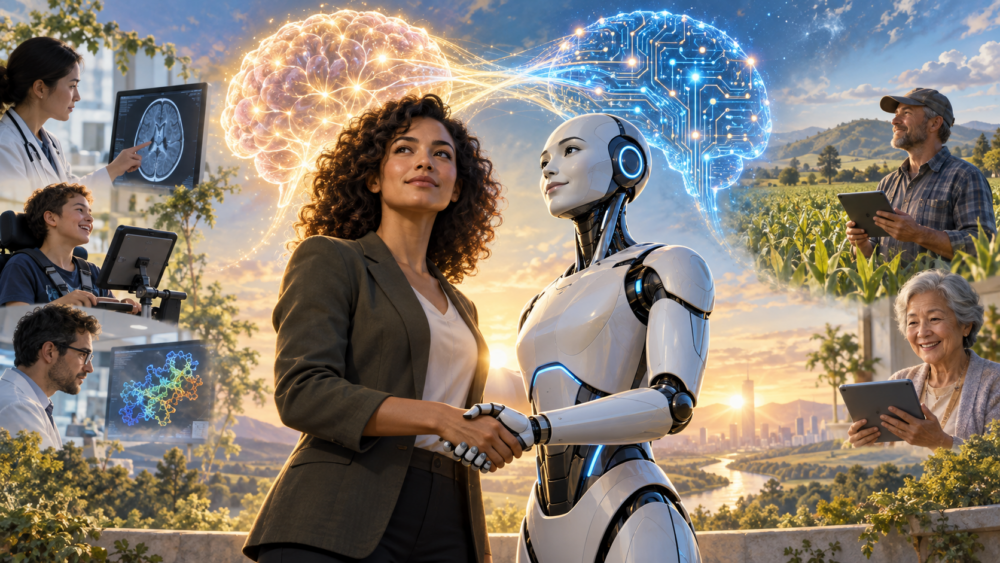
Photo illustration -Human intelligence provides the purpose, judgment and responsibility. Artificial intelligence expands what humanity can achieve.
Self-driving technology is delivering measurable reductions in dangerous crashes, showing how artificial intelligence can serve humanity where a split second matters most.
By: Ya Libnan – Article 17 in our series about how AI is helping humanity:Analysis
A family arriving home safely rarely makes the news. A devastating road crash does.
That imbalance can obscure one of artificial intelligence’s most promising contributions: helping prevent the collision before anyone needs an ambulance.
The World Health Organization estimates that road crashes kill approximately 1.16 million people every year. Road traffic injuries are the leading cause of death among children and young adults aged 5 to 29. Behind those figures are families whose lives change forever.[1]
Now, real-world evidence from driverless vehicles offers a compelling reason for hope.
In its September 24, 2026 safety update, Waymo reported results covering more than 270 million miles driven without a human driver through June. Across five metropolitan service areas—Atlanta, Austin, Los Angeles, Phoenix and San Francisco—its vehicles were involved in 82% fewer injury-causing crashes and 95% fewer crashes involving serious injury or death than human-driver benchmarks.[2]
These comparisons include crashes regardless of fault. Waymo estimates that its vehicles experienced 841 fewer injury-causing crashes than would be expected from human drivers covering comparable mileage in those operating areas.[2]
That is an extraordinary result. It also deserves precise language: 841 is an estimated reduction in crashes, not a verified count of lives saved. The serious-injury-or-death category combines different outcomes; it does not establish a separate percentage reduction in fatalities.
Nevertheless, reducing crashes that kill or seriously injure people is exactly the direction humanity needs.
There is supporting evidence from insurance research, too. A study conducted jointly by Swiss Re and Waymo examined 25.3 million fully autonomous miles. Compared with the human-driver insurance baseline, it found 92% fewer bodily injury liability claims and 88% fewer property damage liability claims.[3]
This was research involving the vehicle’s developer, rather than a wholly independent audit. But insurance claims provide another way to assess safety beyond a company’s promotional promises.
How does AI help?
Waymo combines cameras, radar and lidar—a technology that uses laser pulses to measure surrounding objects. AI interprets these signals, identifies road users, predicts possible movements and plans how the vehicle should steer, accelerate or brake.[4]
Consider an illustrative situation: a cyclist approaches an intersection while a pedestrian moves toward the crossing. The system must track both, assess their possible paths and choose a safe response. That ability to process several developing hazards is central to the promise of autonomous driving.
Software does not become sleepy, drink alcohol or look down to read a text message. It can still make mistakes, which is why its performance must be demonstrated through testing and real-world evidence.
Readers also need one essential distinction. A car that assists its driver is different from a vehicle authorized to carry passengers without one. Level 2 assistance can control steering and speed while requiring continuous human attention. Level 4 automation performs the driving within defined operating conditions and service areas.[5]
A driver must never interpret an impressive product name as permission to stop supervising a system that requires supervision.
Waymo’s findings apply to its own technology and operating environments. They cannot automatically be extended to every manufacturer, road, climate or country.
Human responsibility remains supreme. Engineers design and validate these systems. Regulators establish the conditions for deployment. Operators must investigate failures and correct defects. Where driver supervision is required, the person behind the wheel remains responsible for providing it.
Governments should demand transparent evidence while supporting technology that demonstrates a safety benefit. Better roads, safer speeds, seat belts and effective enforcement remain essential alongside AI.
The most meaningful achievement of self-driving technology will be measured in people who reach their destinations unharmed.
A child returns from school. A cyclist gets home. A family’s evening continues without a hospital emergency.
That is a future worth working toward—and another powerful example of AI helping humanity.
Other Ya Libnan articles in the series
AI helped recover $1 Billion in check fraud—Protecting America’s taxpayers
When disaster strikes, AI helps rescuers find where help is needed most
AI is helping save millions of liters of water every day
Six weeks, remarkable progress: How AI and teachers helped students learn in Nigeria
AI is helping scientists see Pancreatic cancer before it becomes visible
AI can help invent tomorrow’s medicines—and build pharmaceutical independence
AI is helping find the people the world’s deadliest infectious disease leaves behind
AI helped doctors find 29% more breast cancers—In a trial of over 105,000 women
AI helped a man with ALS speak nearly two million words
When every minute matters: How AI is helping doctors save Sepsis patients
AI is helping save eyesight before it is lost
AI is helping scientists invent new weapons against superbugs
AI has given scientists a new map of life. Analysis
When AI gives families time to escape a flood
Two patients show how AI can help save precious time
How Artificial Intelligence is already improving our lives, Analysis
Sources
- WHO, Road traffic injuries, July 20, 2026: https://www.who.int/news-room/fact-sheets/detail/road-traffic-injuries
- Waymo, September 24, 2026 safety update and dashboard: https://waymo.com/blog/shorts/safetydata-september26/and https://waymo.com/safety/impact/
- Waymo–Swiss Re research announcement, December 19, 2024: https://waymo.com/intl/jp/blog/2024/12/new-swiss-re-study-waymo/
- Waymo Driver technology: https://waymo.com/waymo-driver/
- NHTSA, Automated Vehicle Safety: https://www.nhtsa.gov/vehicle-safety/automated-vehicle-safety
