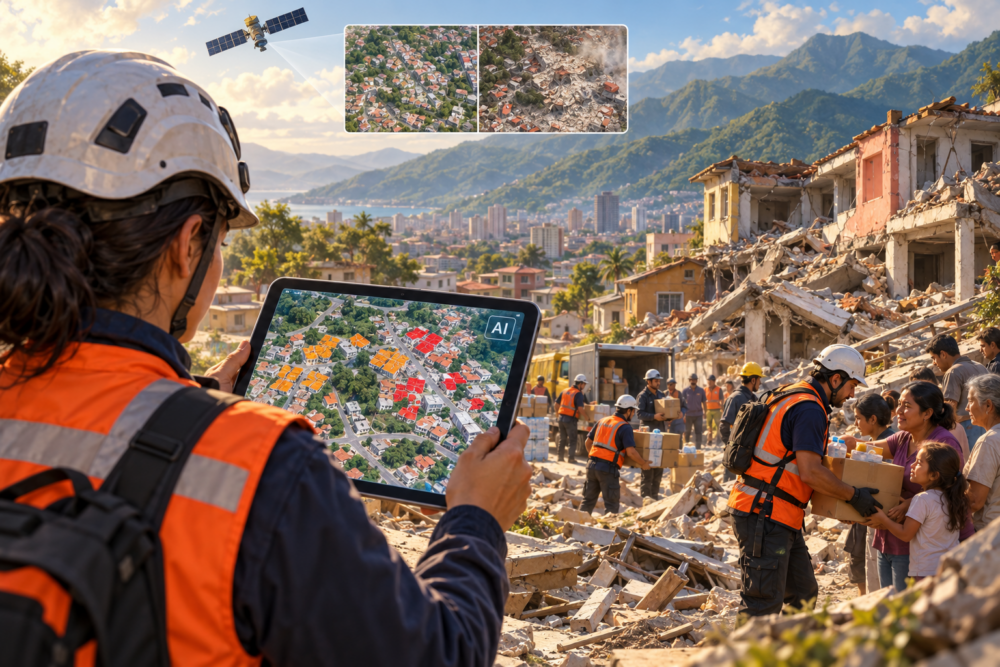
Conceptual illustration. : AI helps identify devastated neighborhoods. Human rescuers and relief workers turn that information into help for families who urgently need it most.
Used after devastating earthquakes and floods, AI can turn satellite images into damage maps—helping humanitarian teams assess destruction faster and direct assistance where it is urgently needed.
By: Ya Libnan – Article 15 in our series about how AI is helping humanity:Analysis
When an earthquake strikes, the first question is painfully simple: Where should help go first?
Rescue teams may be ready. Volunteers may be gathering supplies. Yet nobody immediately has a complete picture of the destruction. A community receiving little attention may be suffering terribly, while damaged routes delay assistance.
Artificial intelligence is helping humanitarian workers answer that urgent question.
This is a success story about human beings using a powerful tool to serve other human beings at their most vulnerable.
Recent examples in Venezuela and Colombia
According to a September 22 Microsoft report, Catholic Relief Services and its local partner, Caritas Venezuela, used AI-assisted damage analysis after Venezuela’s June 2026 earthquakes to identify heavily affected areas and prioritize assistance.
The technology was HASTE, short for High-speed Assessment and Satellite Tracking for Emergencies. Microsoft reports that its maps also informed decisions within an hour of Colombia’s August earthquake.
In Venezuela, the United Nations Office for the Coordination of Humanitarian Affairs distributed the analysis through its humanitarian network, helping organizations develop a shared understanding of the damage.
These are documented uses in disaster response. They do not establish a specific number of lives saved by AI.
How an image becomes useful information
HASTE’s research workflow begins with satellite or aerial imagery. A human operator labels examples, trains an event-specific model and reviews its damage estimates. The model helps extend that assessment across a larger area.
Microsoft’s technical documentation stresses that the outputs are preliminary signals requiring human validation and expert interpretation. An overhead image cannot determine whether someone is alive beneath rubble.
The practical value is helping responders understand where destruction appears concentrated, so they can investigate and plan assistance with better information.
Think of the decisions facing an emergency coordinator. Which neighborhoods should teams assess first? Where might shelter be urgently needed? What information should be shared with other relief organizations?
Better information can help people make those decisions. Local knowledge and field reports remain essential.
A second example: Faster assessments, lower costs
The World Food Programme has developed another tool, SKAI, with Google Research. WFP reports that it delivers post-disaster assessment insights 13 times faster and at 77 percent lower cost than manual methods. It was used after the 2023 Türkiye–Syria earthquakes and the 2022 Pakistan floods.
WFP also reports that its DEEP tool analyzed drone imagery after Hurricane Fiona in 2022 within hours, rather than the up to three weeks previously required, helping identify severely affected areas and direct support.
These comparisons concern assessment work, rather than guarantees about how quickly every survivor receives assistance. But faster assessment is a concrete improvement in a task on which humanitarian action depends.
The partnership worth supporting
The person driving an aid truck, treating an injury or searching a collapsed building remains indispensable. Technology becomes useful through their courage, experience and judgment.
AI can help organize the view from above. People must connect it with conditions on the ground and act on what they learn.
That partnership deserves investment. Humanitarian organizations need access to suitable imagery, trained analysts and tools they can evaluate and adapt. Communities need responders who understand their circumstances and listen to them.
Public discussion of AI should include this work. Alongside legitimate questions about the technology, we should recognize the humanitarian teams putting it to constructive use.
When disaster strikes, compassion brings people forward. Better information helps them decide where to go.
AI is helping strengthen that connection—and that is a reason for hope.
Other Ya Libnan articles in the series
AI is helping save millions of liters of water every day
Six weeks, remarkable progress: How AI and teachers helped students learn in Nigeria
AI is helping scientists see Pancreatic cancer before it becomes visible
AI can help invent tomorrow’s medicines—and build pharmaceutical independence
AI is helping find the people the world’s deadliest infectious disease leaves behind
AI helped doctors find 29% more breast cancers—In a trial of over 105,000 women
AI helped a man with ALS speak nearly two million words
When every minute matters: How AI is helping doctors save Sepsis patients
AI is helping save eyesight before it is lost
AI is helping scientists invent new weapons against superbugs
AI has given scientists a new map of life. Analysis
When AI gives families time to escape a flood
Two patients show how AI can help save precious time
How Artificial Intelligence is already improving our lives, Analysis
Sources for editors
- Microsoft, September 22, 2026: https://news.microsoft.com/source/features/ai/when-disaster-strikes-ai-helps-responders-reach-people-more-quickly/
- Microsoft HASTE transparency documentation: https://github.com/microsoft/haste/blob/main/TRANSPARENCY.md
- World Food Programme: https://www.wfp.org/stories/does-artificial-intelligence-hold-key-ending-hunger
