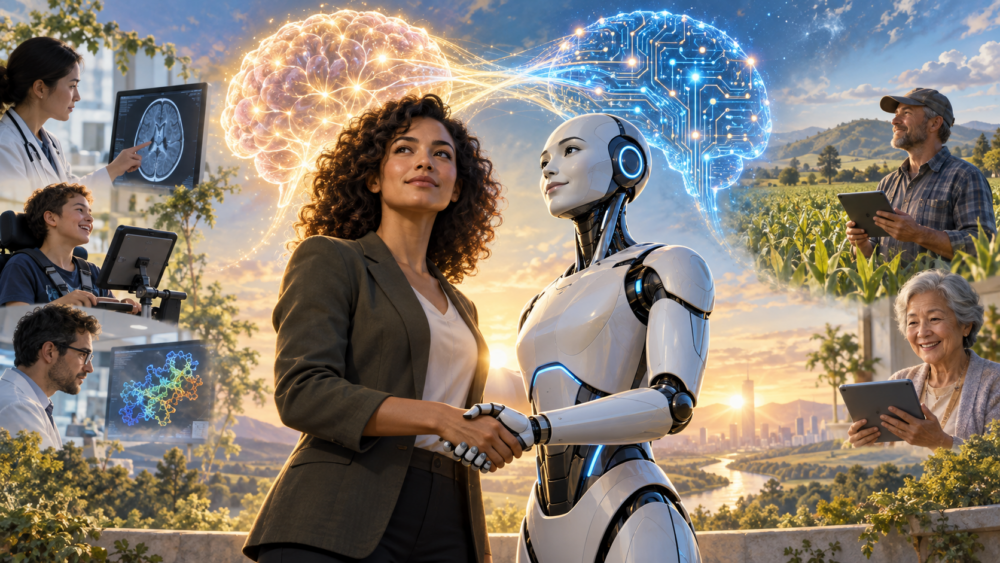
Photo illustration -Human intelligence provides the purpose, judgment and responsibility. Artificial intelligence expands what humanity can achieve.
Researchers have used AI to design entirely new candidate antibiotics against drug-resistant gonorrhea and MRSA. The discoveries are still being tested, but they offer a powerful new way to fight infections that are outsmarting existing medicines.
By: Ya Libnan – Article five in our series about how AI is improving our lives : Analysis
Picture a patient entering a hospital with an infection that should be treatable. The doctor prescribes an antibiotic, but the bacteria survive. Another medicine is tried, and they survive that too. The danger is no longer theoretical: bacteria are evolving defenses against drugs on which modern medicine depends.
The World Health Organization warns that antibiotic resistance threatens treatment of common infections and makes routine medical care more hazardous. Developing a new antibiotic is difficult. Scientists must find a molecule that kills the bacteria without harming the patient, and the bacteria may eventually learn to resist it.
Now a team at the Massachusetts Institute of Technology has demonstrated a remarkable new approach. Instead of asking AI only to search a library of existing compounds, the researchers used generative AI to design new molecules. They focused on two formidable targets: drug-resistant gonorrhea and methicillin-resistant Staphylococcus aureus, commonly known as MRSA.
The team did not simply accept a computer’s suggestion. Researchers selected promising designs, made the compounds, and tested them against bacteria. Two candidates, named NG1 and DN1, showed activity against the targeted infections in animal models. The work was reported in the journal Cell in 2025.
That sequence is the real success story. Human scientists defined the problem. AI explored chemical possibilities that would be difficult to examine one by one. Chemists made the proposed molecules. Biologists tested whether they worked. Each stage required human judgment and experimental proof.
Why does this matter so much? Antibiotics underpin far more than the treatment of a sore throat or a wound. They help protect people undergoing surgery, cancer treatment and other medical procedures. When bacteria become resistant, advances throughout medicine become more precarious. A new method for discovering antibiotics could therefore benefit patients well beyond the two infections studied at MIT.
We should also be clear about what the researchers have—and have not—achieved. NG1 and DN1 are candidate drugs, not medicines that doctors can prescribe today. Laboratory and animal results cannot establish that they will be safe and effective in people. They need further development and clinical trials. The promise lies in showing that AI can help create potential antibiotics with new chemical structures, giving scientists more places to look in a race they cannot afford to abandon.
The MIT team has been building this approach over several years. Earlier AI work identified promising compounds against other dangerous bacteria. The newer research takes a further step: using AI to propose molecules from the ground up. It changes the question from “Which existing compound might work?” to “What new compound might we be able to make?”
That is a breathtaking expansion of scientific imagination. AI can examine possibilities at a scale no individual scientist could match. Yet the laboratory remains the judge. A molecule has to work in the real world, and a medicine ultimately has to help a human being safely.
We have not run out of ways for AI to serve humanity. In the battle against superbugs, it is helping scientists search for weapons that did not previously exist. If even some of these candidates eventually become safe treatments, patients facing once-untreatable infections may have another chance. That is a story worth following—and a partnership between human ingenuity and AI worth celebrating.
Sources for editors
- MIT News, August 14, 2025: https://news.mit.edu/2025/using-generative-ai-researchers-design-compounds-kill-drug-resistant-bacteria-0814
- Collins Lab, MIT, Antibiotics-AI Project, with journal citations: https://www.collinslab.mit.edu/antibiotics-ai-project
- World Health Organization, Global antibiotic resistance surveillance report 2025: https://www.who.int/publications/i/item/9789240116337
