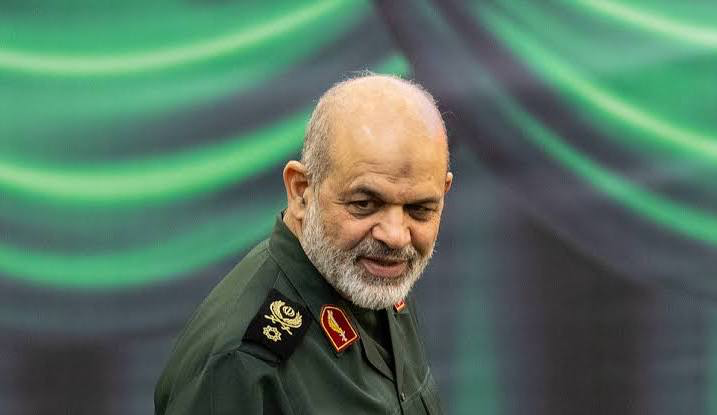
Brig. Gen. Ahmad Vahidi Was appointed as commander of the paramilitary Islamic Revolutionary Guard Corps (IRGC). He was accused of involvement in the 1994 bombing of a Jewish community center in Argentina,
HERE IS THE LATEST
- The number of vessels tracked transiting the Strait of Hormuz fell to a one-week low of eight, according to data reported by the Reuters news agency. Around 150 ships a day passed through the vital waterway before the war started on Feb. 28.
- Six people on a vessel in the Red Sea were killed by the Iran-backed Houthi rebels, Yemen’s coast guard said Tuesday.
- The U.S. military said Tuesday it had fired on a Panama-flagged ship in the Gulf of Oman that tried to evade the American blockade of Iran.
Who is Ahmed Vahidi, the new commander of the Islamic Revolutionary Guard Corps?
This week has seen some significant appointments from Iran’s new — and still unseen — Supreme Leader, Mojtaba Khamenei, as he continues to reshape the country’s military and national security leadership.
Six senior military leaders have been appointed in total.
Among the most consequential was the appointment of previous interior and defense minister Brig. Gen. Ahmad Vahidi as commander of the paramilitary Islamic Revolutionary Guard Corps (IRGC). Vahidi, a secretive figure accused of involvement in the 1994 bombing of a Jewish community center in Argentina, is seen as one of the most powerful figures in Iran, following the death of former Supreme Leader Ali Khamenei in February.
The IRGC remains one of the most influential institutions in the Islamic Republic, exercising extensive military, political, economic and security influence.
Despite his growing authority, Vahidi has maintained a relatively low public profile since the beginning of the war. Civilian political figures, particularly Parliament Speaker Mohammad Bagher Ghalibaf, have been considerably more visible.
Vahidi, an IRGC veteran and former Quds force commander, had already been serving in the role following the February killing of Iranian military officer Mohammad Pakpour.
Oil from tanker grounded off Oman has started reaching mainland, Reuters reports
Oil from a spill off Oman has started to reach the country’s mainland, the U.N.’s shipping body said on Wednesday, according to the Reuters news agency.
“Oil is drifting offshore to the northeast of [Oman’s] Al-Qibliyyah Island, with some oil reported to be reaching the mainland. Oil spill contingency planning is in place,” a spokesperson at the International Maritime Organization (IMO) said.
The oil is believed to be leaking from the grounded tanker Caroline Bezengi, with the slick now covering almost 155 square miles, according to the Omani government.
The IMO said the tanker was carrying approximately 800,000 barrels of oil from Russia to Asia, but grounded off the coast of Oman on June 30, Reuters reported.
“Oil has been leaking from the vessel for some time. The seasonal monsoon has limited access to the vessel and delayed salvage operations,” the IMO said.
Erdogan eyes expansion of regional defense pact
Turkish President Recep Tayyip Erdogan said Wednesday he hoped more countries would join a defense agreement signed last week between Turkey, Saudi Arabia and Pakistan.
“Our vision for it is not limited to the three countries,” the Turkish leader told the London-based Asharq Al-Awsat daily, which is owned by the Saudi royal family. “Rather we aspire for it to grow, and perhaps appropriate conditions will emerge one day for all countries of the region to gather under its umbrella.”
Foreign Minister Hakan Fidan on Saturday said Turkey expected Egypt to join the pact, called the Mecca Joint Defense Agreement. Egypt has not commented on the agreement nor on the remarks by Fidan, who will visit Cairo on Thursday and Friday.
The pact consolidates three major U.S. allies into an alternative security architecture that rejects Israel’s hegemony and seeks to boost security cooperation, while also opening the way for “developing joint projects in the defence industries,” Erdogan said. It contains a clause saying any attack on one would be seen as an attack on all.
Oil spill reaches island in Strait of Hormuz as Iranian authorities investigate source
Oil from a spill has reached parts of Iran’s Qeshm island in the Strait of Hormuz, Iran’s semi-official Fars news agency reported Wednesday, and authorities are investigating its source.
According to the report, Iran’s Department of Environment said oil was spotted along parts of the island’s coastline. Cleanup operations are underway and are expected to be completed by the end of Wednesday.
International Energy Agency cuts 2026 oil demand forecast again as traffic on Strait of Hormuz remains low
The International Energy Agency (IEA) on Wednesday sharply reduced its forecast for global oil demand this year, with supplies still crimped by the disruption of shipping through the Strait of Hormuz and high prices deterring buyers.
Demand is expected to slump by 1.6 million barrels per day, compared with its forecast slump of one million barrels in its previous monthly report in July.
Crude prices have remained well above levels seen before the U.S. and Israeli attacks on Iran in late February, sparking a war that has seen oil infrastructure damaged in several Gulf countries and some supply routes for oil severely disrupted.
Tehran also responded by effectively shutting down tanker and cargo traffic in the Strait of Hormuz, through which around one-fifth of global oil supplies usually transit.
“The ongoing closure of the Strait of Hormuz and elevated fuel prices continue to weigh on oil consumption,” the Paris-based IEA said.
Despite a purported ceasefire and repeated claims that a deal to open the strait was imminent – which the IEA referred to as “sudden diplomatic pivots” – only a handful of ships are being let through, leading to volatile pricing on global oil markets.
The IEA said global supplies rose by 2.4 million barrels per day in July, to reach 101.5 million barrels per day, but that was still 6.3 million per day lower than a year ago.
But “renewed hostilities and maritime disruptions in July and early August undermined the recovery efforts,” the agency said.
It now expects global supply to fall by 4.3 million barrels per day on average this year, before recovering next year.
On the demand side, the IEA is projecting a return to growth in the fourth quarter of this year.
Iran claims it still has more than 75% of its missile and drone capability
Iran still has more than 75% of its missile and drone capability intact, a military official said Tuesday.
Iranian Army Deputy Commander for Executive Affairs, Brig. Gen. Alireza Sheikh, told state news agency IRNA that “more than 75% of Iran’s missile and drone capabilities remain intact and ready.”
The claim comes after President Trump denied last week that the U.S. has nearly run out of its stockpile of long-range missiles.
“The ‘leakers’ of these treasonous statements are being hunted down,” Mr. Trump wrote on social media. “Long term jail sentences will be sought!”
Sheikh also emphasized Iran’s drone capability, particularly the Arash drone, claiming that it had “become the enemy’s nightmare.”
He added that Iran’s strategy was to impose disproportionate costs on its adversaries with relatively inexpensive systems.
“Victory in diplomacy is the product of power on the battlefield,” he added.
Strait of Hormuz traffic falls to one-week low
The number of vessels tracked transiting the Strait of Hormuz fell to a one-week low of eight, according to data reported by the Reuters news agency, as the ongoing conflict and stalemate kept shipping companies away from the vital waterway.
Tuesday’s tally of eight vessels fell below a 10-day average of about 12, for the lowest daily count since August 5, according to Kpler data reported by Reuters.
Around 150 ships a day passed through the vital waterway before the war started on February 28.
CBS
