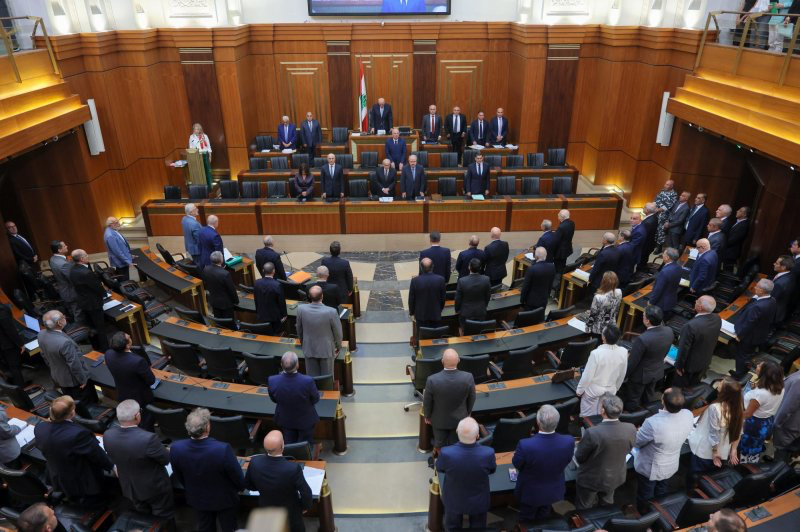
Lebanese lawmakers attend a parliamentary session to discuss the abolition of the death penalty in Beirut, Lebanon, on Tuesday. Photo by Wael Hamzeh/EPA
Lebanese lawmakers have approved legislation prohibiting the death penalty, making Lebanon the first Middle Eastern country to end capital punishment.
The Lebanese Social Democratic Party said the draft law was approved Tuesday by a majority of the Lebanese Parliament following the introduction of amendments. It replaces the death penalty with life imprisonment with hard labor, according to Amnesty International, which said there are 85 people on Lebanon’s death row.
“I just came to tell the Lebanese people that the death penalty was lifted and this is a historic day for Lebanon,” Justice Minister Adel Nasar told reporters following the vote. “Lebanon is regaining its leading role in the region and worldwide.”
In a second statement, Nasar clarified that abolishing the death penalty should not be viewed as a leniency toward crime, but a rejection of killing. Depriving someone of their freedom is “a harsher punishment,” he said.
By ending capital punishment, nations that have likewise banned the death penalty will no longer have a reason to reuse to extricate fugitives of Lebanese justice.
“The abolition of the death penalty is a historic step in Lebanon’s legal and judicial history and Lebanon has joined the ranks of countries that have abolished the death penalty,” he said.
Lebanon last carried out an execution on Jan. 17, 2004, according to Amnesty International, which celebrated the passing of the legislation.
“Lebanon’s decision to abolish the death penalty marks a major milestone and a victory for human rights in the country,” Heba Morayef, Amnesty International’s regional director for the Middle East and North Africa, said in a statement.
“After more than two decades without executions, today’s step transforms a precarious hiatus in executions into lasting legal protection upholding the right to life and bringing Lebanon in line with the global trend towards abolition.”
United Nations High Commissioner for Human Rights Volker Turk was among those to congratulate Lebanon on passing the law.
“I call on the other countries that still maintain the death penalty to follow [Lebanon’s] lead in ending this inhumane practice,” he said in a statement.
“In a country subject to devastating attacks and experiencing profound loss and suffering, this decision represents a powerful and principled commitment to the right to life.”
Similarly, High Representative of the European Union for Foreign Affairs and Security Policy Kaja Kallas described Lebanon as setting a “powerful example” for other countries throughout the Middle East and worldwide.
She said this legislation “marks a significant step forward for human rights in the country.”
“The European Union looks forward to continuing its close cooperation with Lebanon in promoting and protecting human rights, fundamental freedoms and the rule of law and reiterates its strong support for the Lebanese authorities’ reform agenda and their engagement in consolidating the state and protecting its citizens,” she said in a statement.
MP Abdul Rahman al-Bizri, an Independent Member of Parliament introduced the draft legislation to remove capital punishment from Lebanese law, which was formally submitted and backed by a multi-bloc group of lawmakers.
Justice Minister Adel Nassar strongly championed the bill through the government and cabinet stages, alongside support from independent and cross-bloc MPs.
Opposition: The legislative change was opposed during the parliamentary session mainly by Hezbollah’s bloc and its ally the Free Patriotic Movement.
Lebanon’s abolition of the death penalty comes as parliament also debates a controversial general amnesty law, the largest since the end of its 15-year civil war in 1990, that could reduce sentences or even release some people convicted of violence offences.
Family members of Lebanese soldiers and servicemen killed in attacks have repeatedly protested against the law, some saying they had hoped to see the perpetrators who killed their family members executed rather than be issued reduced prison sentences.
One observer commented on Hezbollah’s opposition by saying : “Looks like Hezbollah plans to keep the option of assassinating people as it has done for years . Hezbollah operatives assassinated several top Lebanese leaders between 2004 and 2008
UPI/ YA
