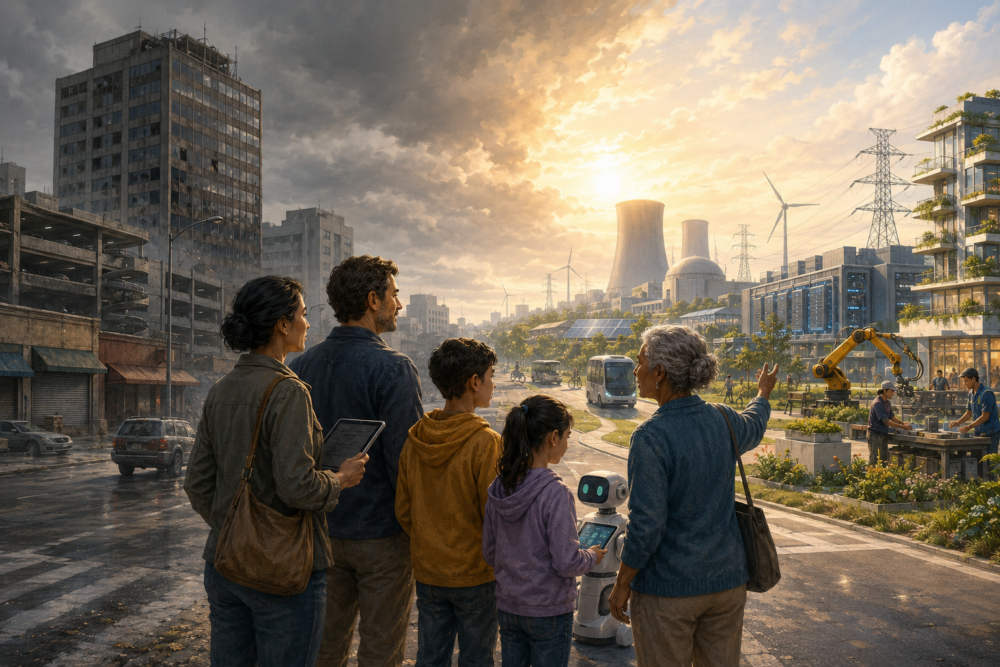
The photo illustration shows a family preparing together rather than fearing the future. The future will reward neither fear nor complacency. Survival will belong to those who prepare, adapt and invest in what tomorrow cannot do without.
AI, robotics and autonomous transportation may make life cheaper and more productive—but surviving the transition will require new skills, prudent investments and ownership of the assets the future cannot do without.
By : Ya Libnan Editorial Board, Opinion
Elon Musk predicts that artificial intelligence and robotics will eventually make employment optional and money largely irrelevant. Former Google X executive Mo Gawdat foresees a darker possibility: machines may create extraordinary wealth, but that wealth and power could become concentrated in the hands of those who own and control them.
Neither outcome is certain, and the timetable may be exaggerated. But the direction of change is becoming difficult to dispute.
Artificial intelligence will enable companies to produce more with fewer employees. Robots will replace increasing amounts of physical labor. Autonomous vehicles may reduce the need to own cars. Remote work and AI assistants may allow smaller teams to operate businesses that once required hundreds of employees and enormous offices.
The greatest danger is not that money will disappear. It is that millions of people will continue planning their lives as though nothing fundamental is about to change.
Employment Will Change Before It Disappears
It is premature to declare that nearly all jobs will vanish. The World Economic Forum estimates that 92 million existing jobs could be displaced by 2030 while 170 million new positions are created. The International Labour Organization similarly concludes that AI is more likely, at least initially, to transform many occupations than eliminate them completely.
But those reassuring totals conceal enormous personal disruption.
The person whose profession disappears cannot pay the mortgage with a statistic showing that another profession was created elsewhere. New jobs may require different qualifications, exist in another city or pay substantially less. Older workers may struggle to retrain, while young people may discover that the entry-level positions through which previous generations built experience have been automated.
AI will probably not eliminate work overnight. It will first eliminate tasks, then reduce the number of people needed to perform each job.
A department employing 100 people may need only 30 people supported by AI. A law firm may handle more cases with fewer junior lawyers. One engineer may accomplish what previously required an entire team. Smaller companies will be able to compete with much larger organizations.
Work will remain—but there may be much less of it available to humans.
The Office Economy Will Shrink With It
If fewer employees are required, less office space will be needed. If AI permits more people to work from home, fewer employees will commute every day.
That change will extend far beyond office buildings.
Fewer commuters could mean reduced demand for downtown restaurants, convenience stores, dry cleaners and business hotels. Public-transit systems may collect less revenue. Municipalities could lose property taxes. Banks holding loans against declining office buildings could face substantial losses.
Parking garages are particularly vulnerable. Their value depends on large numbers of people driving privately owned vehicles to the same destination and leaving those vehicles unused for hours.
AI attacks the employment side of that equation. Remote work attacks the commuting side. Autonomous transportation attacks the car-ownership side.
Together, they could transform the economics of entire cities.
The TaaS Prediction May Have Been Early, but It Was Not Foolish
The Transportation-as-a-Service, or TaaS, theory predicted that fleets of autonomous electric vehicles would eventually provide transportation more cheaply than privately owned cars.
The original timetable was clearly too optimistic. Regulation, technology, consumer confidence and infrastructure have all taken longer than expected. Nevertheless, the underlying economics remain persuasive.
A privately owned automobile sits unused for most of its life while its owner pays for purchase, financing, insurance, maintenance, fuel and parking. An autonomous fleet vehicle could operate throughout the day and spread its cost across many passengers.
If reliable autonomous transportation becomes widely available, many households—especially those in cities—may decide that they no longer need a second car. Some may not need a car at all.
That would affect automobile manufacturers, dealerships, repair shops, gasoline stations, auto insurers, parking companies and lenders. It would also release enormous areas of valuable urban land presently devoted to storing idle vehicles.
The parking garage of today could become the apartment building, warehouse, medical center or data facility of tomorrow—but only if it can economically be converted.
Scarcity Will Not Disappear—It Will Move
AI can make intelligence inexpensive. It can reduce the cost of accounting, research, education, software, diagnosis and design. Robots may eventually reduce the cost of manufacturing, agriculture, construction and transportation.
But AI cannot manufacture unlimited land, water, copper, uranium or electricity. It cannot create additional hours in a day or duplicate the personal attention of a trusted doctor. It cannot instantly build power plants, transmission lines, mines, data centers or semiconductor factories.
The future will therefore contain abundance and scarcity at the same time.
Routine intellectual work may become extremely inexpensive, while the electricity required to operate AI becomes more valuable. Office buildings may lose demand, while data centers and power infrastructure gain it. Some urban parking properties may become obsolete, while strategically located land becomes more valuable.
Technology will not eliminate scarcity. It will change what is scarce.
That is the key to planning for the future.
How Individuals Should Prepare
People should not panic, abandon their careers or stop saving. Predictions about the end of work have been wrong before. But continuing to rely upon one employer, one profession or one type of asset is becoming increasingly dangerous.
Every worker should begin asking three questions:
Can AI perform the repetitive part of my job?
Can one AI-assisted employee eventually do the work of several people?
What can I provide that requires judgment, trust, accountability, creativity or a genuine human relationship?
Workers should learn to use AI rather than compete against it blindly. The safest employee may not be the person with the longest résumé, but the person who understands the profession and knows how to multiply his or her productivity with technology.
Families should also be cautious about excessive debt. A 30-year financial obligation assumes decades of reasonably stable income. That assumption may become less dependable as employment changes more rapidly.
An emergency reserve, manageable debt and diversified investments are no longer merely conservative financial habits. They are protection against technological displacement.
Investors Must Distinguish Tomorrow’s Assets From Yesterday’s Assumptions
The future is unlikely to reward every company labeled “AI,” “robotics” or “nuclear.” Exciting technology can still produce a terrible investment when shares are purchased at an unrealistic valuation.
Investors should concentrate on the durable necessities behind the transformation:
- Electricity generation and transmission
- Nuclear fuel and dependable power
- Semiconductor manufacturing and equipment
- Data-center infrastructure and cooling
- Copper and other essential materials
- Cybersecurity
- Robotics and industrial automation
- Water infrastructure
- Healthcare and services requiring human trust
- Adaptable land and buildings in strong locations
At the same time, investors should carefully examine assets whose value depends on yesterday’s behavior: conventional office towers, inflexible parking garages, businesses dependent on daily commuting and companies relying exclusively on widespread private-car ownership.
Not all of these assets will fail. Offices will not disappear completely, and Americans will not abandon their cars overnight. But declining demand does not have to reach zero to destroy an overleveraged investment. A 20 or 30 percent reduction can be enough.
Ownership May Become More Important, Not Less
Musk may eventually be correct that AI will create extraordinary abundance. But until society determines how that abundance will be distributed, ownership will remain decisive.
If robots produce the goods, the owners of the robots will initially receive the profits. If AI consumes enormous quantities of electricity, the owners of energy and infrastructure will benefit. If fewer workers are needed, wages may represent a smaller share of economic wealth while returns to capital represent a larger share.
That means people should not interpret “money will become irrelevant” as an invitation to stop saving. The transition may produce the opposite result: owning productive, carefully valued assets could become essential to maintaining independence.
The future may ultimately deliver cheaper goods, shorter working weeks and a higher standard of living. It could liberate humanity from exhausting and repetitive labor.
But transitions are rarely painless, and abundance does not distribute itself.
Governments must modernize education, encourage retraining, protect displaced workers and prevent control of AI from becoming dangerously concentrated. Businesses must help employees adapt rather than treating them as disposable. Individuals must prepare before disruption reaches their own profession or community.
The age of artificial intelligence may create more abundance than the world has ever known. But survival—and prosperity—will belong to those who recognize that the future will not simply arrive.
It must be prepared for.
