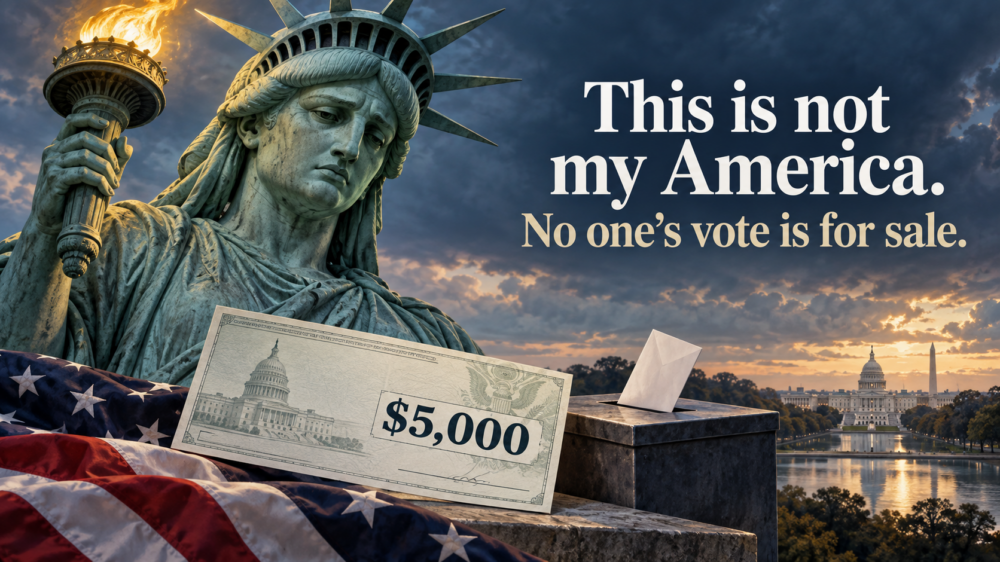
Photo illustration – America’s freedom is priceless. Public money must never become an inducement for concentrating political power.
Trump’s promise of a $5,000 “dividend” if Republicans retain Congress raises a larger question: Should any president connect public money to granting his party complete control of government?
By: Vlad Green, Opinion
President Donald Trump has promised a $5,000 “dividend” to every adult American citizen if Republicans retain control of both the House of Representatives and the Senate in November.
“If the Republicans win, you win with us and you get $5,000,” Trump declared at the Republican midterm convention in Dallas.
The proposal is extraordinary. With approximately 270 million adults in the United States, it could cost about $1.35 trillion. Trump did not explain precisely how it would be financed or administered.
But its enormous financial cost is only part of the problem.
The more troubling issue is the message behind the promise: give one political party control of both houses of Congress, and every adult citizen will receive $5,000.
Public money belongs to the American people. It is not the president’s personal money, and it should never be presented as a reward for delivering Congress to his political party.
The United States is not a corporation. The president is not its owner, and American citizens are not shareholders waiting for him to distribute their own money.
A serious legal and constitutional question
Federal law prohibits offering an expenditure to induce someone to vote, withhold a vote, or vote for or against a candidate. A willful violation can be punished by a fine and up to two years in prison.
Whether Trump’s proposal technically violates that statute remains debatable. Because the proposed payment would reportedly go to every adult citizen regardless of whether—or how—that person voted, one attorney told the Associated Press that it would constitute a campaign promise rather than illegal vote-buying.
But something does not have to be criminal to be inappropriate, dangerous or corrosive to democracy.
Nor can a president simply order approximately $1.35 trillion out of the Treasury. The Constitution gives Congress—not the president—the power of the purse. Any such payment would require congressional authorization.
That makes the promise even more troubling: Americans are being asked to give one party control of Congress so that the same party can authorize the promised checks.
My vote is not for sale
My answer to this offer is simple:
My vote is priceless. No one can buy my freedom for $5,000—or for any amount.
The greatest thing about America is not its wealth, military power or stock market. It is its freedom.
America’s strength comes from political competition, an independent Congress, an independent judiciary, a free press and a constitutional system of checks and balances. No president was intended to exercise unlimited power, and no political party was intended to control the country permanently.
The First Amendment protects freedom of speech, freedom of the press and the rights of the people to assemble and petition their government. These protections allow citizens to challenge their leaders without fear and to replace them through peaceful elections.
That is the America millions of immigrants came here seeking.
I have lived under one-party rule
Let me be absolutely clear: I am not suggesting that America is becoming communist. Communism is not the point.
The danger I am warning about is one-party dictatorship—and dictatorship can emerge from the political left, the political right or any ideology built around unquestioned loyalty to a party or leader.
I have lived in communist countries. I have seen what happens when one party dominates the government and meaningful opposition disappears. Under no circumstances would I want to live under such a system again.
Millions of immigrants came to America after leaving countries where they could not speak freely, criticize their rulers or remove them peacefully from office. They came here seeking the freedom to think, speak, worship and vote according to their consciences.
They did not come here to exchange one form of political submission for another.
Dictatorship rarely announces its arrival
A dictatorship does not always arrive overnight with tanks in the streets and a declaration that democracy has ended.
It can develop gradually.
Loyalty to one leader begins replacing loyalty to the Constitution. The legislature becomes a rubber stamp. Independent judges are treated as enemies. Journalists are intimidated or discredited. Political opponents are portrayed not merely as mistaken, but as illegitimate, criminal or un-American.
Elections may continue, but they become less meaningful as those controlling the government use public power and resources to preserve their rule.
The former Soviet Union provides one historical warning. Its Communist Party became the directing and controlling force of the state, while genuine political competition disappeared.
Eventually, a system that appeared powerful from the outside became rigid, unaccountable and incapable of correcting its failures. The Soviet Union collapsed, but not before generations of people had lived without the political freedom Americans often take for granted.
Again, my warning is not that America will adopt Soviet communism. It is that the concentration of political power—under any ideology—can lead to repression, corruption and national decline when no independent institution remains strong enough to challenge it.
Unified government is not yet dictatorship
A Republican president serving alongside a Republican-controlled House and Senate would not, by itself, make America a one-party state. The United States has experienced periods of unified government under both Republicans and Democrats.
The decisive question is what the governing party does with that power.
Does it respect the opposition’s right to organize and compete? Does it protect honest elections? Does it accept judicial independence? Does Congress exercise its constitutional responsibilities, or merely obey the president? Can journalists investigate the government without intimidation? Can political power still change hands peacefully?
Those are the tests separating democratic government from one-party rule.
Trump’s $5,000 proposal therefore raises a question much larger than the value of a government check:
Is America being asked to vote for a policy—or being offered public money in return for concentrating political power in one party’s hands?
Freedom is worth more than $5,000
Americans facing high living costs may understandably welcome financial assistance. But genuine economic relief should be debated openly, funded responsibly and provided according to the country’s needs—not tied rhetorically to the victory of one political party.
If a $5,000 payment is sound public policy, the president should submit a detailed proposal to Congress now. Let Republicans and Democrats examine its cost, financing, inflationary consequences and fairness. Let it stand or fall on its merits.
American citizens should not be told, in effect: give my party Congress, and I will give you a check.
My vote is not a commodity. It is not a bargaining chip, and it is not something any president can purchase with money from the public treasury.
It represents my freedom, my conscience and my responsibility to future generations.
Having lived under systems where political choice was severely restricted, I do not take that freedom for granted. I came to America because this country offered something dictatorships never could: the right to disagree with those in power and help remove them peacefully.
That right is worth infinitely more than $5,000.
I can already imagine the Statue of Liberty looking down upon a ballot box and a government check, her face filled with disappointment, declaring:
