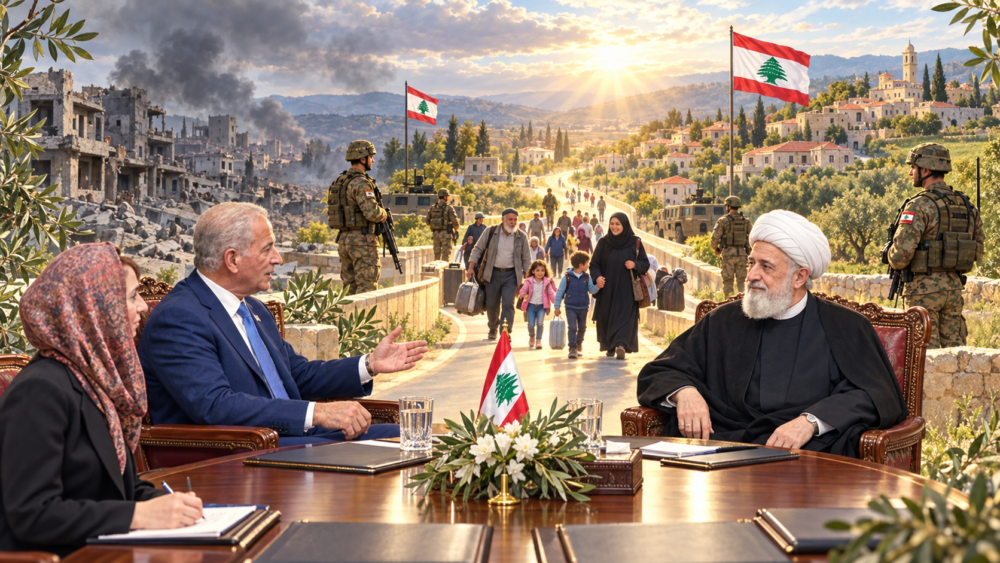
Dialogue with Shiite religious leaders could help secure Hezbollah’s disarmament through the Lebanese state—not to weaken the Shiite community, but to protect it from another devastating war.
By : Ya Libnan Editorial Board, Opinion
The recent meeting between United States Ambassador Michel Issa and Sheikh Ali al-Khatib, vice president of the Higher Islamic Shiite Council, may prove to be one of the most encouraging diplomatic developments in Lebanon’s search for peace.
For too long, the question of Hezbollah’s weapons has been presented as a confrontation between the Lebanese state and the Shiite community. That is both inaccurate and dangerous.
Lebanon’s Shiites are not Hezbollah, and Hezbollah should not be permitted to claim exclusive authority to speak in their name.
No Lebanese community has suffered more from Hezbollah’s wars than the Shiites of southern Lebanon. Their children have been killed, their homes destroyed, their villages emptied and their livelihoods repeatedly shattered. Hezbollah claims that its weapons protect them, but those weapons have increasingly turned their towns into battlefields and their families into the first victims of conflicts decided by Iran.
The purpose of this entire diplomatic process must therefore be clearly understood: it is to safeguard Lebanon’s Shiite community—not to punish, weaken or marginalize it.
Ambassador Issa was right to visit the Higher Islamic Shiite Council and listen directly to its leadership.
Following the meeting, Issa emphasized that Washington wants to protect the interests of the Shiite community and help displaced residents return safely to their homes. He also indicated that the United States was prepared to receive Hezbollah’s position—but strictly through the Lebanese state, which represents Lebanon and its national interests.
This is the correct approach, and Washington should pursue it.
The United States should continue talking with responsible Shiite religious and community leaders who may be able to persuade Hezbollah that its weapons no longer protect the community. On the contrary, Hezbollah’s continued military activity has exposed southern Lebanon and its overwhelmingly Shiite population to repeated Israeli attacks.
But these contacts must respect one unbreakable principle: there can be only one Lebanese negotiating authority—the government of the Lebanese Republic.
Shiite religious leaders can serve as intermediaries. They can listen to the fears of their community, communicate with Hezbollah and help secure its acceptance of a disarmament agreement.
If Hezbollah formally authorizes them to convey its position, they could become an effective bridge between the organization and the Lebanese government. This may allow difficult issues to be discussed without granting Hezbollah the status of a state within the state.
These religious leaders must not, however, negotiate a separate agreement with Washington or Israel. Nor should Hezbollah be treated as a sovereign entity entitled to conduct its own foreign policy. Every proposal must be submitted to the Lebanese government, negotiated under its authority and implemented by the Lebanese Army.
Sheikh al-Khatib reportedly told Ambassador Issa that Lebanese Shiites did not take up arms by choice but because of Israeli occupation. He also indicated that the community could consider disarmament if it received credible guarantees protecting its security, future and continued presence in Lebanon.
Those concerns should not be dismissed. No community should be asked to surrender weapons while fearing abandonment, displacement or retaliation.
But the answer cannot be permanent sectarian armament. If every Lebanese community claims the right to maintain its own military force because it once faced danger, Lebanon will never become a sovereign and functioning state.
The answer is to provide security guarantees through the Lebanese Republic: a strong Lebanese Army, an enforceable agreement ending hostilities, complete Israeli withdrawal from Lebanese territory, the return of Lebanese detainees, international assistance for reconstruction and firm guarantees that displaced southerners can return safely to their homes.
These guarantees must protect Shiites as Lebanese citizens—not as members of an armed enclave controlled by Hezbollah or Iran.
Disarmament must therefore be presented for what it should be: not an attack upon the Shiite community, but protection from another war.
The message to Lebanon’s Shiites should be unmistakable:
You are not being asked to surrender your security. You are being offered the protection of your state so that no armed organization can ever again drag your families into a war you did not choose.
The dispute over sequencing must also be resolved through diplomacy.
Washington argues that Hezbollah must surrender its weapons before the United States can successfully pressure Israel to withdraw. Sheikh al-Khatib reportedly insists that Israeli withdrawal and security guarantees must come first.
Neither side should allow this disagreement to destroy what may be the best opening Lebanon has had in years.
A phased and reciprocal agreement offers a practical way forward. Hezbollah could begin surrendering its heavy weapons and military installations to the Lebanese Army in designated pilot areas. Israel could simultaneously withdraw from corresponding Lebanese territory and cease its attacks there.
As each side fulfills its commitments, the process could expand until the Lebanese Army controls all Lebanese territory, Hezbollah no longer operates an independent military force and Israel completes its withdrawal.
Verification could be conducted by an internationally supported mechanism working with the Lebanese government and Army—not through separate arrangements with Hezbollah.
The Higher Islamic Shiite Council could play a historic role in convincing the community that disarmament does not mean surrendering its dignity or security. It means transferring responsibility for protecting the south from an Iranian-backed organization to the legitimate institutions of Lebanon.
This dialogue should therefore continue and expand. Washington should engage Shiite religious leaders, community representatives, municipal officials and residents of the south. But it must do so as part of a national process led exclusively by the Lebanese government.
If Hezbollah genuinely wants to protect Lebanon’s Shiites, it should authorize credible Shiite leaders to help communicate its position and negotiate the peaceful transfer of its weapons through the Lebanese state. It should then publicly accept and implement the agreement reached by Lebanon’s legitimate government.
This may be the opening for which Lebanon has been waiting: an opportunity to replace confrontation with persuasion, fear with guarantees and permanent warfare with lasting security.
Shiite religious leaders can help open the door. Hezbollah can decide to walk through it. But only the Lebanese state must determine where that door leads.
The objective is not to weaken Lebanon’s Shiites. It is to ensure that they never again pay the highest price for a war launched by Hezbollah on behalf of Iran.
Lebanon’s future must be negotiated under one government, secured by one army and protected under one flag.
