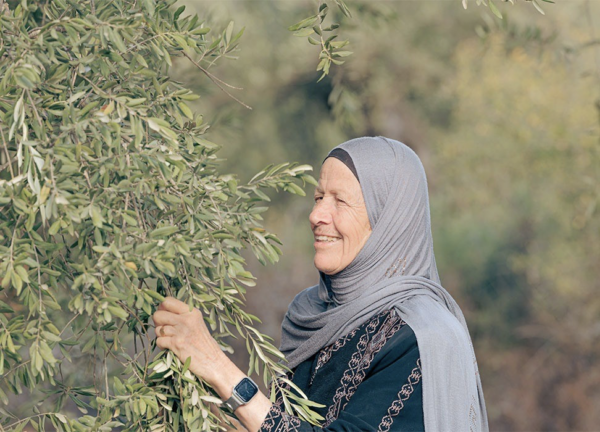
Olive harvester Fathiya Alqam at her farm in the occupied West Bank. © UN Human Rights – Palestine | Mustafa Hamamrah
Fathiya Alqam was 14 when the Israeli occupation started in 1967. At 73, she chooses to stay in Turmusaya, by her olive trees in the occupied West Bank, even with her six children living abroad.
“For Palestinians, the olive tree is a homeland,” she told UN Human Rights – Palestine. “I stay because I want my country. I’m anchoring my children to their land, to our homeland. Why should I abandon my livelihood and leave?”
Her children sometimes come back for the olive harvest, she said. This year, her 23-year-old son arrived in Turmusaya to pick olives with the family. Israeli settlers were waiting on Alqam’s land.
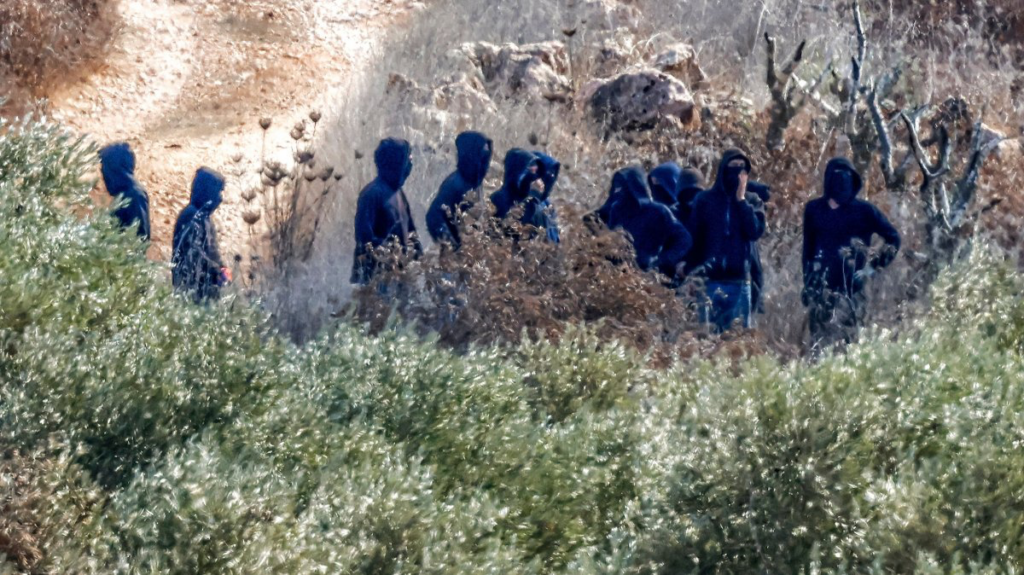
Masked Israeli settlers are shown stealing Palestinian’s olives . They talke them to an Israeli settler press to make olive oil.
“They kicked us out of our land. I was afraid for my son,” she said. “It is dipped in blood; every bite of olive, every drop of oil we get out of the olives; it is dipped in blood.”
It was one of several settler attacks that she endured this season, preventing her from picking olives in several plots that her family owns in the village. Over the past three years, she said she gradually lost access to six dunums of land, a quarter of her property, due to Israeli movement restrictions and settler attacks.
2026’s olive harvest season recorded the highest number of harvest-related settler attacks on record — over 420 attacks since September, according to OCHA, causing injuries and property damage including to more than 4,000 trees and saplings. The attacks included the use of live ammunition and arson, destroyed olive groves and ancient trees, damaged property, and involved the theft of harvested olives and agricultural equipment.
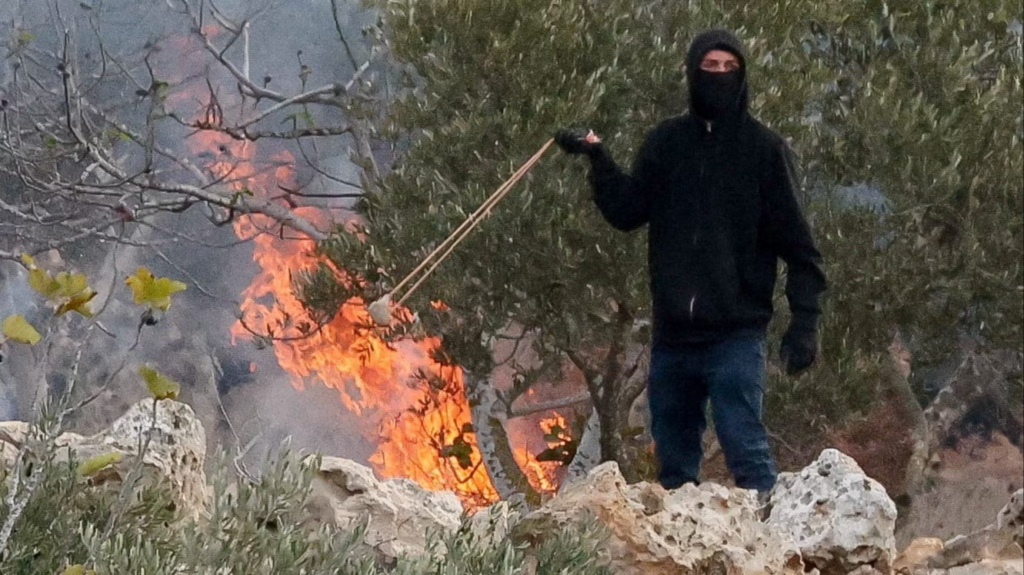
An Israeli settler casts a projectile towards Palestinians, near a fire, amid clashes during Palestinians’ olive harvest in Abu Falah near Ramallah in the Israeli-occupied West Bank, October 16. REUTERS/Ammar Awad
“In the beginning it was the military bothering us, now it is the settlers too. Every year they expand deeper and inch closer to our homes. I remember the first time I tried to pick my olives, and they were waiting on my land, telling me that it is theirs. Every year now they force us to abandon a piece of the land,” Alqam said.
Israeli authorities also routinely deny permits to farmers who try to coordinate access to their lands across the complicated, discriminatory movement regime involving Israeli barriers, checkpoints, iron gates, trenches, and roads designated for Israeli-only traffic.
The cumulative impact has been devastating to the Palestinian rural economy, with losses in the olive sector estimated at USD 157 million since October 2023 by the Palestinian Ministry of Agriculture.
For Alqam, the loss is not only economic.
“They attack because they know the olive trees are the homeland for us. If the olives are gone, the homeland is gone,” Alqam said.
Since October 2023, Israel has intensified and accelerated its effort to consolidate the annexation of Palestinian land and replace Palestinian communities with Israeli settlers. In this period, Israeli forces and settlers killed over 1,100 Palestinians, and displaced tens of thousands across the occupied West Bank, according to the Office in Palestine.
And Palestinian communities, in Turmusaya and beyond, have limited lines of defense left. The Israeli legal system is asymmetrical and discriminatory to Palestinians, shielding Israeli forces and settlers from accountability.
Over the past three years, Israeli forces and settlers have also increasingly attacked international and Israeli solidarity activists who join farmers to deter and bring attention to the violence, causing severe injuries and sometimes leading to detention.
Supporting olive farmers
The Protection Cluster, led in the Occupied Palestinian Territory by UN Human Rights – Palestine, with more than 120 national and international partners works with the Food Security sector to support Palestinian farmers during the harvest season. Protection partners accompany farmers to their groves to help with olive picking, deter and document attacks, and provide referral pathways where needed.
Partners also provide farmers with cash assistance, legal support to challenge access restrictions, psycho-social support to families, and agricultural support including tools and equipment. The Cluster works with communities to develop and support community led safety and preparedness initiatives. But the scale of Israeli violence and restrictions is overwhelming communities’ capacity to prepare and partners’ ability to respond.
“What can we do?” Alqam asked. “I hope we can be free on our own land, at our own homes, to be able to once again take our children to celebrate the harvest and see the trees. Instead, we live in fear, scared to death.”
Watch Fathiya Alqam’s full story here:
UN.org
