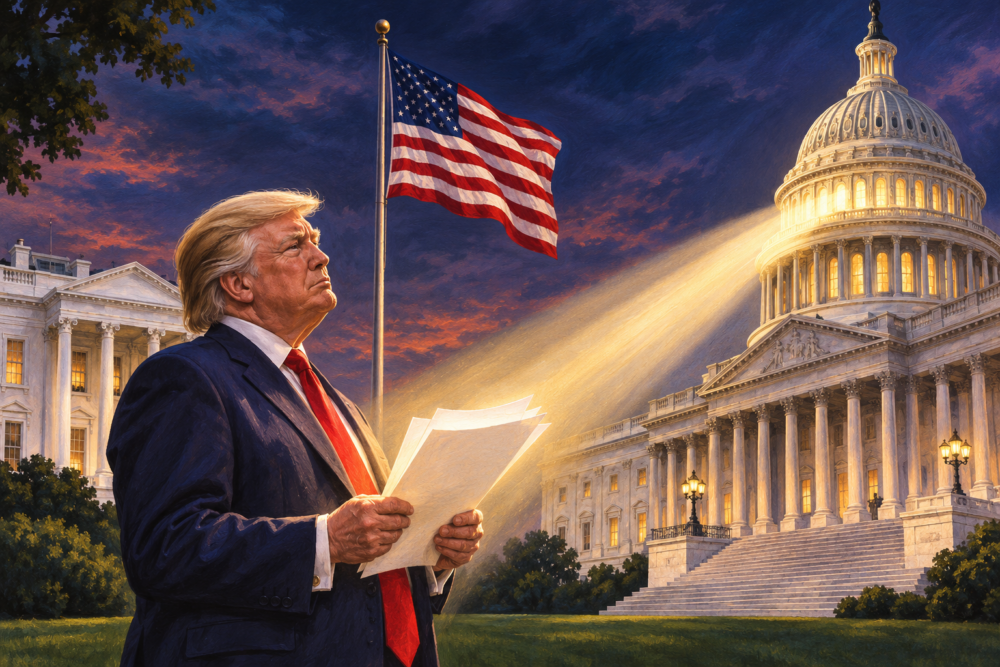
Editorial illustration- The presidency carries power. The Constitution demands accountability
Bolsonaro’s departure for Florida raises a larger question: whether leaders who demand loyalty to their country will submit to its institutions when their own interests are at stake.
By: Vlad Green, Opinion
Flávio Bolsonaro’s departure for the United States after losing Brazil’s presidential election offers an uncomfortable reminder: the strength of a democracy is measured not only by how it elects leaders, but by whether powerful politicians accept defeat and answer to its institutions.
Bolsonaro arrived in Miami amid investigations and a dispute over surrendering his passports. He denies that he fled. His departure nevertheless raises questions about accountability that extend well beyond Brazil.
For Americans approaching the congressional elections, one question deserves particular attention: If Republicans lose control of Congress, will President Donald Trump accept the scrutiny that could follow?
Trump has already identified the stakes in personal terms. In January, he warned Republican lawmakers that they needed to win the midterms because otherwise Democrats would find a reason to impeach him.
That warning deserves examination. Congressional elections determine who writes legislation, controls spending and oversees the executive branch. They should not be reduced to a campaign to protect one individual from investigation.
The presidency belongs to the American people. Congressional oversight belongs to them, too.
There is no credible public evidence that Trump plans to seek refuge in Moscow if Republicans lose. Suggesting otherwise as an established possibility would distract from the immediate issue: whether he would recognize an opposition-controlled Congress as a legitimate constitutional authority.
A congressional defeat would not remove Trump from office. The House can impeach a president, but conviction and removal require a two-thirds vote of senators present. Winning a congressional majority and securing that threshold are very different things.
The more immediate consequence could be renewed oversight: hearings, demands for records and investigations into decisions that lawmakers believe warrant examination.
Those processes must be fair. Allegations require evidence. Political disagreement alone does not justify impeachment, and an opposition majority would have a responsibility to distinguish misconduct from policies it simply dislikes.
But fairness also requires cooperation from the executive branch, subject to legitimate constitutional disputes resolved through lawful processes. A president cannot reasonably demand that every investigation disappear because he considers his opponents hostile.
The public has a right to know how presidential power is exercised, whose interests government decisions serve and whether officials respect the limits of their authority.
That principle should unite Republicans, Democrats and independents.
Republican lawmakers should remember that protecting the constitutional powers of Congress protects their own future ability to hold a Democratic president accountable. Democrats should remember that credible oversight requires discipline and evidence, rather than a predetermined verdict.
Both parties should reject the idea that loyalty to a president takes precedence over loyalty to the country.
Brazil’s experience should prompt reflection, not predictions of an identical American outcome. Different countries have different institutions, legal proceedings and political circumstances. One politician’s departure does not establish what another will do.
Yet the underlying democratic test is universal: Will those who exercise power accept the institutions empowered to examine their conduct?
Trump could answer that question by committing to respect the election results, recognize Congress’s oversight responsibilities and address allegations through lawful procedures.
Whatever the election brings, Americans should reject both political persecution and personal immunity from accountability.
The most consequential question is not whether Trump would board a plane to Moscow. It is whether he would accept that remaining in the White House means answering to the constitutional system he was elected to serve.
No president owns that system. No party should help him escape its scrutiny.
