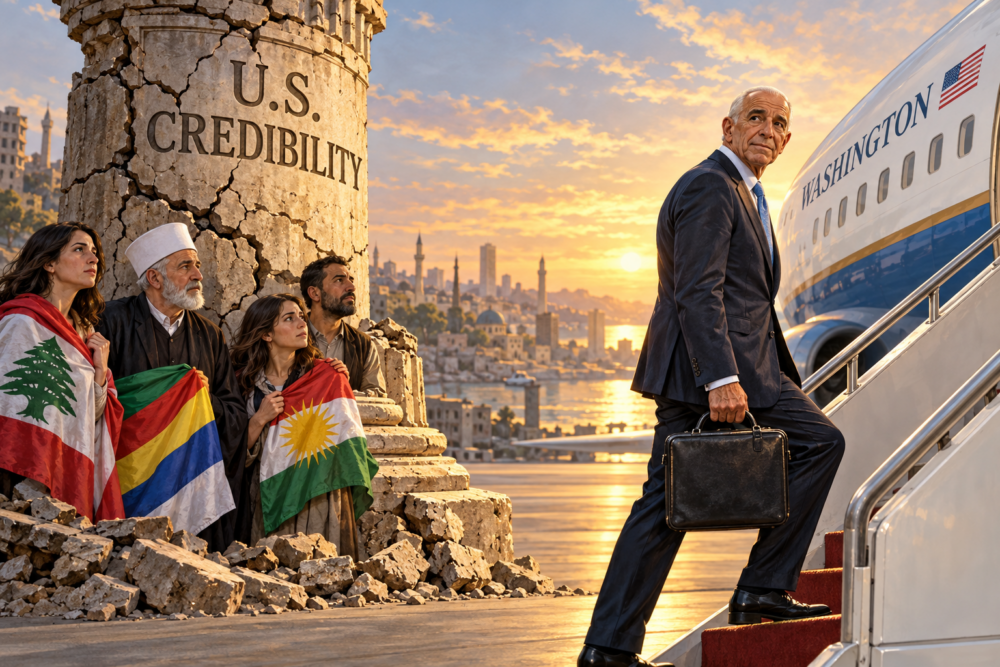
Photo illustration : “Bring the envoy home. Rebuild America’s credibility.”
Washington needs an envoy who respects Lebanon’s sovereignty, takes Syria’s minorities seriously and understands that diplomatic language can endanger lives.
By: Ya Libnan Editorial Board , Opinion
An American envoy’s responsibility is to advance American interests while building confidence in America’s judgment. When his statements deepen distrust and risk inflaming sectarian tensions, Washington must reconsider whether he remains the right representative.
Tom Barrack has reached that point. President Donald Trump should recall him to Washington and appoint a replacement.
The latest controversy concerns Syria’s vulnerable Druze community. According to The Jerusalem Post, Barrack described the area between Sweida and Daraa as “the captagon manufacturing operation of the world.” He also accused an unnamed Druze sheikh of exploiting perceived foreign backing to mistreat other Druze. His remarks were widely interpreted as targeting Sheikh Hikmat al-Hijri, although Barrack did not identify him.
These are serious accusations. An American official making them should present verifiable evidence, identify the individuals or networks allegedly responsible and carefully distinguish criminal activity from the civilian population.
Israeli Druze diplomat and historian Dr. Reda Mansour condemned the remarks, warning that broadly criminalizing a vulnerable minority could expose it to further sectarian violence. That warning deserves Washington’s attention.
Drug trafficking must be investigated wherever it occurs. Accountability requires evidence and individual responsibility. Sweeping allegations against a community can become ammunition for those already looking for an excuse to attack it.
Syria’s minorities have substantial reasons to fear for their safety. A United Nations commission documented widespread and systematic violence against civilians by government-affiliated factions during the March 2025 coastal bloodshed. Investigators found no evidence that the central government directed those attacks, but the findings demonstrated the urgent need for protection and accountability.
Against that background, American diplomacy should insist that Damascus earn public trust through its conduct. Diplomatic recognition cannot substitute for civilian security, credible investigations and punishment of perpetrators.
Barrack’s approach to the Kurds raises another question about American reliability. Reuters reported in January that Washington’s support shifted toward Damascus as Syrian government forces took territory previously controlled by the Kurdish-led Syrian Democratic Forces. Barrack argued that the SDF’s original purpose as an anti-Islamic State combat force had largely expired.
Partners who helped fight ISIS deserve meaningful safeguards during any political transition. Future American partners will judge Washington by how it treats those who previously stood beside it.
Lebanon has its own reasons for concern. At the Doha Forum in December 2025, Barrack advocated closer alignment between Lebanon and Syria. Cooperation between sovereign neighbors is desirable, but language about their political relationship demands historical sensitivity.
Syrian troops remained in Lebanon for nearly three decades before withdrawing in 2005. Lebanese sovereignty must therefore be affirmed explicitly whenever Washington discusses closer relations with Damascus.
The United States should also make clear that its Syria policy reflects independent American judgment. Turkey’s security concerns deserve consideration, alongside the rights and security of Kurds, Druze, Christians, Alawites and other Syrians.
Supporting Syria’s territorial integrity does not require dismissing every proposal for decentralization. Syrians need a political settlement that makes shared citizenship credible and protects communities against domination.
Recalling Barrack would be a necessary first step. Washington should review his accusations, clarify its commitments to minority protection and appoint an envoy capable of rebuilding confidence across the region.
America needs representatives whose words demonstrate accuracy, restraint and respect for sovereignty. When an envoy repeatedly becomes the controversy, his effectiveness suffers—and America pays the price.
For the sake of American credibility, it is time to bring Tom Barrack home.
