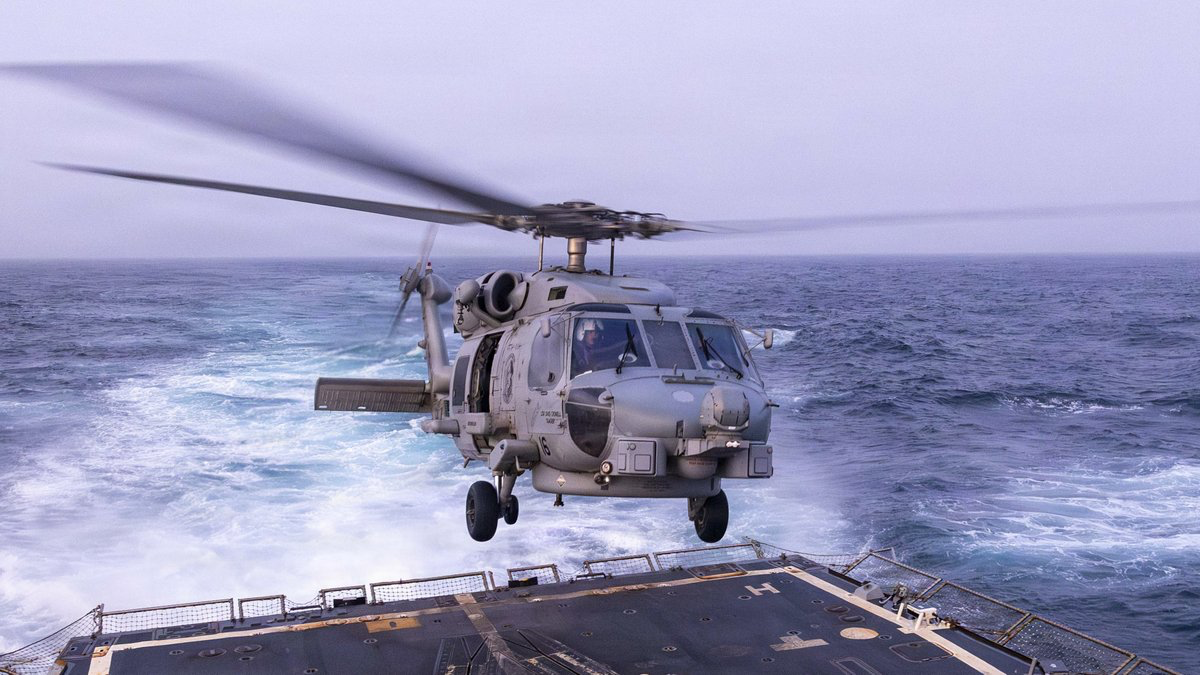
A U.S. Navy MH-60R Sea Hawk helicopter launches from the flight deck of USS Rafael Peralta (DDG 115) while enforcing the U.S. blockade against Iran.
HERE IS THE LATEST–
President Trump said Wednesday that Iran is desperate to affect the midterm elections and mused the conflict would end right afterward. “I think the war will end immediately after the election, because they can’t hold out any longer,” he told reporters.
Yemen’s Houthis seized the key Red Sea port of Mokha on Thursday, according to military sources . If confirmed, the move would make it easier for the Houthis to target ships transiting the Bab el-Mandeb Strait, a crucial waterway for Saudi Arabian oil exports.
Israel said Thursday it completed the demolition of key underground infrastructure built by the Iran-backed Hezbollah group on the strategic Ali al-Taher ridge in southern Lebanon.
U.S. blockade has now redirected 96 vessels, CENTCOM says
The reinstated U.S. blockade on the Strait of Hormuz has crept closer to redirecting 100 commercial ships traveling into or out of Iranian ports, the U.S. Central Command said Thursday.
The U.S. military said 96 vessels have now been redirected since July 14, an increase of two ships since the last update on Monday.
It was also noted that 50 ships supporting humanitarian aid have been allowed to pass through the Strait of Hormuz.
Hezbollah underground infrastructure destroyed in southern Lebanon, Israel says
Israel said Thursday it completed the demolition of key underground infrastructure built by the Iran-backed Hezbollah group on the strategic Ali al-Taher ridge in southern Lebanon.
“This is strategic terrorist infrastructure that was built over two decades, with Iranian funding and planning,” said a joint statement by Prime Minister Benjamin Netanyahu and Defense Minister Israel Katz, adding its destruction “completes the achievement of operational control over the Ali al-Taher ridge — above and below ground.”
The network of tunnels included eight underground routes with a combined route of 5,400 meters and included dozens of explosive drones, machine guns, anti-tank missiles and hundreds of mines, according to the Israel Defense Forces.
The Israeli army said it will continue to operate in its so-called “Security Zone” in southern Lebanon “in order to clear the area and prevent the Hezbollah terrorist organization from carrying out terror attacks against Israeli civilians.”
As part of the trilateral agreement between Lebanon, Israel and the U.S. signed in June, Israel is supposed to hand over security in the zone to the Lebanese army. Israel has so far resisted doing so, saying it will only hand over security once Hezbollah surrenders all of its weapons and territory.
Iran destroys U.S. sea drone in Strait of Hormuz, IRGC says
Iran’s Revolutionary Guards said on Thursday its navy targeted a U.S. unmanned surface vessel in the Strait of Hormuz.
“The Navy of the Islamic Revolutionary Guard Corps targeted a Saildrone Explorer-type unmanned surface vessel in the Strait of Hormuz area,” they said in a statement carried by their Sepah news outlet under the headline “Destruction of a US Saildrone in the Strait of Hormuz.”
The ideological arm of the Iranian military added the sea drone had been used in the region by the U.S. Fifth Fleet stationed in Bahrain.
Washington has previously used Saildrone Explorer USVs to gather data and images in the Gulf. The sea drones are driven by solar and wind energy and can be deployed on missions in the ocean for up to one year.
This isn’t the first time Iran has seized a U.S. Saildrone Explorer. In September 2022, Iran seized multiple drones, but then later released them at the United States’ request.
Iran on Wednesday said it captured an unmanned U.S. submarine drone, providing video of the drone being pulled out of the water. The U.S. military said one of its underwater drones had “malfunctioned.”
House Democrats criticize Trump over war outside RNC midterm convention
Four prominent House Democrats criticized President Trump’s war with Iran in a press conference outside the Republican’s midterm convention on Thursday.
Colorado Rep. Jason Crow, a former Army Ranger who served in Iraq and Afghanistan, called the war “a quagmire” that has resulted in the deaths of 18 service members and cost American taxpayers billions of dollars.
“Here we are in another endless quagmire that’s costing Americans hundreds of billions of dollars, and working class kids do the fighting and dying where the elite and the privileged bang their war drums and act tough” Crow said. “I have had enough. Americans have had enough. We will never stop calling it out.”
Rep. Madeleine Dean, from Pennsylvania, called out Republican Sen. Dave McCormick, and Reps. Ryan Mackenzie and Rob Bresnahan, all also from battleground state, for voting in favor of tariffs but against the War Powers Act, which could end the war in Iran.
“What is President Trump doing right now while he faces record low approval ratings, and while the American people are demanding an end to war and tariffs?” Dean said. “He’s escalating the war in Iran. At the same time, he denies we’re in war.”
Protecting Yemen’s coast is in international interest, government official says
The leader of Yemen’s internationally recognized governing council on Thursday urged Arab and other nations to help protect the country’s coasts, after the Iran-backed Houthis seized control of the key Red Sea city of Mokha.
“The protection of Yemen’s coasts and the restoration of state control over its territory, ports and waters is a joint Yemeni, Egyptian, Arab and international interest,” said Rashad al-Alimi, who heads Yemen’s Presidential Leadership Council, during a meeting with Egypt’s ambassador.
Mokha has been held by Yemen’s internationally recognized government, but a takeover by Houthi forces would give them a stronghold directly on the coast of the Bab el-Mandeb Strait.
The Houthis have targeted Saudi ships exporting oil out of the Red Sea through the Bab el-Mandeb. About 6 to 10% of the world’s oil traveled through the strait before the war, less than half of what travels through the Strait of Hormuz, but still a key waterway.
The Houthis on Thursday accused Saudi Arabia of launching strikes on the southwestern province of Taiz, after they seized Mokha.
“The Saudi enemy launched 10 strikes on the Dhubab district in western Taiz,” the Houthis’ Al-Masirah TV channel said.
U.N. watchdog confirms construction activity at Iran’s Pickaxe Mountain
The United Nations’ atomic watchdog told Bloomberg News on Thursday it had seen construction activity at Iran’s Pickaxe Mountain, a site suspected to be home to nuclear-related activities — and one President Trump has repeatedly mused targeting with strikes.
The International Atomic Energy Agency has not inspected the tunnel complex at the site, which lies to the south of Tehran’s main uranium-enrichning plant, but remote imagery suggests new activity there, IAEA Director General Rafael Mariano Grossi said in an interview with Bloomberg Television.
Mr. Trump has mentioned the site at least twice in the last week.
Speaking Wednesday at the Republican midterm convention, he said: “We notice there’s a little activity at Pickaxe. I would advise Iran not to get cute because we will have to hit them very hard.”
U.S.-led forces begin pullout from Iraq despite the refusal to disarm by Iran backed militias
The U.S.-led anti-jihadist coalition has begun withdrawing from Iraq’s Kurdistan region ahead of a deadline to end their mission in the country, a Kurdish official said Thursday.
They had already completed their withdrawal from other bases in Iraq in January and are now only present in the northern autonomous Kurdistan region.
They are scheduled to complete their withdrawal by Sept. 30, having concluded their mission against the Islamic State group in Iraq, according to a 2024 agreement between Baghdad and Washington.
“Under the existing agreement, these forces must leave by the end of September, and they have in fact already begun doing so,” Kurdistan’s interior minister, Rebar Ahmed, told journalists.
“The process has started also in the Kurdistan region, with those forces transferring daily to other locations outside Iraq,” he added.
Sabah al-Numan, spokesman for the head of Iraq’s armed forces, also said Thursday that foreign forces were accelerating their withdrawals.
The coalition forces exited Syria earlier this year.
The U.S.-led troops deployed to Iraq and Syria in 2014 to fight the Islamic State, which had seized large swathes of both countries and committed massacres and other atrocities.
The group was defeated in Iraq in 2017 and in Syria in 2019.
Although members of the jihadist group remain in desert and mountainous areas, their attacks have massively declined, and Iraqi forces continue to launch operations against them.
The presence of the coalition, especially after the Islamic State’s defeat, has been a persistent point of contention between Iraqi authorities and Tehran-backed armed factions in the country.
The Iran backed militias were supposed to disarm as the US pulls out but so far they reportedly refused to do so – For years, the Iran-backed groups have targeted coalition troops, most recently in support of Tehran during the war that began in late February.
CBS
