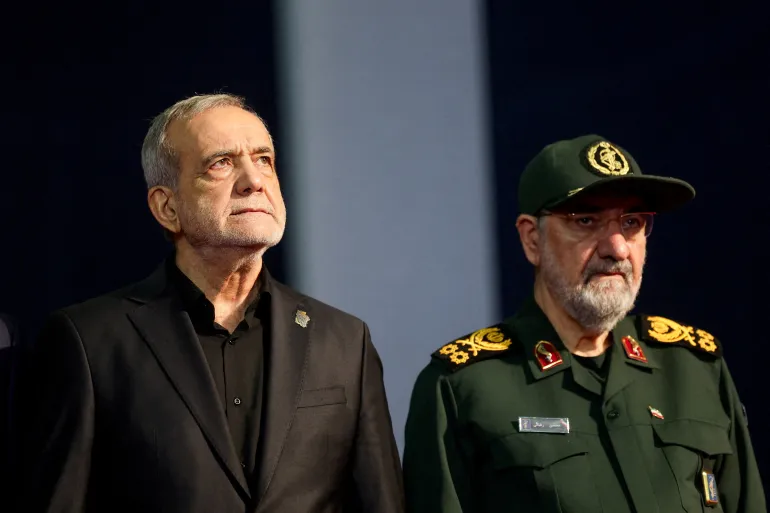
Iranian President Masoud Pezeshkian and Mohsen Rezaei, now secretary of the Supreme National Security Council, at a farewell ceremony for Iran’s late Supreme Leader Ayatollah Ali Khamenei, who was killed on February 28 Mohammed Salem/Reuters]
HERE IS THE LATEST-
- President Trump insisted Thursday that Iran is “begging to make a deal,” as Iranian officials pushed back against U.S. economic pressure and talks between the two countries remained stalled six months into the war. Mr. Trump initially said the war would last six weeks, but now says it will take “as long as necessary.”
- U.S. Central Command chief Adm. Brad Cooper has echoed the president in saying the Strait of Hormuz is clear of sea mines, saying it is “open, and momentum is building.” Some U.S. allies reportedly doubt that assertion, however, and regardless, Iran’s threat to commercial vessels is keeping transits to a fraction of their pre-war level.
- Asked Thursday if the U.S. would impose sanctions on Chinese banks that cooperate with Iran, which analysts say is crucial to make the economic warfare tactic against Iran successful, Mr. Trump shot back: “Who said I’m not?” and added that he did not “have to announce everything.”
Iran calls U.S. sanctions “economic terrorism
Iran’s foreign ministry released a new statement on Friday calling the latest sanctions on the country “economic terrorism” and continuing to say they are an assault on Iranian sovereignty and in violation of the U.N. charter — both claims the country has been making for days.
The statement said the imposition of sanctions “constitutes US state terrorism against Iran and the world.”
“The US abuse of the dollar as a tool to intimidate other countries in order to force them to follow its interventionist policies, which violate international law, in relation to Iran, constitutes a violation of the national sovereignty and right to self-determination of all member states of the United Nations,” the statement said. “US sanctions against Iran, due to both their nature and consequences, constitute a flagrant violation of the UN Charter.”
Foreign Minister Abbas Araghchi made similar statements in a letter to U.N. Secretary-General Antonio Guterres earlier this week. He called for the U.N. to condemn the U.S. actions against the sovereignty of Iran.
“Unfortunately, the indifference and appeasement of the United Nations system and its member states toward the flagrant violations of international law by the United States and [Israel] have led to the emergence of an extremely dangerous pattern of lawlessness and the commission of the gravest international crimes by them, the consequences of which have placed the entirety of human civilization under an unprecedented threat,” the statement written Friday read.
China is the only notable country so far to agree with Iran’s claims that the sanctions violate U.N. law and to have said they will not comply with them.
“Undoubtedly, the Iranian nation, united and of one mind, relying on its vast civilizational heritage and the inspiring religious and national teachings, and drawing upon the great experiences of recent decades, will repel the malignity of its evil enemies and will increase the power and strength of our homeland day by day,” the statement said.
Thousands of seafarers still trapped in Strait of Hormuz, U.N. maritime agency says
Around 6,000 sailors on 400 ships are still unable to leave the Strait of Hormuz, the United Nations’ International Maritime Organization said Friday.
“Thousands of seafarers in the region continue to live and work under conditions of heightened risk and uncertainty,” IMO Secretary-General Arsenio Dominguez said, providing the figures in a statement marking six months since the war’s start.
He said the conflict was still causing major disruptions to vital supply chains for fuel and other commodities, with consequences around the world.
“The deterioration of maritime security around the globe — from the Black Sea to the Red Sea and Gulf of Aden — is detrimental to us all,” Dominguez said. “But it is particularly distressing for the thousands of innocent seafarers affected.”
Despite the IMO’s announcement of a “large-scale” plan to help rescue thousands of mariners still trapped in the Gulf, only 136 vessels and about 2,900 seafarers have been evacuated, and none since the end of June, when the effort was paused amid renewed attacks by Iran.
At least 19 mariners have been killed in the region since Feb. 28, when the U.S. and Israel jointly launched the war on Iran.
U.S. CENTCOM chief says Strait of Hormuz “momentum is building,” reiterating stance that all mines cleared
The head of the U.S. military’s Central Command, Adm. Brad Cooper, has echoed President Trump’s insistence that the Strait of Hormuz shipping lanes are clear of sea mines, saying they are “open, and momentum is building.”
He acknowledged, however, that vessels still seek direct U.S. military protection to use the vital waterway, which Iran has scared many commercial shippers away from since the U.S. and Israel launched their joint war on Iran six months ago — driving global oil prices up by about 30% compared to pre-war levels.
In a video statement posted online Thursday evening, Cooper said the U.S. military had “meticulously and quietly” cleared mines laid months ago by Iran’s Islamic Revolutionary Guard Corps.
“Internationally recognized transit routes in the strait are free of Iranian sea mines thanks to the incredible work of the U.S. military,” he said. “Today, international shipping lanes are open, and momentum is building.”
Mr. Trump said Thursday the U.S. helped 24 oil tankers transit the strait the previous night, reiterating his insistence that the waterway was de-mined, which he’d said several times before Cooper released his statement.
But two dozen ships is a far cry from the roughly 120 that would typically transit the strait daily before the U.S. and Israel launched their joint war on Iran, and shippers remain highly wary of using the waterway given Iran’s ongoing threat to vessels that risk passage without coordination with Tehran.
Some U.S. allies have also said they do not believe the strait has been fully de-mined, according to a Wednesday report by Bloomberg.
Regardless of whether mines still lurk in the water, Iran’s threat to attack ships has kept traffic to a minimum. Even as he touted building momentum, Cooper acknowledged that ships still want direct U.S. assistance to make the passage, saying: “Over the past several months, U.S. forces have assisted nearly 1,500 commercial vessels in transiting the strait by providing coordinated protection.”
He said while the U.S. had enabled those ships to move 750 million barrels of crude oil out of the Persian Gulf, “Iran has exported zero barrels of oil from its shores since we resumed the naval blockade in mid-July.”
Iranian Oil Minister Mohsen Paknejad acknowledged on Thursdaythat the country’s exports had “declined to some extent” — which is likely a significant understatement — but he insisted “the sale of our oil outside our territorial waters, in distant waters — meaning the delivery of oil to our customers — has continued,” despite the U.S. blockade.
Analysts note Iran can also export its energy products over land, including to its most valuable trade partner, China.
CBS
