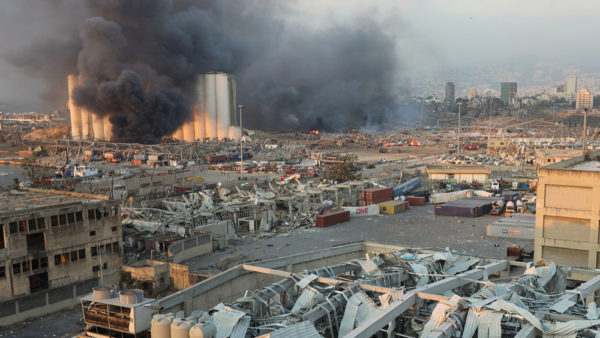
The site of the explosion which killed at least 220 people , injured 7000 and left 300, 000 homeless after 2,750 Tons of Ammonium Nitrate that was illegally stored there exploded . President Michel Aoun and PM Diab knew about the Ammonium Nitrate 15 days before the explosion but did nothing about it . Judge Fadi Sawan who initially was in charge of the investigation charged Diab and 3 Hezbollah linked officials with negligence over the explosion was fired and replaced by Judge Tarek Bitar who could not complete his investigation because Hezbollah obstructed it and threatened to fire him too . (AP Photo/Hussein Malla, Beirut, Lebanon
The Iran-backed Hezbollah militant group has been for months trying to get Judge Tarek Bitar who is investigating the blast fired, reportedly because it is concerned about exposing its role in supplying the Syrian government with the explosive chemical for use in its barrel bombs. As Lebanon runs out of wheat Hezbollah is being blamed for starving the Lebanese people for the sake of supplying Syria with the explosive chemical to kill more Syrian civilians.
Six years after Beirut was destroyed, those who knew about the ammonium nitrate—and belonged to the political alliance that obstructed accountability—are presenting themselves as champions of truth and justice.
By : Ya Libnan Editorial Board , Opinion
Beirut- Speaking on the sixth anniversary of the Beirut port explosion, Free Patriotic Movement MP Nicolas Sehnaoui declared that “morality calls upon us” to unite in pursuit of truth and justice.
The words were eloquent. The record is far less inspiring.
Sehnaoui spoke of loyalty to the victims, national unity and Beirut rising again like the phoenix. But his speech carefully avoided the central question: Who prevented the Lebanese people from learning the truth?
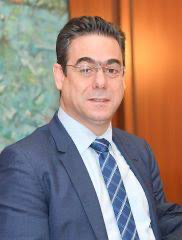
Free Patriotic Movement MP Nicolas Sehnaoui
He blamed Lebanon’s repeated destruction on “foreign armies” and concluded by declaring that “no matter how much Lebanon’s enemies destroy our homeland, we will rebuild it.”
But the ammonium nitrate did not remain at the port for nearly seven years because a foreign army ordered Lebanese officials to neglect their duties. Beirut was destroyed from within—by a political and administrative system in which officials knew of the danger, failed to act and then resisted accountability.
That is the truth Sehnaoui’s speech conspicuously avoids.
Michel Aoun, founder of the FPM and president of Lebanon when the explosion occurred, acknowledged that he had been informed about the ammonium nitrate on July 20, 2020—fifteen days before the explosion.
The warning was not about an ordinary commercial cargo. Lebanese security officials warned the presidency and the prime minister’s office that approximately 2,750 metric tons of ammonium nitrate stored at the port presented a grave security threat and could destroy Beirut. Reuters reported that the warning reached both President Aoun and Prime Minister Hassan Diab.
Aoun later said that he had directed the relevant authorities to “do what is needed.” But a president who receives a warning that an explosive stockpile could destroy his capital cannot simply forward the document and consider his responsibility discharged.
He was commander in chief. He headed the Higher Defence Council. He possessed both the authority and the moral obligation to demand immediate action.
Nothing effective was done.
On August 4, 2020, the warnings became reality. More than 220 people were killed, thousands were injured, approximately 300,000 were displaced, and entire neighborhoods were devastated. Human Rights Watch subsequently found evidence that senior officials—including President Aoun—had been informed of the danger and failed to act adequately to protect the public. Its investigation documented the chain of official knowledge and negligence.
The failure did not end with the explosion.
Judge Fadi Sawan, the first investigator, was removed after charging former prime minister Hassan Diab and three former ministers. His successor, Judge Tarek Bitar, encountered an extraordinary campaign of lawsuits, refusals to appear for questioning, political denunciations and intimidation.
Hezbollah became the most powerful political force demanding Bitar’s removal. In September 2021, a senior Hezbollah official reportedly sent the judge a message warning: “We will remove you.” Reuters documented that threat and the judicial confirmation that followed.
Where was the FPM while its principal ally was attacking the investigation?
Michel Aoun’s political alliance with Hezbollah was not incidental. It formed the foundation of his presidency and gave Hezbollah Christian political cover for years. The FPM cannot now separate itself from the system of power it helped sustain.
This does not establish that every FPM official was personally responsible for the explosion. Nor does it predetermine the criminal responsibility of anyone whom a court has not convicted. But political responsibility does not require a criminal verdict. It begins with acknowledging who knew, who failed to act and who helped create the political environment in which investigators could be threatened and the judicial process paralyzed.
Sehnaoui is right about one thing: the port explosion should be a cause for all Lebanon.
But morality requires more than commemorative ceremonies, murals and poetic references to the phoenix. It requires naming those who failed. It requires protecting Judge Bitar. It requires compelling every summoned official to appear before the judiciary. Above all, it requires the FPM to confront its own record instead of hiding behind abstract references to Lebanon’s “enemies.”
Beirut’s reconstruction is not proof that justice has been achieved. It is proof that ordinary Lebanese rebuilt what their rulers allowed to be destroyed.
The victims do not need another promise that Beirut will rise again. Beirut has already risen—through the courage of its people.
What has not risen is the truth.
And those who helped bury it have no right to stand before the ruins and pretend they have been searching for it.
