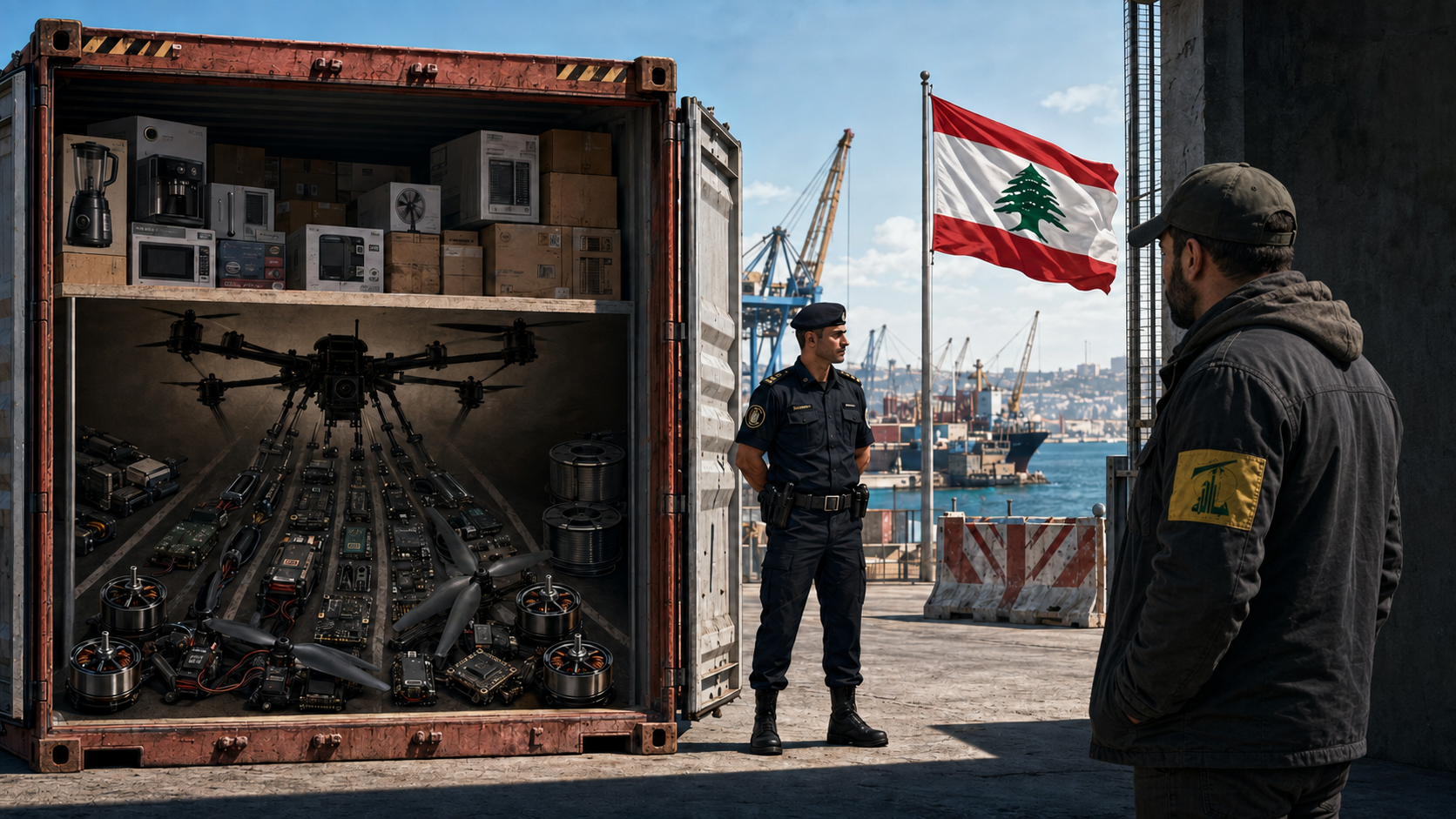
illustration- Lebanon’s sovereignty begins at its ports: every shipment must be traced from its declared cargo to its final recipient.
An international procurement operation stretching from China and Europe to Lebanon’s ports reveals how civilian trade, shell companies and dual-use technology are being exploited to supply Hezbollah’s private war machine.
By: Ya Libnan , Special Report
Lebanon cannot claim to be restoring sovereignty while its ports, airport and commercial import system continue to serve as supply routes for an armed organization operating outside the authority of the state.
The recent seizure of a large quantity of smuggled commercial drones by the Tripoli Customs Office should not be treated as an isolated customs violation. It is another warning that Hezbollah’s weapons infrastructure does not depend exclusively on missiles and drones arriving fully assembled from Iran. Increasingly, the organization appears to be importing civilian and dual-use components that can be assembled, modified and weaponized inside Lebanon.
This is not ordinary smuggling. It is an international procurement system designed to hide military production behind legitimate commerce.
The businessman at the center of the investigation
Lebanese businessman Rabih al‑Tawil became a central figure in the investigation after French authorities sent Lebanon a judicial request connected to an Interpol notice concerning a network suspected of exporting equipment used in drone manufacturing.
Tawil operated an established Lebanese company involved in electrical equipment and commercial imports. That legitimate business history allegedly provided a channel through which specialized components could enter Lebanon without immediately attracting the attention normally associated with military cargo.
According to information disclosed during the investigation, Tawil acknowledged importing electrical and electronic equipment through three maritime shipments and delivering it to another individual whom he said he knew only by a nickname. He denied knowing that the equipment could be used for military purposes, although he reportedly believed that the recipient might be connected to Hezbollah.
The Military Public Prosecution subsequently charged Tawil with a misdemeanor under Article 72 of Lebanon’s Weapons Law. After interrogating him for several hours, First Military Investigating Judge Ghada Bou Alwan issued a formal arrest warrant, keeping him in detention.
Approximately 25 days later, Bou Alwan released Tawil on bail of 20 million Lebanese pounds (about $225) . Government Commissioner to the Military Court Claude Ghanem reportedly approved the release.
That decision was not an acquittal. It did not establish that the imported equipment was harmless, dismiss the allegations or resolve the French investigation into the wider procurement network.
Tawil’s defenders described the imported products as motors for toys, surveillance cameras and ordinary electrical equipment. They accused prosecutors of treating commercially available goods as weapons and portrayed his detention as politically motivated.
But the “toy engines” defense goes directly to the heart of the problem.
Drone motors, electronic speed controllers, cameras, microprocessors and navigation components frequently originate in civilian industries. Their legality as individual products does not determine whether they are being accumulated and diverted for military production.
A motor designed for a model aircraft can also power an attack drone. A surveillance camera can provide an FPV operator with a live view of a target. A gyroscope intended for civilian navigation can stabilize an explosive aircraft. A fiber-optic cable installed for telecommunications can also guide a drone through an electronically jammed battlefield.
The relevant questions are not merely what the products were called on their invoices. The state must determine who ordered them, in what quantities, who financed the purchases, who received them after customs clearance and how they were ultimately used.
A procurement network stretching across Europe
The French judicial investigation formed part of a much larger European operation.
The trail reportedly began when Spain’s Guardia Civil identified unusually large purchases of drone-related materials by Lebanese nationals operating through companies in Catalonia. Investigators uncovered a procurement network extending across Spain, Germany, France and Britain.
Different markets supplied different parts of the system.
Spain reportedly served as an important purchasing and corporate base for obtaining drone frames, propellers, guidance components and other commercially available equipment. German suppliers provided access to high-performance motors and engines. French commercial channels supplied electronic components, microcontrollers, stabilization equipment and related technology.
Individually, these products could be entirely legal. Collectively, and in sufficient quantities, they could supply an industrial drone-production program.
European investigators concluded that the components purchased by the network could have supported the construction of hundreds—and possibly as many as one thousand—explosive drones.
This is the weakness Hezbollah learned to exploit: governments monitor completed weapons more closely than civilian components capable of becoming weapons after they reach their final destination.
No single invoice needs to say “military drone.” No container needs to carry Hezbollah’s name. The procurement network can divide the weapon into separate shipments, buyers, companies and jurisdictions.
By the time the components are reunited in Lebanon, customs officials may have approved every individual transaction without recognizing the military system being assembled in front of them.
Tripoli was not an isolated incident
In December 2024, Lebanese authorities at the Port of Tripoli seized four industrial drones arriving from China through a shell company.
The cargo was reportedly declared as agricultural irrigation equipment. Each drone was capable of carrying a payload of approximately 14 kilograms—enough to be converted into a highly destructive weapon.
Investigators also determined that earlier shipments of dual-use electrical components had already entered Lebanon successfully.
That is why celebrating an individual interception is not enough. Every seizure must trigger a backward and forward investigation.
Authorities must determine who purchased the shipment, how it was financed, which customs broker cleared it, whether the importer had previously received similar cargo, who owned the destination warehouse and whether related shipments had already entered through Beirut, Tripoli, the airport or land crossings.
For every shipment intercepted, the government must ask how many others passed undetected.
The greatest failure may not occur when a container enters the port. It may occur after customs stamps the documents and allows the cargo to disappear into Lebanon’s domestic distribution system.
The fiber-optic warning
Hezbollah’s growing use of fiber-optic-guided FPV drones makes this procurement network even more dangerous.
Conventional drones depend on radio-frequency links that can be disrupted by electronic warfare. Fiber-optic drones remain physically connected to their operators through extremely thin cables carried on spools. Commands and live video travel through the cable, making the aircraft resistant to radio-frequency jamming.
The technology transforms inexpensive commercial components into a weapon capable of challenging far more sophisticated defensive systems.
Hezbollah has acknowledged manufacturing these drones inside Lebanon. That admission confirms a fundamental change in the threat: the organization is no longer merely receiving completed Iranian weapons. It is developing a domestic military-manufacturing capability supplied through international commercial markets.
Lebanese customs figures examined in this investigation show an extraordinary increase in fiber-optic imports, from approximately 83,000 tons in 2023 to 146,000 tons in 2024.
A ten-kilometer spool used by an FPV drone can weigh approximately two kilograms. Not every imported cable is intended for Hezbollah, and Lebanon has legitimate telecommunications and infrastructure requirements. But an increase of this magnitude demands an immediate audit comparing the volume of imports with actual civilian consumption, declared projects, purchasers and inventories.
Lebanon cannot simply ban fiber-optic cables, motors or electronic components. These products are essential to legitimate businesses.
It can—and must—identify anomalous purchasing patterns and track where sensitive shipments go.
Lebanon needs intelligence-driven customs enforcement
Lebanon should establish a permanent dual-use technology unit combining the expertise of Customs, the Lebanese Army, the Internal Security Forces, General Security, telecommunications specialists, engineers and financial investigators.
That unit should be empowered to:
- Identify unusually large or commercially unjustified orders of sensitive components.
- Verify the beneficial owners of importing companies and shell corporations.
- Require credible end-user declarations for high-capacity drones, powerful motors, guidance systems and specialized electronic equipment.
- Compare each importer’s orders with its historical business activity and the legitimate needs of the Lebanese market.
- Track selected shipments after customs clearance to verify that they reach their declared customer.
- Audit earlier shipments connected to companies, brokers and individuals implicated in the network.
- Share procurement intelligence with European and regional security authorities.
- License high-capacity drones and maintain a national registry of their owners and operators.
- Investigate suspicious financial transfers connected to fragmented component purchases.
- Create a computerized warning system capable of recognizing when separate imports collectively form the components of a weapons platform.
Customs officers cannot be expected to identify every motor, processor, sensor or spool without technical assistance. Lebanon needs engineers, continually updated databases and intelligence from countries monitoring Hezbollah’s overseas procurement operations.
Sovereignty cannot end at the customs gate
Lebanon has repeatedly declared that all weapons must be placed exclusively under state control. But weapons do not begin as finished missiles displayed at military parades.
They begin with purchase orders, bank transfers, invoices, front companies, shipping containers and civilian components moving through ports under harmless commercial descriptions.
If the state looks only for completed weapons, it will always arrive too late.
The Tawil investigation and the wider European procurement operation expose the architecture through which legitimate international trade can be converted into Hezbollah’s military power.
Whether Tawil knowingly participated in that network is a matter for the courts, and he remains entitled to the presumption of innocence. But his release on bail does not erase the shipments, the intermediary, the French investigation or the larger supply chain.
Nor does calling the equipment “toy engines” answer the decisive question: Where did those engines go after they entered Lebanon?
The government must follow the entire chain—from the overseas seller to the Lebanese importer, from the customs broker to the warehouse, and from the intermediary to the final workshop.
Lebanon cannot afford another national disaster produced by authorities who examined shipping papers but refused to investigate destinations.
A country that does not control what crosses its borders cannot control what happens within them.
Sovereignty is not a declaration issued by the Cabinet. It is the daily exercise of authority at every port, airport and border crossing. It means knowing what enters Lebanon, who ordered it, who paid for it, where it went and whether it is being used to equip an illegal army.
Closing Hezbollah’s drone-supply network is not simply a customs matter.
It is a test of whether the Lebanese state is finally prepared to become the sole sovereign authority on Lebanese soil.
