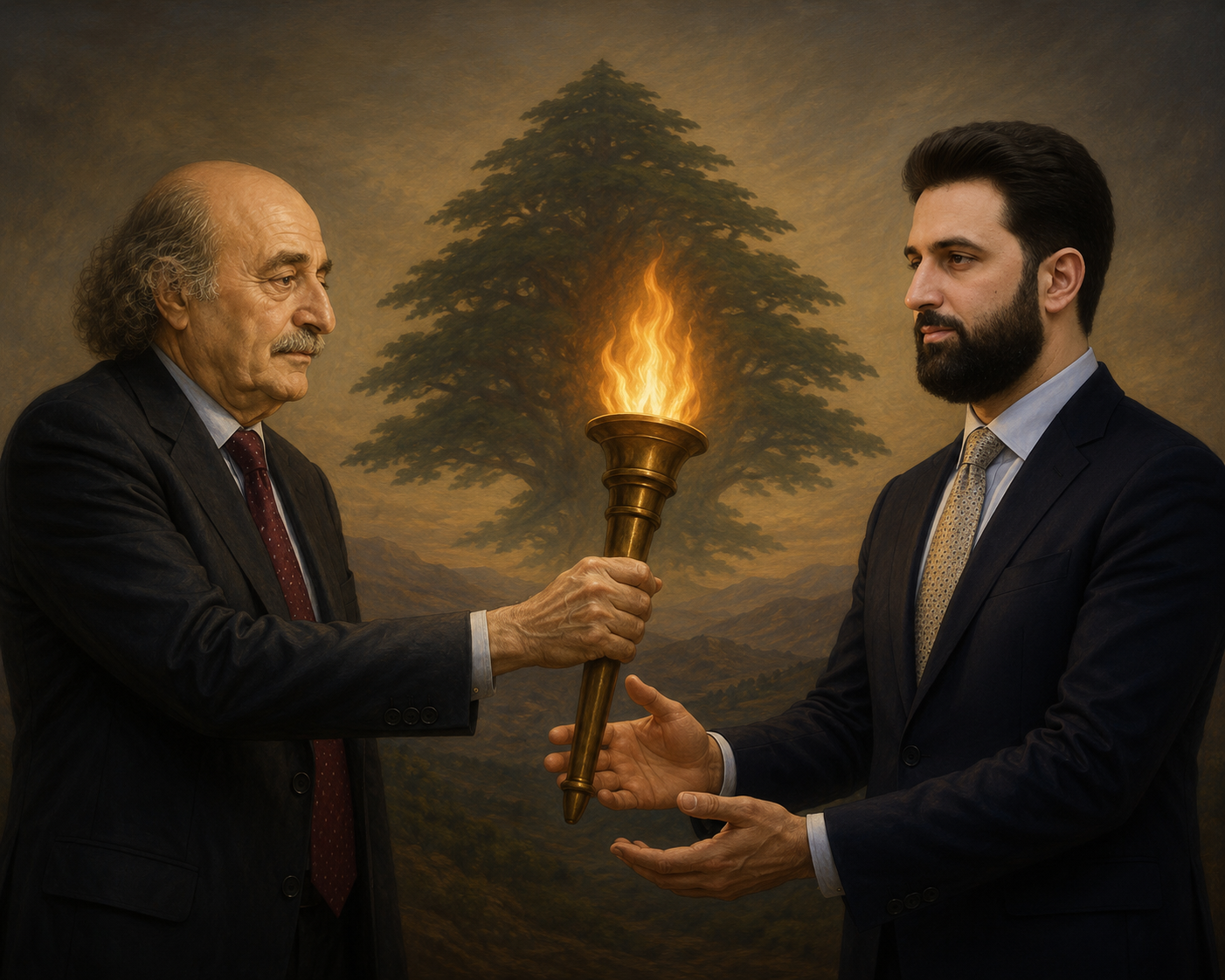
Illustration: Walid Jumblatt passing the torch to his son Taymour .The torch does not diminish the one who passes it—it illuminates the path ahead
Leadership is measured not only by how long one leads, but by knowing when it is time to pass the torch
By: The Editorial Board , Opinion
Walid Jumblatt has been one of Lebanon’s most influential politicians for nearly half a century. He played a historic role in representing the Druze community and often positioned himself as Lebanon’s ultimate political survivor, adapting to every major regional shift.
Today, however, that political instinct appears increasingly disconnected from both his own constituency and the realities of the region.
His opposition to the emerging Israel-Lebanon peace process, his continued alignment with Parliament Speaker Nabih Berri and Hezbollah on this issue, and his close relationship with Syrian President Ahmed al-Sharaa have left many Druze questioning whether he still reflects their aspirations.
Following the fall of Bashar al-Assad’s regime, Jumblatt quickly traveled to Damascus to meet Syria’s new president, Ahmed al-Sharaa. He publicly supported preserving Syria’s territorial unity under the new government and rejected proposals that would give Sweida greater autonomy.
That position placed him in direct conflict with many Druze leaders inside Syria, particularly Sheikh Hikmat al-Hijri, who has argued that the Druze of Sweida need meaningful guarantees for their security after repeated attacks on their community.
Jumblatt has also engaged in an increasingly bitter public dispute with Sheikh Mowafaq Tarif, the spiritual leader of Israel’s Druze community. Rather than building bridges among Druze communities across the region during a period of historic uncertainty, these confrontations have deepened divisions.
Within Lebanon, Jumblatt’s opposition to efforts aimed at reaching a lasting peace between Lebanon and Israel also raises questions about whether he is keeping pace with changing public sentiment. After decades of devastating wars, many Lebanese—including growing numbers within the Druze community—appear more interested in stability, sovereignty, economic recovery, and ending the cycle of conflict than in preserving old political alignments.
His continued political coordination with Nabih Berri and Hezbollah on this issue risks tying the Druze community to policies that many Lebanese believe have contributed to decades of political paralysis, corruption, and repeated wars.
Perhaps the greatest challenge facing Walid Jumblatt today is credibility. Throughout his long career, he has changed alliances many times—sometimes out of political necessity, sometimes out of pragmatism. While that flexibility once helped him survive Lebanon’s turbulent politics, many now see it as inconsistency rather than strategic leadership.
This is why the time has come for a generational transition.
For the first time in decades, Lebanon has a president and prime minister who appear genuinely committed to rebuilding the country rather than serving competing regional agendas. They deserve the support of every Lebanese leader, especially Walid Jumblatt. If he truly wishes to serve the interests of the Druze community, he should stand behind a government working to restore Lebanon’s sovereignty, rebuild its economy, and return the country to the path of peace and stability.
Taymour Jumblatt already leads the Democratic Gathering parliamentary bloc and represents a younger generation with an opportunity to redefine Druze politics for a changing Middle East. He has the chance to focus less on regional rivalries and more on protecting Lebanon’s sovereignty, strengthening state institutions, rebuilding the economy, and restoring confidence among the Druze community and other Lebanese.
By passing the torch to his son, Walid Jumblatt would do more than renew Druze leadership. He would set an example for every political movement in Lebanon. Across the country, too many parties remain dominated by the same leaders who have shaped Lebanon’s politics for decades. No community—Sunni, Shiite, Christian, or Druze—can build a better future without giving a new generation the opportunity to lead. Lebanon needs political renewal as much as it needs economic recovery.
Political movements cannot remain tied indefinitely to the instincts of past generations. Lebanon is entering a new era, and the Druze community deserves leadership that looks forward rather than backward.
Walid Jumblatt’s legacy is secure. But leadership is not only about what one has accomplished in the past. It is also about recognizing when it is time to pass the torch.
