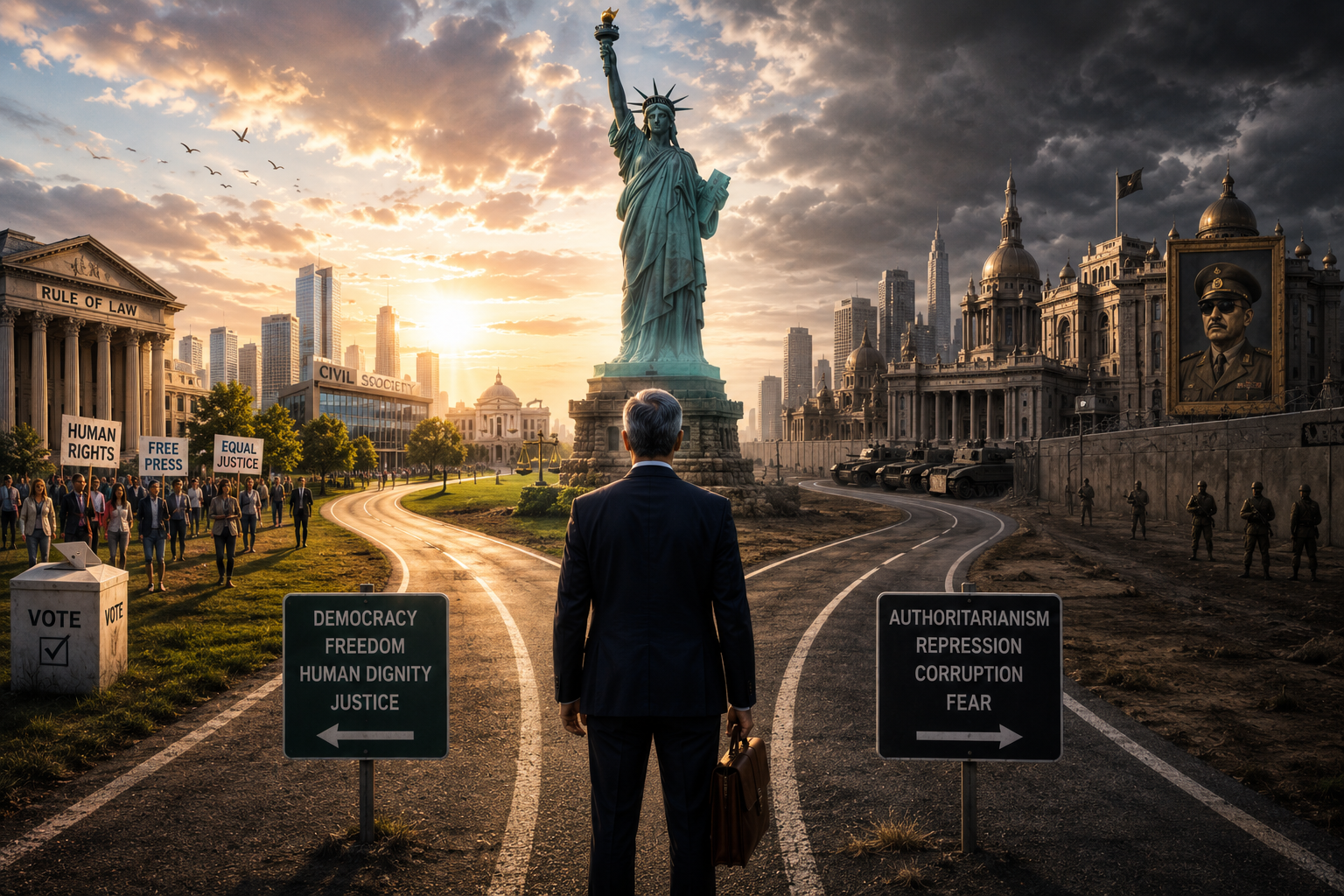
Illustration: At every crossroads in history, America has faced the same choice: stand with power, or stand with the principles that made America
The controversy surrounding Tom Barrack raises a larger question: Does Washington still seek to promote democracy and human rights in the Middle East, or has it settled for managing relationships with those who hold power?
The growing debate surrounding U.S. envoy Tom Barrack misses the larger issue. Before judging any envoy, Americans should first ask a more fundamental question: What exactly is Washington trying to achieve in the Middle East?
The answer matters because diplomats do not operate in a vacuum. They are chosen to implement policy, not create it. The type of envoy a president selects often reveals more about America’s priorities than any official policy statement.
If Washington’s objective is to maintain stability, cultivate relationships with powerful leaders, and secure strategic interests regardless of how countries are governed, then a dealmaker may be precisely the right choice. Such a mission calls for someone skilled at building personal relationships, negotiating agreements, and navigating complex power structures.
But if America’s objective is to promote democratic institutions, minority rights, political pluralism, accountable government, and the rule of law, then a very different type of representative is needed.
For decades, American leaders have spoken about democracy as both a moral principle and a strategic interest. The argument has been simple: societies that respect political participation, individual rights, and institutional checks and balances tend to be more stable, more prosperous, and less likely to produce extremism.
Yet America’s actions have often sent a different message.
Time and again, Washington has found itself partnering with authoritarian governments in pursuit of stability, counterterrorism cooperation, military access, or economic interests. This tension between ideals and interests has been a defining feature of U.S. Middle East policy for generations.
The result is that many people across the region no longer judge America by what it says. They judge it by whom it empowers.
For all of America’s imperfections and contradictions, most Americans still take pride in certain core ideals. They believe in individual liberty, equal justice under the law, freedom of speech, freedom of religion, political participation, and the right of people to choose their own leaders.
These principles are not merely constitutional concepts. They are part of America’s national identity. They are what distinguish the United States from many authoritarian systems around the world.
When Americans send representatives abroad, they expect those representatives to advance not only America’s strategic interests but also its values. They expect them to stand for human dignity, respect for minorities, the rule of law, and accountable government.
This does not mean imposing American-style democracy on every country. Nor does it mean refusing to engage with authoritarian governments when national interests require it. Diplomacy often demands pragmatism.
But there is a difference between engaging authoritarian leaders and appearing to embrace their worldview.
Americans generally understand that foreign policy requires compromise. What they are less willing to accept is a foreign policy that seems disconnected from the principles they themselves cherish at home.
The most successful American diplomats have historically balanced realism with ideals. They protected U.S. interests while ensuring that America’s voice remained associated with freedom, justice, opportunity, and human rights.
That balance matters because America’s influence has never rested solely on its military or economic power. It has also rested on the belief—however imperfectly applied—that the United States represents something larger than power itself.
If America genuinely wishes to advance democratic values, it needs representatives who understand that lasting stability cannot be built solely through relationships with those already in power.
Such envoys must be willing to engage not only presidents, kings, and military commanders, but also journalists, civic leaders, minority communities, local governments, and emerging democratic institutions.
They must understand that democracy is not merely about elections. It is about protecting the rights of those who lose elections as well.
A diplomat tasked with promoting democratic development must be seen as a bridge-builder among diverse communities, not merely a negotiator among powerful elites.
The Middle East has spent much of the last century under strong centralized rulers who promised stability. Some delivered order for a time. Few delivered lasting peace, prosperity, or political inclusion.
The lesson is not that every democracy succeeds. The lesson is that sustainable stability ultimately depends on institutions that outlive individual leaders.
Countries become durable when citizens trust their courts, their constitutions, and their political systems—not merely the person sitting in the presidential palace.
The real question is not whether Tom Barrack is the right envoy.
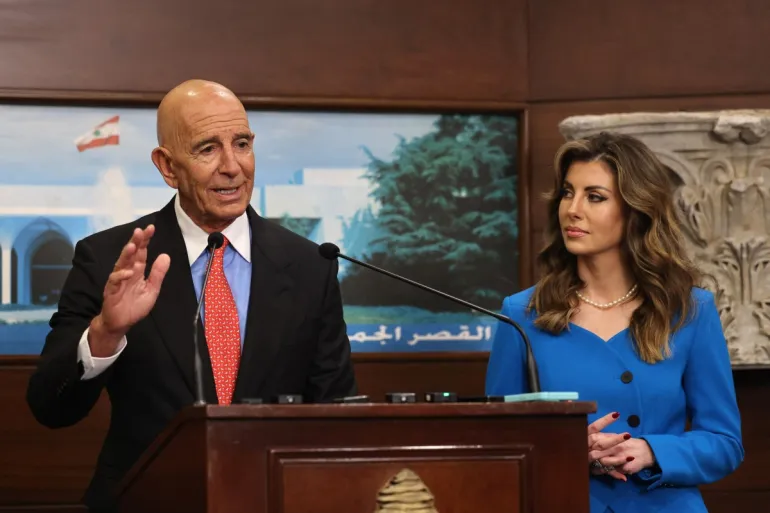
US ambassador to Turkiye and special envoy for Syria Tom Barrack speaks at the Presidential Palace in Baabda, Lebanon, on August 26, 2025. US envoy Morgan Ortagus (R) was standing next to him . He prompted outrage in Lebanon after telling media to ‘act civilised’. [Anwar Amro/AFP]
The real question is what mission Washington has assigned him.
If America’s goal is transactional diplomacy and managing relationships with existing power structures, then a dealmaker may be exactly what is required.
But if America still believes that democracy, pluralism, minority rights, accountable government, and equal justice are essential to long-term stability in the Middle East, then it must ensure that its representatives embody those principles.
America’s foreign policy should reflect both its interests and its ideals. Americans do not merely want their representatives to make deals. They want them to represent the values that define the nation itself—freedom, democracy, human rights, equal justice, and respect for all people.
The debate over any envoy ultimately comes back to a simple question: When America speaks abroad, does it sound like America?
Before choosing the messenger, Washington must define the mission. And before defining the mission, it must remember the values of the people it represents.
