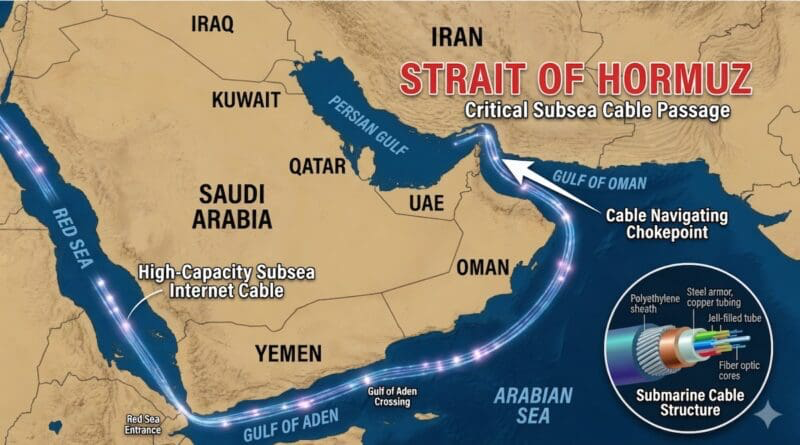
Map of subsea cables in Strait of Hormuz and the Middle East. Credit: Tasnim News Agency
By Zaid M. Belbagi, OpEd
The war with Iran has exposed an uncomfortable truth about the global economy: It still runs through a handful of narrow waterways, and the digital layer that sits beneath them is dangerously fragile.
Submarine communications cables carry about 99 percent of intercontinental data and an estimated $10 trillion in financial transactions each day, and a meaningful share of that traffic passes through the Strait of Hormuz. Long understood as an energy chokepoint, the strait is now being reframed also as a digital one.
This vulnerability has not gone unnoticed in Tehran; on April 22, the Tasnim News Agency, a media outlet directly linked to Iran’s Islamic Revolutionary Guard Corps, published a detailed report mapping undersea internet cables and cloud infrastructure in the Arabian Gulf. The piece warned of a potential digital catastrophe should the conflict with the US escalate.
Titled “Three practical steps for generating revenue from Strait of Hormuz internet cables,” the article represented a veiled threat against the region’s digital backbone, floating the idea of extracting value from the transactions pulsing through the cables that cross the strait.
This is not conventional military signaling but asymmetric warfare, the practice of attempting to counter well-funded and technologically sophisticated adversaries with cheaper and lower-tech tools targeting critical vulnerabilities.
To Iran, subsea cables represent an almost ideal target because they are difficult to defend and expensive to repair, and they underpin a vast share of global commerce. Damaging them, or even threatening to do so, imposes costs on adversaries without requiring open confrontation.
The Strait of Hormuz connects the Arabian Gulf to the Gulf of Oman, and a significant share of the world’s petroleum and natural gas exports pass through it. About seven major cable systems also pass through it, of which only two, Falcon and Gulf Bridge International, are within Iranian territorial waters. These routes account for less than 1 percent of global bandwidth but provide the primary connectivity for the Gulf states and are a significant artery for India. The recent IRGC announcement that foreign operators must obtain permits from Iran and pay “protection fees” to maintain cables in Iranian waters reframes the strait once again as a tool of pressure.
The vulnerabilities extend beyond Hormuz, however. The Suez Canal and the Bab El-Mandeb strait remain exposed to Houthi attacks, repeatedly forcing shipping to reroute around the Cape of Good Hope. The Strait of Malacca, Asia’s principal shipping artery, carries about a quarter of traded goods worldwide and faces its own pressures from piracy, gray zone naval activity, and sheer congestion.
The pattern across each of them is the same: modern power flows through a small number of routes that were never designed to absorb the stresses now placed on them.
The real play by Iran here is not to actually cut the cables but to hold the repair infrastructure hostage. On March 12, Alcatel Submarine Networks, the French state-owned company contracted to lay Meta’s 2Africa Pearls cable, issued “force majeure” notices for operations in the Arabian Gulf, effectively suspending maintenance in waters adjacent to the conflict zone.
This means the 2Africa Pearls Gulf extension, which was scheduled to go live this year and connect to Oman, the UAE, Qatar, Saudi Arabia, Bahrain, Kuwait, Iraq, Pakistan and India, is now on hold indefinitely. Networks are being forced to reroute through older systems that are less secure and more easily intercepted.
Tehran’s moves to turn the Iranian seabed into a licensing jurisdiction relies on this dynamic: pay protection fees or accept that future faults will go unrepaired indefinitely.
In 2024, damage to the Asia-Africa-Europe-1, Europe India Gateway, and Seacom cables disrupted approximately 25 percent of internet traffic between Asia and Europe and took months to repair. This was without any active military conflict preventing repair vessels from accessing the damage sites.
In trading environments where milliseconds can determine outcomes, even small spikes in latency can produce cascading order failures and real financial losses. Deloitte and the Brookings Institute estimate that connectivity disruptions can wipe out hundreds of millions of dollars in localized or regional gross domestic product within days.
The market is also unusually concentrated. Hyperscalers such as Meta, Google and Microsoft now fund as much as half of all new cable projects, leaving global routing dependent on a small group of private-sector actors. Terrestrial alternatives, analysts warn, would not be able to fully absorb the required volume if major Gulf systems were taken offline.
Tehran already operates one of the most centralized internet-control systems in the world, with sophisticated shutdown and filtering mechanisms coordinated through national border gateways. Within hours of the Feb. 28 strikes by the US and Israel, the capacity of Iran’s own internet system dropped to just 4 percent of normal, the largest nation-state internet blackout ever recorded.
This domestic apparatus reflects a deep institutional understanding of connectivity as a strategic tool for control. The extension of this logic offshore, through a new permit regime, raises the prospect that Tehran could apply its onshore legal framework to the seabed.
The consequences of this for data sovereignty would be significant. Operators working under Iranian jurisdiction could in theory be compelled to provide backdoor access to traffic, comply with state-directed censorship protocols or expose cryptographic keys to avoid asset seizures or localized blockades. Espionage and bulk data interception would become structurally easier.
What Iran is doing is weaponizing connectivity with the aim of raising insurance premiums in the Gulf, increasing uncertainty among international firms, and forcing boardrooms to calculate the costs of prolonged regional instability. In the long term their goal is more ambitious: to convert geography into permanent leverage.
For the Gulf states, a decade of digital sovereignty has been approached as a question of where data is stored, with localization laws and sovereign clouds treated as proof of autonomy. Iran has just demonstrated that territorial control counts for little when the digital traffic feeding it must cross a strait in which a hostile neighbor can intercept it.
The country threatening these cables is the one that has spent the longest time learning to live without them, and this asymmetry is what the region must now plan for.
Eurasian Review
