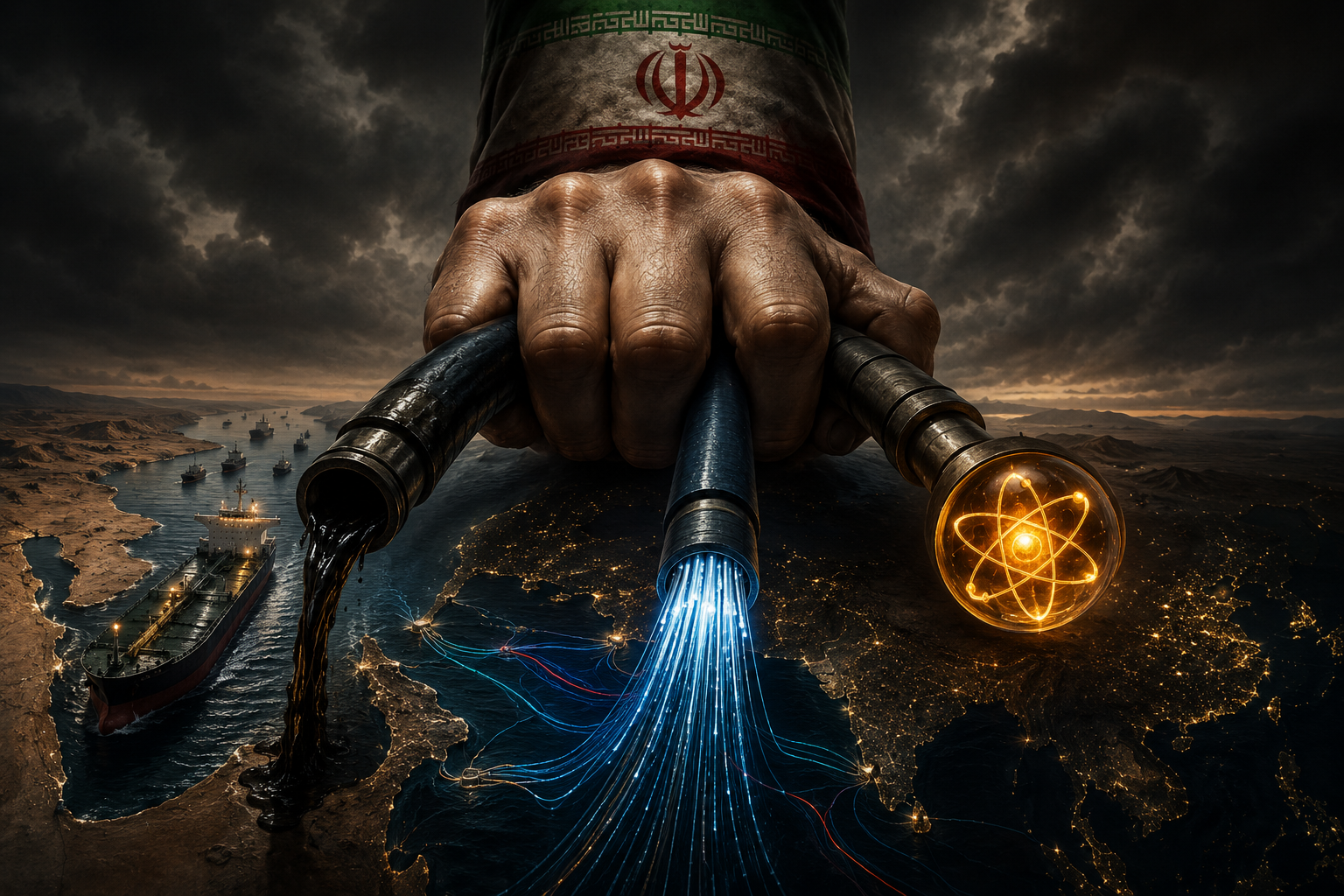
Illustration- Iran’s leverage no longer rests on oil alone. Today, Tehran seeks influence through nuclear escalation, maritime disruption, and digital infrastructure.
Tehran is no longer threatening only oil markets. It is weaponizing nuclear fear, the Strait of Hormuz, and undersea internet infrastructure to hold the world hostage.
By: The Editorial Board , Opinion
For decades, Iran’s greatest source of leverage was its ability to disrupt oil flows through the Strait of Hormuz. Whenever tensions rose, Tehran would threaten shipping, energy markets would panic, and the world would once again be reminded of the strategic importance of the narrow waterway through which a significant portion of global oil and LNG supplies pass.
Today, however, Iran’s strategy has evolved into something far more dangerous.
Since the outbreak of war between the United States, Israel, and Iran in February 2026, Tehran has increasingly relied on what can only be described as multi-domain blackmail. Rather than depending solely on oil-related threats, Iran is attempting to exploit several critical global chokepoints simultaneously: its nuclear program, international shipping routes, and even the digital infrastructure that powers the modern world.
The goal is simple: create enough fear, uncertainty, and economic risk that the international community feels compelled to make concessions.
Iran’s nuclear program remains the centerpiece of this strategy.
For years, Tehran has treated uranium enrichment as a bargaining chip rather than a civilian energy program. Each diplomatic confrontation is accompanied by new threats, new enrichment levels, new inspections disputes, and new demands for sanctions relief. The message is always the same: give Iran what it wants or face the consequences of a more advanced nuclear program.
The Strait of Hormuz represents the second pillar of Iran’s pressure campaign.
Recent Iranian efforts to impose so-called “navigational service fees” on vessels transiting Hormuz illustrate how far Tehran is willing to go. Iran argues that it is merely providing maritime services. But when a country contributes to the instability, creates the risks, and then charges others for safe passage, that is not a service. It is a protection racket.
Freedom of navigation is a fundamental principle of international law. No nation should be allowed to transform an international waterway into a toll booth for political leverage.
Yet Tehran’s ambitions appear to extend even further.
Reports that Iran may seek to exert influence over undersea internet and communications infrastructure crossing the region reveal a disturbing new front. The global economy no longer runs solely on oil. It runs on data. Financial transactions, communications, cloud computing, military coordination, and international commerce depend on a vast network of undersea cables connecting continents.
Just as the world cannot allow a single country to hold global energy supplies hostage, it cannot permit any nation to threaten the digital arteries of the international economy.
What makes this strategy particularly dangerous is that each pressure point reinforces the others.
A nuclear crisis creates political uncertainty.
Threats against Hormuz create energy shocks.
Threats to communications infrastructure create financial and technological risks.
Together, they generate fear far beyond the actual military capabilities involved. The objective is not necessarily to win a war. The objective is to make the cost of resisting Iran appear higher than the cost of accommodating it.
History teaches that appeasing such behavior only invites more of it.
In the 1980s, when Iran threatened international shipping in the Gulf, the United States and its allies responded by defending freedom of navigation rather than accepting Iranian control of maritime commerce. That principle remains just as important today.
The world does not need another war. But neither can it afford to reward coercion.
The response should be firm, coordinated, and international. The United States, Europe, Asia, and the Gulf states all have a stake in protecting the free flow of energy, trade, and information. They should make clear that international waterways are not toll roads, undersea communications networks are not bargaining chips, and nuclear extortion will not produce political rewards.
Iran’s leaders must understand that geography does not confer ownership.
The Strait of Hormuz belongs to the world economy.
Global communications networks belong to the world.
And the threat of nuclear proliferation belongs to no one.
The international community faces a simple choice: confront multi-domain blackmail now, or live in a future where every strategic chokepoint becomes a weapon.
If Iran succeeds, others will surely follow.
And that would make the world far more dangerous than it is today.
