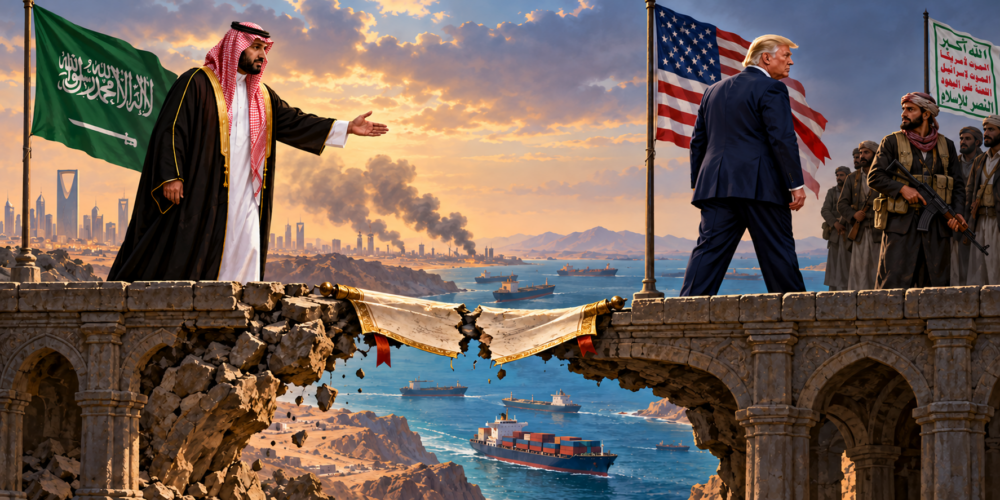
Photo illustration – “Loyalty is tested in a crisis. When an ally’s outstretched hand goes unanswered, the bridge of trust begins to crumble.”The second line in the Houthi flag reads ” Death to America”
Washington cannot celebrate a strategic partnership with Riyadh, then seek assurances from its ally’s attackers while leaving Saudi security unresolved.
By : Ya Libnan Editorial Board, Opinion
Friendship is easy to celebrate at a state dinner. Loyalty is tested when danger arrives.
President Donald Trump has repeatedly celebrated his relationship with Saudi Crown Prince Mohammed bin Salman. He has welcomed Saudi investment, promoted American weapons sales and presented their partnership as a triumph of his diplomacy.
Now that relationship faces a more consequential test: whether Washington’s promises mean anything when Saudi Arabia comes under attack.
In September, as Houthi forces captured Yemen’s strategic port of Mocha, MBS reportedly called Trump twice seeking American strikes. Washington declined direct intervention, keeping its forces focused on Iran and the Strait of Hormuz while avoiding another front.
Days later, reports emerged that American officials had met Houthi representatives in Muscat. Sources said the Houthis promised to spare American vessels. One source additionally said they would spare Israeli and other commercial ships—with the exception of Saudi vessels. This does not establish that Washington approved attacks on Saudi Arabia. But it raises a troubling question: Was Washington securing assurances for itself while leaving its partner exposed?
For Riyadh, such an outcome would understandably feel like abandonment.
Trump’s history makes that prospect particularly troubling.
In 1994, when Trump faced financial difficulties, Chase Manhattan sought help from his friend Tom Barrack. According to a Washington Post profile, also republished by The Philadelphia Inquirer, Barrack searched for financial backing and obtained commitments from members of the Saudi royal family. Trump ultimately chose Hong Kong investors, but Barrack helped persuade Chase to delay foreclosure, giving him time to arrange financing.
That episode belongs alongside other documented Saudi transactions: Prince Alwaleed bin Talal’s purchase of Trump’s yacht in 1991 and participation in the Plaza Hotel purchase in 1995. These were commercial dealings, not personal favors from MBS. Nevertheless, they demonstrate that Saudi connections figured in Trump’s business history long before his presidency.
The strongest argument for American solidarity, however, rests on the partnership Trump formally endorsed.
On November 18, 2025, Trump and MBS signed the U.S.–Saudi Strategic Defense Agreement. The White House celebrated it as strengthening their defense partnership and reinforcing regional deterrence. It also highlighted Saudi funding to offset American costs and Riyadh’s recognition of Washington as its primary strategic partner.
Those declarations created expectations that ceremonies and weapons contracts alone cannot satisfy.
The public announcement does not establish an automatic obligation to launch American airstrikes. But strategic credibility demands an explanation of how Washington’s response fulfills the partnership’s stated purpose.
Saudi Arabia’s conflict with the Houthis predates the current Iran war. Riyadh intervened in Yemen in 2015, followed by a fragile truce in 2022. The wider regional war has helped reignite a confrontation the kingdom spent years trying to contain. Saudi Arabia is bearing consequences of a conflict Washington helped unleash.
American intelligence assistance deserves acknowledgment. Yet it does not erase the gap between Saudi expectations and Washington’s reluctance to intervene directly.
The stakes also extend to Saudi Arabia’s economic future. MBS’s Vision 2030 seeks to diversify the economy beyond oil, expand tourism, attract investment and create opportunities for a younger generation. Its ambitions could offer lessons for economic modernization across the Middle East.
Those ambitions depend on security and confidence. Investors need predictability, tourists need safe travel, and businesses need reliable infrastructure and shipping routes. Houthi attacks threaten the foundations on which that transformation rests.
Washington should recognize what is at risk: the future of a strategic partner pursuing economic change, with consequences for prosperity and stability throughout the region.
Supporting Saudi security need not mean an unlimited American war. Washington can strengthen air defenses, help protect civilian infrastructure and insist that maritime negotiations include Saudi shipping.
Freedom of navigation cannot become a privilege negotiated separately for selected flags.
A policy that protects American vessels while leaving Saudi vessels vulnerable risks rewarding Houthi coercion and strengthening Iranian leverage. Whatever Trump’s intentions, those consequences would undermine his own strategic partner.
That is why disloyalty reaches beyond the relationship between two leaders.
Other partners will ask whether American commitments survive the moment honoring them becomes inconvenient. They will judge Washington by its conduct under pressure.
Trump owes Saudi Arabia a clear explanation of what his partnership delivers when danger arrives.
America’s word must be worth more than the ceremony at which it was given.
Photo illustration – “Loyalty is tested in a crisis. When an ally’s outstretched hand goes unanswered, the bridge of trust begins to crumble.”
