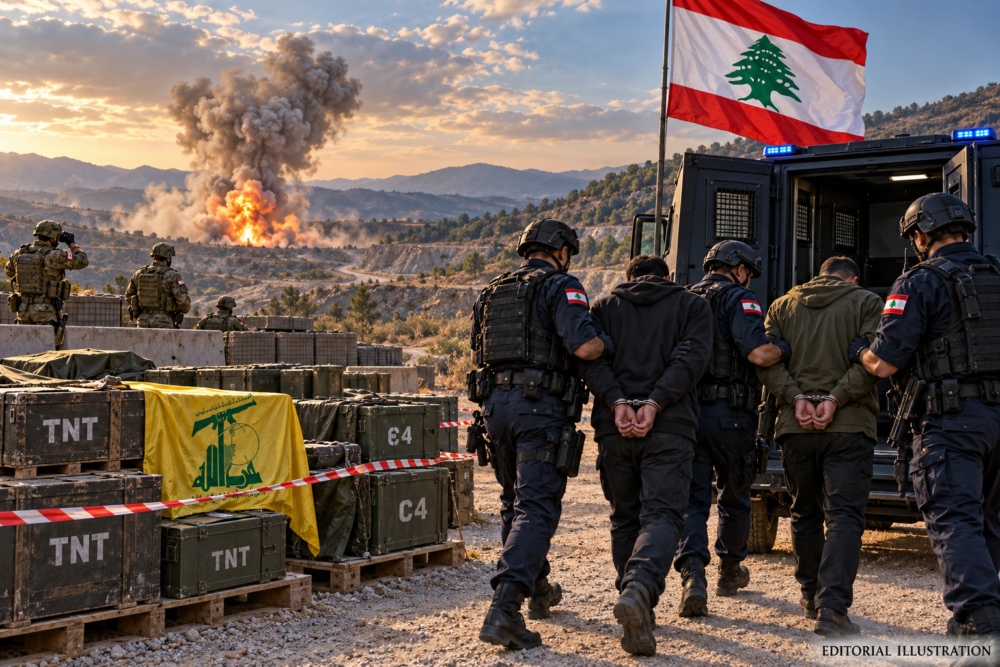
Photo illustration : Lebanon’s sovereignty demands action: destroy the seized explosives under judicial supervision and bring those responsible to justice.
The seized explosives must be safely destroyed, those responsible brought to justice, and the state’s authority enforced—above ground and below it.
By : Ali Hussein , Lebanese Political Analysts , Opinion
An explosives shipment intercepted on the road to Beirut is more than a security incident. It is a test of whether Lebanon’s government will enforce its authority against an armed organization accustomed to operating beyond the state’s control.
The response must be clear: preserve the evidence, arrange the safe destruction of the confiscated explosives under judicial supervision, and arrest everyone whom the evidence implicates in organizing, financing or directing the shipment.
Prime Minister Nawaf Salam has promised a thorough investigation. He deserves public support. But accountability must reach beyond the people transporting the cargo.
Judicial officials told the Associated Press that the vehicle intercepted at Dahr al-Baidar carried 780 kilograms of explosives, including TNT and C4. Two people were detained. Salam recalled that C4 had been used in notorious political assassinations in Lebanon.
On October 15, Hezbollah MP Hassan Fadlallah acknowledged that the vehicle and its cargo belonged to Hezbollah. He said the explosives were intended for use against Israeli forces and demanded their return, along with the release of the detainees.
The government’s answer must be no.
No political party has the right to transport explosives outside state authority and then dictate what security forces may confiscate. Describing the cargo as weapons of resistance does not place it beyond Lebanese law.
Lebanon’s history makes public anxiety understandable. Rafik Hariri’s assassination in 2005 and the political killings that followed left wounds that have never healed. That history demands vigilance. It does not, by itself, establish the intended purpose of this shipment.
Hezbollah denies planning assassinations. Investigators must determine the destination and intended use through evidence. But the government does not need to uncover an assassination plot before enforcing its prohibition on unauthorized military activity.
Who supplied the explosives? Who financed them? Who ordered their transportation? Who was supposed to receive them? Where are any additional stockpiles connected to the same network?
The discovery of an underground excavation between Fanar and Zaatriyeh, near Roueissat–Jdeideh, raises further questions. Reports alleging Hezbollah involvement remain disputed. A military source denied a military purpose, while Fanar’s mayor said Army Intelligence attributed the digging to a search for gold.
That explanation cannot substitute for a transparent investigation.
In Lebanon, even groundwater exploration and well drilling are subject to state authorization. Claiming to search for gold therefore does not settle the question of legality. Where is the excavation permit? Who issued it, and what work did it authorize?
Authorities must establish which permissions were required, publish their findings and take action over any violations.
If Hezbollah is constructing military facilities near residential communities, it is exposing more Lebanese families to the danger of war and Israeli attacks. No organization has the right to impose that risk on a neighborhood, whatever its religious composition. Israel remains responsible for complying with its obligations to protect civilians.
The government banned Hezbollah’s military activities on March 2. Lebanon also committed to disarming Hezbollah under the framework reached through U.S.-brokered talks with Israel. Those commitments require enforcement.
Aoun and Salam must order comprehensive inspections of credible suspected military sites, dismantle unauthorized facilities and protect investigators from political pressure. Any credible threats against public officials must receive equally urgent attention.
Israel must fulfill its obligations toward Lebanon. Its continued occupation cannot give Hezbollah a permanent exemption from state authority.
Secure the explosives. Preserve the forensic evidence. Obtain judicial authorization for their safe destruction by qualified specialists. Pursue the chain of responsibility and bring those implicated before the courts.
Lebanon cannot reclaim sovereignty through speeches alone. If Aoun and Salam are serious about one state and one army, this is the moment to demonstrate it—above ground and below it.
