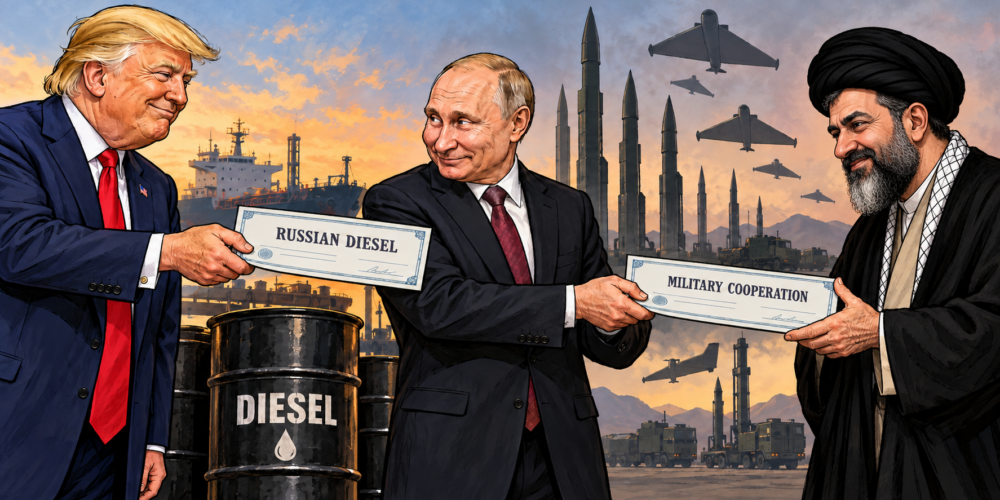
Photo illustration – Buy one, fuel two wars: Russian diesel revenue could strengthen Moscow’s military partnership with Tehran. An editorial cartoon depicting the risk.
Economic relief for Moscow could strengthen a military partnership with Tehran. Washington must weigh the consequences in Ukraine and the Middle East—not simply the price at the pump.
By Vlad Green, Opinion
Buy one, get one free is a familiar sales pitch.
In international politics, a much darker bargain is possible: buy Russian diesel and risk strengthening two adversaries.
That is the wider danger in President Donald Trump’s newly announced fuel agreement with Vladimir Putin. Its consequences may reach beyond Ukraine, because Russia’s war machine is connected to Iran’s military industry through weapons, technology, production agreements, and payments.
The diesel comes from Russia. The strategic benefit need not stop there.
On October 9, Trump announced an opening for Russian diesel deliveries to American and global markets. The U.S. Treasury issued a license authorizing transactions involving that fuel.
The administration’s stated goal is lower prices. But no publicly announced Russian commitment to end the war accompanied the fuel agreement.
That omission matters even more when we examine Moscow’s relationship with Tehran.
Iran supplied Russia with Shahed attack drones and helped it establish domestic production of Iranian-designed weapons. Russia now manufactures these drones itself. The relationship has grown beyond shipments of finished aircraft into cooperation that helps sustain a military production system.
This is not speculation about whether the two governments might someday cooperate.
In April 2024, the U.S. Treasury described a $1.75 billion contract under which Russia and Iran’s defense ministry cooperated to finance and produce Iranian-designed attack drones at Russia’s Alabuga facility. Treasury also identified a company used to receive millions of dollars in payments from Alabuga and its subsidiaries as part of that arrangement.
The financial connection is documented. The military connection is documented.
In September 2024, Treasury announced sanctions in response to Iran’s delivery of close-range ballistic missiles to Russia, describing an agreement for hundreds of missiles and Russian personnel receiving training from Iranian personnel.
European governments have also imposed sanctions over Iranian drone and missile transfers to Russia. Their concern extends to related weapons networks threatening security in the Middle East and the Red Sea.
These are connected security problems. Washington should treat them accordingly.
There is an important distinction: we do not have evidence that proceeds from this particular diesel deal have paid for a new Iranian weapons order. Announced shipments are not completed sales, and commercial receipts are not identical to Russian government revenue.
But policymakers should not need a receipt linking a diesel cargo to an individual drone before recognizing the risk.
Additional energy earnings can ease economic pressure on Russia and improve its ability to sustain military spending. Where that spending includes cooperation with Iranian military entities, some benefits could reach Tehran’s defense establishment.
That is an inference from a documented relationship, not proof that a particular payment has already changed hands.
The danger deserves scrutiny before the money flows.
A better-resourced Russia can continue attacking Ukraine. Continued payments and cooperation with Iran’s military industry could also strengthen capabilities relevant to conflict in the Middle East.
“Buy one, fuel two wars” describes that potential double consequence. It is a warning about interconnected war economies, not a claim that every diesel purchase automatically finances two weapons programs.
Farmers and truckers deserve affordable fuel. Families deserve relief from high transportation costs. Those needs are real.
So are the security interests of Ukrainians facing attacks and of America’s partners threatened by Iranian weapons and armed groups.
A sound policy must account for both.
If Washington offers Russia economic relief, it should demand an enforceable return: a verified reduction in attacks, meaningful progress toward ending the war, and safeguards against the relief strengthening sanctioned military networks.
Those conditions should be negotiated with Ukraine and coordinated with European allies. Violations should trigger the restoration of restrictions.
The administration should also explain how it evaluated the Russia–Iran connection. How will the authorized trade interact with existing sanctions? What monitoring will accompany it? What peace commitments justify accepting the strategic risk?
These questions belong at the center of the agreement.
Trump had leverage that could have been used to advance peace. Without a disclosed concession from Putin, the announced deal risks easing pressure on a country whose military partnerships extend well beyond its borders.
America should pursue lower fuel prices with its eyes open.
A bargain at the pump must not become a subsidy for aggression.
Before celebrating Russian diesel, Washington should ask who else may benefit.
It could be buying from one adversary—and helping sustain the military capabilities of two.
