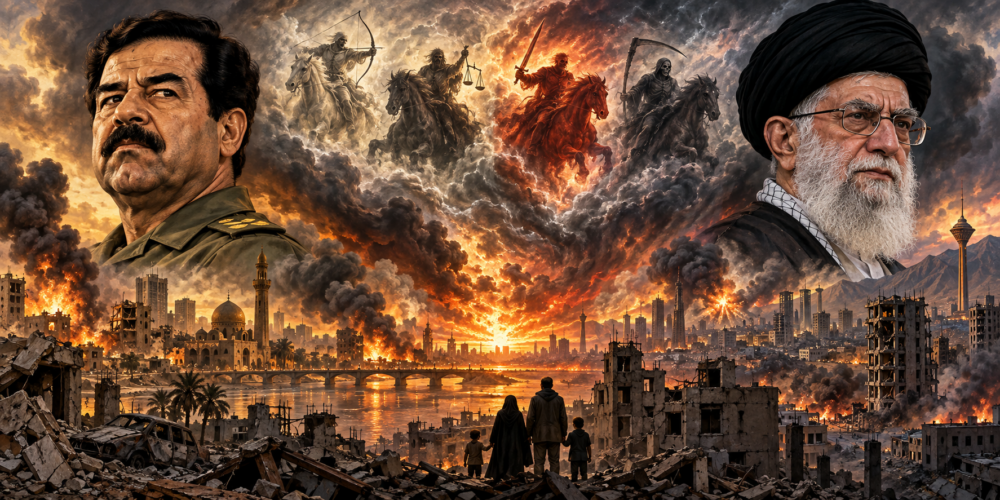
Photo Illustration : From Iraq to Iran, civilians bear the cost of war. Their lives must never become instruments of someone else’s vision of Armageddon.
Iraq taught the world the cost of accepting certainty without evidence. Religious rhetoric surrounding the Iran war now demands scrutiny—and clear answers about its purpose and its end.
By : Ya Libnan Editorial Board, Opinion
Wars kill real people. They destroy homes, separate families and leave survivors carrying injuries and grief for the rest of their lives. No government should ask its soldiers—or the civilians caught in their path—to become instruments of someone’s interpretation of biblical prophecy.
That is why reports linking the Iran war to Armageddon deserve serious attention.
The Military Religious Freedom Foundation published a complaint from an anonymous American service member alleging that a commander described the conflict as part of a divine plan and associated President Donald Trump with bringing about Armageddon and the return of Jesus Christ. The foundation has reported receiving other complaints about similar rhetoric.
These are allegations, not established findings. The identities of the commander and complainant in the published account were withheld. Associated Press reported that it could not independently verify the claims. We should demand an investigation rather than announce a verdict.
But the concern extends beyond anonymous accounts.
Defense Secretary Pete Hegseth’s public use of Christian scripture and religious imagery in discussing the war is documented. Reuters has also reported on Trump and allied evangelical leaders using religious language to rally support for the conflict. Some of those leaders connect Israel with beliefs about the Second Coming.
None of this proves that the administration launched the war to fulfill prophecy. Hegseth’s religious rhetoric does not, by itself, establish that he wants Armageddon. Nor does belief in Jesus’s return establish a desire to provoke war.
Nevertheless, Americans are entitled to ask whether religious convictions are influencing military decisions—and whether officials can distinguish personal faith from the responsibilities of public office.
We have paid dearly before for failing to challenge the case for war.
In February 2003, Secretary of State Colin Powell stood before the United Nations and presented what the Bush administration described as evidence of Iraq’s weapons of mass destruction. His reputation gave that presentation enormous authority.
The central claims about existing chemical and biological weapons stockpiles and a reconstituted nuclear weapons program proved wrong. A presidential commission subsequently concluded that the intelligence community had been “dead wrong” in almost all its prewar judgments about Iraq’s WMD.
The commission also found that intelligence officials failed to convey serious doubts about a key source before Powell’s presentation. Powell later called the speech a blot on his record.
It is unnecessary to claim that everyone knew the weapons were absent, or that Powell knowingly lied, to recognize the magnitude of the failure. Uncertain and unreliable information was presented to the world with confidence it did not deserve. The consequences were catastrophic.
There were also disputed accounts that President George W. Bush invoked Gog and Magog, biblical figures associated with the end times, in discussions with French President Jacques Chirac about Iraq. Those accounts remain contested. They should serve as a reminder to scrutinize claims about religious motives, not as proof that biblical prophecy caused the invasion.
The lesson of Iraq is that a government’s confidence cannot substitute for evidence.
The same principle must apply to Iran.
Americans deserve to know precisely what threats this war is intended to address, what evidence supports those assessments, what military action can realistically accomplish and what conditions would allow the fighting to end.
The Iranian regime’s repression, threats and support for armed proxies deserve scrutiny and condemnation. Recognizing those dangers does not exempt Washington from explaining its own decisions. Opposing a regime does not give another government unlimited authority to escalate a war.
Religious freedom must also be respected. Christians, Jews, Muslims and people of other faiths—or no faith—serve together in the American military. A commander’s religious interpretation should never become a test of loyalty or a substitute for an operational objective.
Congress should require an independent investigation of the complaints about prophetic rhetoric in military briefings. The administration should explain its policy in terms the public can assess: concrete threats, attainable objectives, costs and an end strategy.
My concern is what happens when leaders begin to regard catastrophe as fulfillment. If escalation is interpreted as divine progress, compromise may become harder to accept and human suffering easier to rationalize.
That danger deserves examination without accusing Christianity as a whole. Many Christians reject using their faith to justify war. No religious community should be reduced to its most militant voices.
The people of the Middle East are not characters in someone else’s prophecy. American soldiers are not expendable actors in an apocalyptic drama.
Faith can comfort people facing war. It must never relieve those who order war of their responsibility to prevent needless death.
After Iraq, the world cannot afford another conflict sustained by certainty that outruns evidence. The Iran war must be judged by whether it protects lives and achieves a defensible peace.
No leader should mistake the destruction of human beings for the fulfillment of a divine plan
Editor’s note: In 2003, I published 15 poems on the Poets Against the War website opposing the invasion of Iraq and sent many of them to the White House. The religious rhetoric surrounding today’s Iran war brings back unsettling memories—and reinforces my conviction that every decision to wage war demands evidence, accountability and respect for human life.
