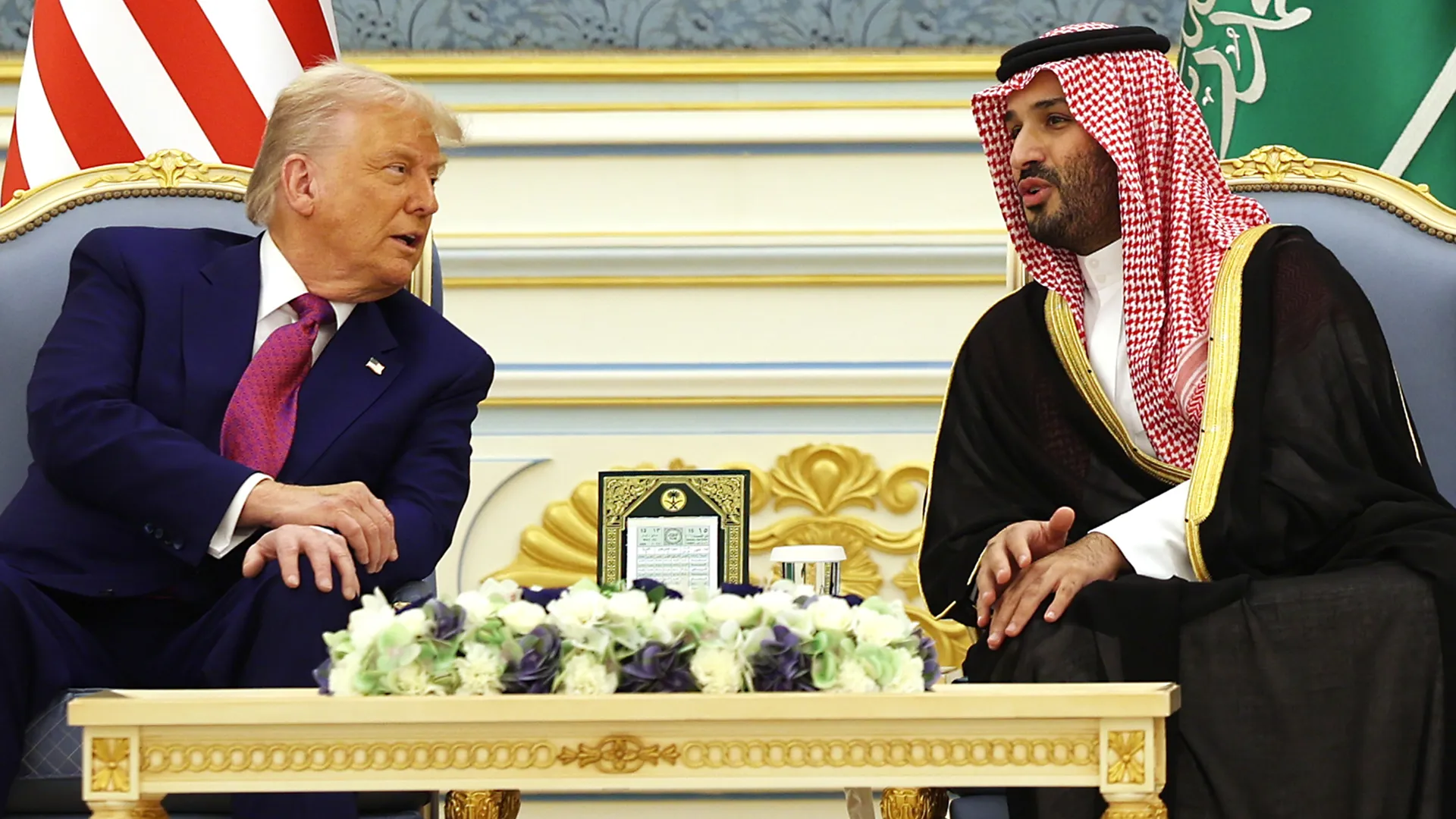
President Trump and Saudi Crown Prince Mohammed bin Salman (MbS) in Riyadh, Saudi Arabia . Photo: Win McNamee/Getty Images
If the relationship fractures over the Abraham Accords link, the economic penalty to the United States will be measured on a global, multi-trillion-dollar scale
By: Vlad Green , Opinion
Foreign policy analysts, economic realists, and regional experts are increasingly warning that the United States’ decision to condition a civilian nuclear cooperation agreement with Saudi Arabia on the Kingdom’s formal recognition of Israel could backfire. While intended to secure a historic diplomatic breakthrough, critics argue this linkage risks undermining long-term American economic interests and, paradoxically, eroding domestic political support for the U.S.-Israel alliance.
The Trump administration’s insistence that the Section 123 agreement will only proceed if Riyadh joins the Abraham Accords has created a profound strategic deadlock. Saudi Arabia has repeatedly maintained that formal normalization with Israel remains non-negotiable without a credible path toward an independent Palestinian state—a condition the current Israeli government firmly rejects. By forcing a choice between a landmark commercial contract and an intractable diplomatic realignment, U.S. policy may be inviting consequences that extend far beyond the Middle East.
From an economic perspective, industrial advocates point out that the financial stakes for the American workforce are immense. Commercial nuclear contracts under discussion are valued in the trillions of dollars, promising sustained revenue and high-tech manufacturing jobs for domestic suppliers like Westinghouse, Centrus Energy, and BWX Technologies. Tying these commercial opportunities to foreign policy prerequisites effectively sidelines American industry. Because Saudi Arabia possesses ample sovereign wealth, it is under no obligation to wait for a change of heart in Washington. Riyadh can readily pivot to state-backed competitors like China National Nuclear Corporation or Russia’s Rosatom, both of which are eager to secure multi-decade contracts that lock in regulatory, technical, and geopolitical influence in the region for the next eighty years.
The more significant long-term risk, however, lies in the shifting dynamics of public opinion within the United States. Historically, American support for Israel has been rooted in shared democratic values, intelligence cooperation, and deep bipartisan consensus. However, political analysts caution that if the American public begins to perceive that tangible domestic economic opportunities—such as high-paying engineering and manufacturing jobs—are being actively sacrificed to achieve specific diplomatic outcomes for foreign nations, the nature of that support could change.
Should a major commercial windfall be permanently lost to Beijing or Moscow over a diplomatic stalemate, the domestic political fallout could be severe. Voters prioritizing domestic manufacturing and economic pragmatism may increasingly view traditional foreign policy frameworks as detached from the interests of working-class Americans. Over time, this economic friction could foster resentment, transforming a historically resilient alliance into a point of contention for future generations of American voters. By overplaying its hand and linking commercial nuclear infrastructure to the Abraham Accords, Washington risks achieving neither regional peace nor domestic economic growth, while inadvertently introducing a volatile economic grievance into the future of U.S.-Israeli relations.
Treating a partnership of this magnitude as a standard transactional lever ignores the tectonic financial weight behind it. If the relationship fractures over the Abraham Accords link, the economic penalty to the United States will be measured on a global, multi-trillion-dollar scale
