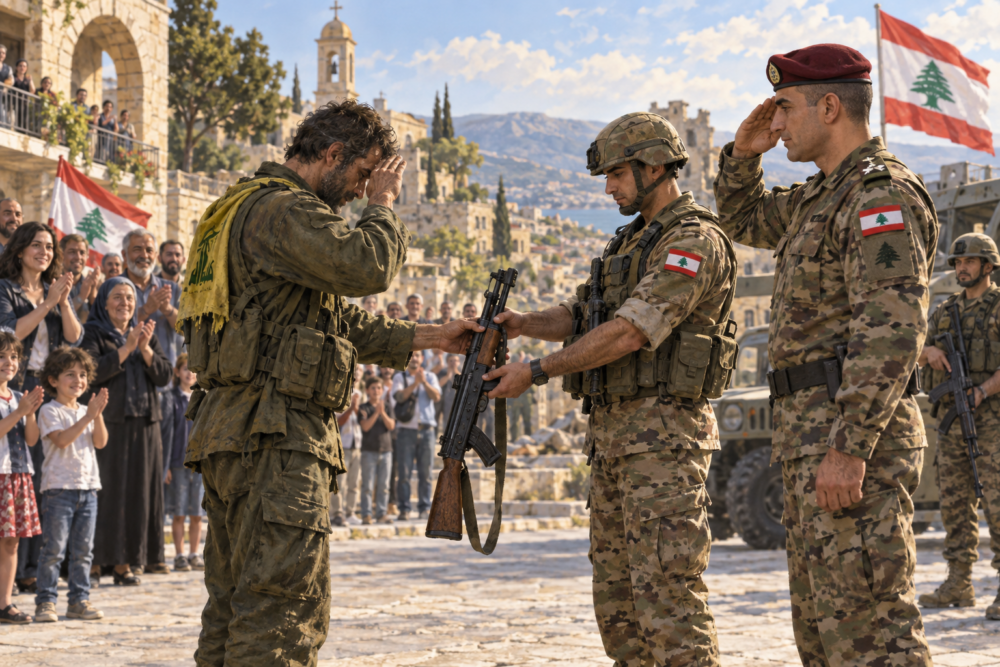
Photo Illustration – A Hezbollah fighter hands his weapon to the Lebanese Army as residents applaud—a dignified step toward one army, one state and a future free from wars Lebanon did not choose.
Hezbollah dragged Lebanon into a war it did not choose, then blamed others for the consequences. It can still choose a different path: hand its weapons to the Lebanese Army and put Lebanon first.
On March 2, Hezbollah attacked Israel after the U.S. and Israeli strikes on Iran and the killing of Iran’s supreme leader. Hezbollah said it was retaliating for his death and defending Lebanon. But the Lebanese government had authorized no war. Israel responded with devastating attacks, and its forces now occupy territory in southern Lebanon. Lebanese families have paid the price for a decision they never made.
That same day, Prime Minister Nawaf Salam’s cabinet banned Hezbollah’s military and security activities and demanded that it surrender its weapons. The government asserted a principle essential to any sovereign state: the decision to wage war belongs to Lebanon’s legitimate institutions, not to an armed party answering to its own command.
Hezbollah responded by portraying itself as the victim. It wants the government to drive Israel out, yet it opposes the direct negotiations through which Beirut is trying to recover occupied territory. Having helped create the crisis, Hezbollah now attacks the people working to resolve it.
Israel must withdraw from Lebanese land. Its attacks on civilians must end. But how does another Hezbollah war bring either outcome closer? Lebanon needs diplomacy backed by a capable Lebanese Army, a verifiable Israeli withdrawal and international support. An armed group operating outside state control weakens Lebanon’s position at the negotiating table.
Hezbollah also tried to undermine Salam’s government. Parliament answered on September 16 by renewing its confidence in the cabinet: 68 MPs voted in favor, 12 against and two abstained. Hezbollah’s MPs walked out before the vote. Even MPs from the Amal Movement, Hezbollah’s longtime political ally, voted for the government.
Amal’s vote does not mean its alliance with Hezbollah has ended. It does show that Hezbollah cannot speak for all of Lebanon’s Shiites or dictate the position of their other political representatives. Its leaders should reflect on what it means when their closest ally will not join them in voting against the government.
Reports from Nmeiriyeh, Arab Salim and Bissariyeh suggest that residents, including local Amal supporters, have resisted efforts to turn homes into Hezbollah military positions. The details of those confrontations remain disputed. But the welcome for the Lebanese Army in Nabatieh was plain to see: residents greeted its patrols with red roses.
Those roses carried a message Hezbollah should hear. Many Shiite Lebanese want their neighborhoods protected by Lebanon’s army. They do not want their homes turned into military positions or their families exposed to another war launched without their consent. No party can claim to defend a community while dismissing the fears of the people who live in it.
Hezbollah has suffered severe military losses. The parliamentary vote and the response to the army in Nabatieh also show the limits of its political claim to lead Lebanon wherever it chooses. Yet its leaders still have a dignified way forward: declare their allegiance to Lebanon in deeds, hand over their weapons to the Lebanese Army and continue their work as a political party within the law.
Lebanon’s Shiites deserve security, representation and a future free from war. So do all Lebanese. The path begins with one government making the decisions of war and peace, and one army defending the country under one flag.
