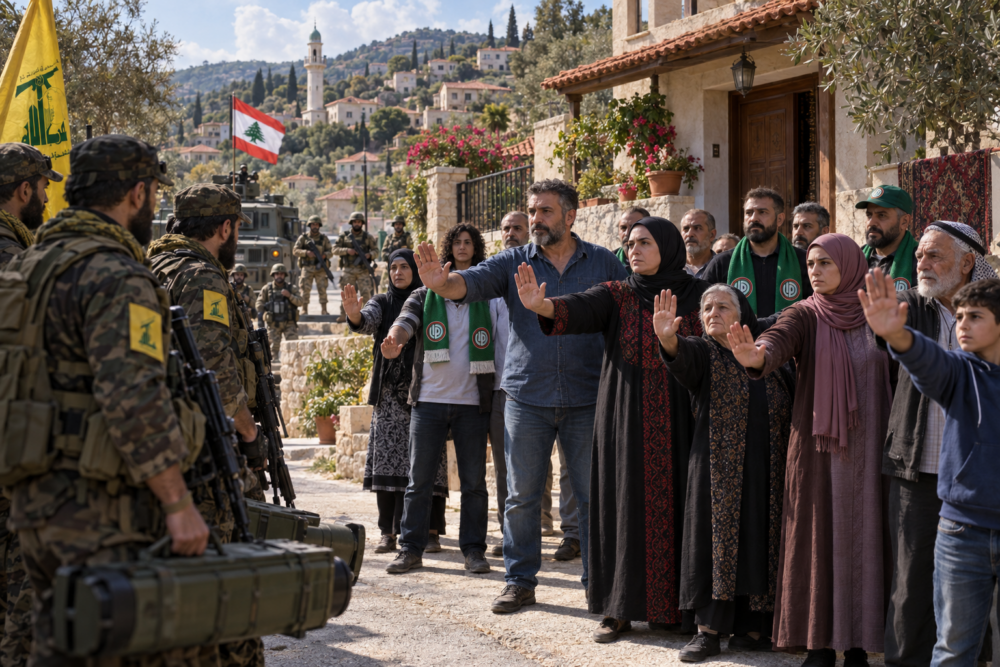
Photo illustration – Amal supporters stand with residents who refuse to let Hezbollah turn their homes into military positions—and their families into human shields.
Reports from Nmeiriyeh, Arab Salim and Bissariyeh suggest that local Amal supporters are standing with residents who refuse to let Hezbollah turn their homes into military positions.
By: Ya Libnan Editorial Board, Opinion
The supposedly unbreakable alliance between Hezbollah and the Amal Movement may be developing cracks—not yet among the leaders who appear together before the cameras, but among the people living in the villages of southern Lebanon.
Recent reports from Nmeiriyeh in the Nabatieh district indicate that armed Hezbollah members from outside the village attempted to establish a position inside one of its houses. Residents objected, and local supporters of the Amal Movement reportedly stood with them. Together, they compelled the armed men to leave.
The details have not been independently confirmed by the Lebanese Army or other official institutions. Predictably, neither Hezbollah nor Amal’s national leadership has publicly acknowledged a confrontation.
But Nmeiriyeh is not an isolated story.
In Arab Salim, reports claimed that Hezbollah attempted to move fighters and military equipment into residential houses, provoking opposition from residents associated with Amal and an exchange of gunfire. In Bissariyeh, another confrontation was reportedly triggered by objections to Hezbollah placing rockets or military equipment among civilian homes.
Officials subsequently denied political or military dimensions to some of these incidents, describing them as individual or family disputes. Such denials must be reported—but they should not automatically be treated as the final word.
Political organizations rarely volunteer evidence of internal division, particularly when their power depends upon presenting a united front. Hezbollah and Amal have an enormous interest in preserving the public appearance of an inseparable “Shiite duo.” Acknowledging that Amal supporters are resisting Hezbollah inside Shiite villages would expose a dangerous truth: Hezbollah’s weapons may no longer enjoy unquestioned acceptance among the people expected to bear their consequences.
The cracks are appearing from below
No one should expect Nabih Berri and Hezbollah’s leadership to announce the collapse of their alliance. The two parties share parliamentary influence, municipal power and an electoral arrangement that allows them to claim collective representation of Lebanon’s Shiites.
But political alliances do not always begin to collapse from the top. They can erode from the bottom.
A local Amal supporter whose family faces the possibility of losing its home does not experience Hezbollah’s military strategy as an abstract political issue. When armed men move equipment into his neighborhood, his house may become an Israeli target. His children—not the politicians in Beirut—will be sleeping nearby.
This creates a fundamental conflict between the interests of Amal’s constituency and Hezbollah’s military agenda.
Amal supporters may continue respecting their movement and identifying with the resistance against Israel while simultaneously refusing to let Hezbollah use their villages as military platforms. That distinction is extremely important. It means disagreement over Hezbollah’s weapons is no longer confined to Hezbollah’s traditional political opponents. It is beginning to emerge within the Shiite community and among supporters of Hezbollah’s closest ally.
That is the crack both parties are desperate to conceal.
Shiites have paid the heaviest price
Lebanon as a whole has suffered terribly from Hezbollah’s decision to enter wars without the authorization of the Lebanese government. But the heaviest human and material burden has fallen upon Shiites in southern Lebanon, the Bekaa Valley and Beirut’s southern suburbs.
They have lost family members, homes, businesses, farms and entire neighborhoods. Hundreds of thousands have endured displacement. Children have lost years of education. Families that rebuilt after earlier wars have watched their homes destroyed once again.
These people were never consulted before Hezbollah opened its latest front in support of Iran. Yet they were expected to absorb the retaliation, defend Hezbollah’s decisions and remain silent about the presence of weapons among their homes.
That is not resistance. It is the exploitation of a community.
Hezbollah claims to protect Lebanon’s Shiites, but no organization can legitimately claim to protect people while denying them the right to protect their own families. A weapon positioned inside a residential neighborhood does not merely threaten Israel. It exposes every nearby civilian to surveillance, evacuation, bombardment and death.
Lebanon’s Shiites are not expendable. Their villages are not military barracks, and their homes are not shields for weapons that the Lebanese state neither controls nor authorizes.
Residents have the right to say no
Every resident of the South has the right to refuse the placement of weapons, fighters, launchers, communications equipment or military installations inside or near civilian homes.
Exercising that right is not treason. It is not collaboration with Israel, nor is it hostility toward the Shiite community. It is self-preservation.
Residents should resist such efforts peacefully and collectively. They should immediately notify the Lebanese Army, their municipalities and the appropriate state authorities. Municipal councils should declare clearly that no armed organization may establish positions inside residential neighborhoods without the authority of the Lebanese state.
The Lebanese Army, in turn, has a duty to protect residents who object. No individual family should be left alone to confront an armed organization. The state must ensure that citizens can refuse the militarization of their property without facing intimidation or retaliation.
This is precisely why Hezbollah’s weapons cannot remain outside state authority. A private organization possessing its own army can pressure residents in ways no ordinary political party can. Citizens cannot exercise genuine consent when the other party arrives armed.
Amal must choose whom it represents
The reports of Amal supporters standing with residents are politically significant. They suggest that some members of the movement understand the danger and are choosing to protect their villages.
Their position deserves recognition.
But local supporters cannot carry this responsibility alone. Amal’s leadership must decide whether its first loyalty is to the safety of Lebanon’s Shiites or to preserving Hezbollah’s armed status.
Nabih Berri cannot indefinitely claim to represent the South while overlooking actions that turn its villages into targets. Amal was founded as a movement for the deprived, not as political cover for an Iranian-backed military organization operating independently of Lebanon.
If Amal supporters in Nmeiriyeh, Arab Salim and Bissariyeh are standing with residents against the militarization of their neighborhoods, the movement’s leadership should stand with them—not silence them, disown them or conceal their objections beneath politically convenient denials.
The future of Amal may depend upon that choice.
A quiet revolt could spread rapidly
These incidents do not yet prove that the Shiite duo is collapsing. Hezbollah retains substantial political, religious and organizational influence, while many Shiites continue to support the principle of resistance against Israel.
But resistance to Israel does not require surrendering one’s home to Hezbollah.
That is where Hezbollah may have badly misjudged its own constituency. Shiites can support the defense of Lebanon while rejecting Iran’s right to decide when Lebanon goes to war. They can oppose Israeli occupation while insisting that only the Lebanese Army carry weapons. They can honor those who died defending their land while refusing to sacrifice another generation for a regional strategy devised in Tehran.
If one village successfully prevents Hezbollah from establishing a military position, residents of another village may find the courage to do the same. What begins as isolated local resistance can spread rapidly once people discover that they are not alone.
That is why these reported confrontations matter—and why the Shiite duo is so anxious to deny their political meaning.
The most serious challenge to Hezbollah may not come from Washington, Israel or Hezbollah’s traditional Lebanese opponents. It may come from within the community that has sacrificed the most for its wars.
Hezbollah may possess weapons, but it does not own the South. It does not own Shiite homes, Shiite villages or Shiite lives.
Lebanon’s Shiites have the right to say:
Do not place your weapons inside our homes. Do not turn our families into human shields. Do not drag our villages into another war.
And when they say it, Amal should stand with them—and so should the Lebanese Army, the Lebanese government and every citizen who believes that Lebanon belongs to its people.
Peace may begin when ordinary people finally say: “Our homes are for our families, not for weapons.”
