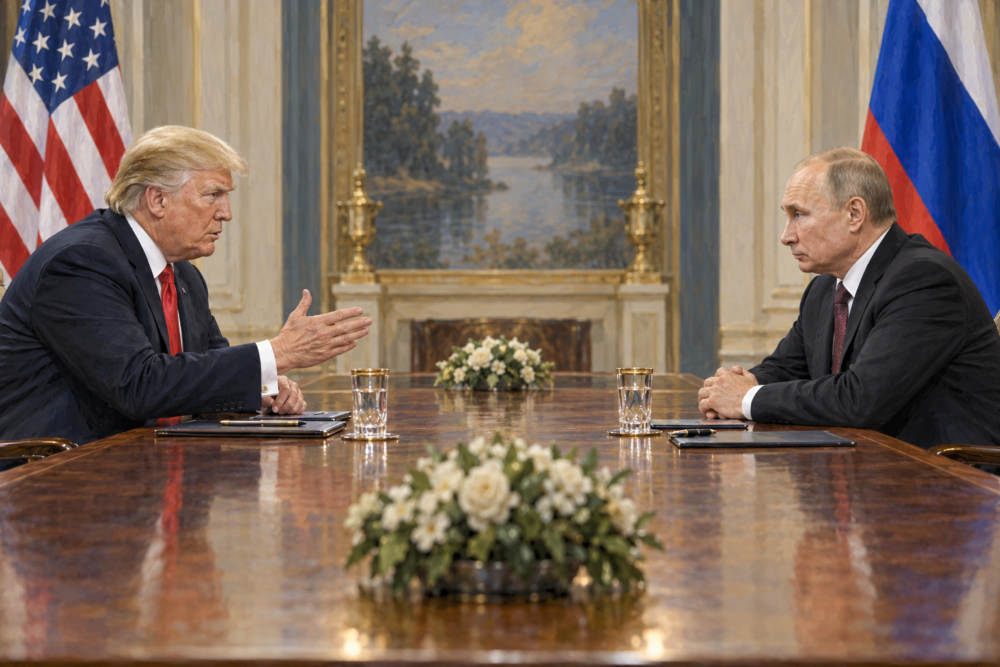
Photo illustration – Trump should judge Putin by his actions—not his words—and demand verifiable steps toward peace.
Putin suppresses challengers at home, continues bombing Ukraine and reportedly assists Iran against American interests. Washington should judge him by his actions—not reward him with prestige.
By: Vlad Green, Opinion
Vladimir Putin apparently cannot tolerate even the mildest political opposition.
With fewer than seven days remaining before Russia’s September 18–20 parliamentary elections, the Kremlin is refining its methods of removing candidates it considers undesirable. At least 36 candidates have reportedly been disqualified by electoral authorities, according to an investigation by the independent Russian media outlet Verstka.
In Putin’s Russia, the threshold for being labeled an extremist or a threat to the state can be extraordinarily low.
One candidate reportedly encountered trouble after posting a photograph of artwork by the British artist Banksy. A social-media message honoring Lemmy Kilmister, founder of the celebrated rock group Motörhead, was reportedly enough to attract the attention of Russian authorities.
These are hardly acts of insurrection. But in today’s Russia, apparently even art, music and independent political activity can be interpreted as challenges to the Kremlin.
Putin is especially vulnerable because Russians are showing signs of exhaustion. His popularity and that of the ruling United Russia party have reportedly been affected by restrictions on internet access, fuel shortages, Ukrainian strikes inside Russia and growing fatigue with a war that has continued far longer than the Kremlin anticipated.
Russia’s invasion was supposed to demonstrate Russian power and produce a rapid victory. Instead, more than four years later, the war continues to consume lives, weapons and national resources.
Putin’s response is not to reconsider the war or permit Russians to debate its consequences freely. It is to eliminate challengers before voters can consider them.
An invitation Zelensky cannot possibly trust
Putin claims to be interested in peace, but his approach to meeting Ukrainian President Volodymyr Zelensky raises serious doubts.
Zelensky has expressed willingness to meet Putin in a neutral international setting, including at the G20 summit in Miami. The Kremlin rejected that possibility and reportedly continued to insist that any face-to-face meeting take place in Moscow.
How could Putin seriously expect Zelensky to accept such an invitation?
Zelensky is almost certainly one of Putin’s most important political and military adversaries. Russia invaded his country, tried to remove his government and continues attacking Ukrainian cities with missiles and drones.
Putin’s treatment of opponents is also well known. His government imprisons critics, excludes candidates, suppresses independent media and treats peaceful dissent as a threat to the state.
Under those circumstances, no reasonable Ukrainian leader could be expected to place his safety entirely in the Kremlin’s hands. Moscow may promise Zelensky protection, but credible diplomacy cannot depend solely upon assurances from the government waging the war against him.
A genuine peace summit should be held in a mutually acceptable neutral country with internationally guaranteed security. Putin’s refusal to meet under such conditions suggests that he may be more interested in humiliating Zelensky than negotiating with him as the president of a sovereign nation.
Iran helped Putin prolong the war
Putin has not sustained his war against Ukraine alone.
Iran supplied Russia with Shahed attack drones and assisted the weapons infrastructure that allowed Moscow to conduct repeated long-range attacks against Ukrainian cities.
These relatively inexpensive drones gave Russia an effective way to terrorize civilians, damage infrastructure and exhaust Ukraine’s limited supply of costly air-defense interceptors. Russia subsequently expanded domestic production of Iranian-designed drones and has launched thousands of them against Ukraine.
Iranian assistance did not deliver Putin the quick victory he wanted, but it helped him prolong the war.
That support also revealed the emergence of a broader strategic partnership. Moscow and Tehran discovered that each could help the other challenge the United States and its allies while imposing enormous costs on civilian populations.
Now, during Iran’s war with the United States and Israel, the assistance appears to be flowing in the opposite direction.
Is Putin helping Iran attack American interests?
American and Ukrainian intelligence assessments have accused Russia of providing Iran with targeting information, satellite imagery, signals and electronic intelligence, cyber assistance and improved drone-navigation technology.
Some details have not been independently established in public, and Moscow has denied portions of the reporting. But the evidence and intelligence assessments are serious enough that Washington cannot simply dismiss them.
American officials reportedly concluded that Russia provided Iran with information that could help it locate and attack U.S. forces and facilities in the Middle East. Western intelligence services have also investigated whether Russian technology or targeting assistance contributed to the accuracy of Iranian attacks against sensitive American sites.
The emerging pattern is alarming.
Iran helped Russia attack Ukraine. Russia is now accused of helping Iran attack American and allied interests.
This is no longer merely a commercial exchange of weapons. It is increasingly an authoritarian partnership in which two governments provide each other with military technology, intelligence and operational assistance to sustain their respective wars.
Putin therefore cannot be viewed only as the leader of a country at war with Ukraine. If the intelligence reports are accurate, he is also assisting a regime engaged in direct conflict with the United States and Israel.
Why does Trump still treat Putin like a peacemaker?
Despite this record, President Trump continues to speak about Putin with extraordinary respect.
Trump has described conversations with the Russian leader as “great” and repeatedly suggested that Putin wants to reach an agreement. He has often treated the conflict as if it were largely the product of personal animosity between Putin and Zelensky.
But the problem is not simply that two men dislike each other.
Russia invaded Ukraine. Putin is demanding territory his military has not been able to capture fully. His government is excluding opposition candidates at home while continuing its attacks abroad. Moscow is also accused of helping Iran target American interests.
Putin should not receive the honors and prestige of a peacemaker merely because he agrees to speak with American representatives.
Diplomacy requires communication, including communication with adversaries. It does not require flattery, ceremonial elevation or acceptance of an aggressor’s version of events.
The time has come for Trump to downsize Putin politically.
That means fewer honors, less public praise and no prestigious summit unless Russia offers measurable concessions. It means refusing to legitimize Moscow as the only acceptable venue for negotiations. It also means rejecting any proposed settlement that merely transfers Putin’s demands from the Kremlin to Kyiv.
Most importantly, it means judging Putin by what he does rather than by what he tells Trump or his envoys.
Is Putin prepared to accept a neutral meeting place?
Is he prepared to negotiate directly with Zelensky as the legitimate president of Ukraine?
Will he accept an enforceable ceasefire?
Will Russia stop attacking Ukrainian civilians and infrastructure?
Will Moscow stop providing military or intelligence assistance that helps Iran threaten American forces?
Unless Putin provides credible answers backed by verifiable action, Washington should stop presenting him as a potential peacemaker.
Russia deserves the opportunity for new leadership
Russia is a great country with a rich history, an educated population and enormous human and natural resources. It should not remain trapped indefinitely in one man’s war.
Putin has dominated Russia for more than a quarter of a century. During that period, political competition has been steadily weakened, independent media suppressed and presidential power increasingly concentrated around one leader and his security establishment.
Russia’s future should be determined by Russians through genuine political competition—not by eliminating candidates before an election and criminalizing harmless expressions of dissent.
The time for new leadership in Russia has arrived. That decision ultimately belongs to the Russian people, but they cannot make it freely while credible opponents are excluded, imprisoned, exiled or intimidated.
If Putin cannot tolerate a Banksy photograph, a tribute to a rock musician or an independent parliamentary candidate, why should Washington believe he will voluntarily tolerate a sovereign, democratic and independent Ukraine?
And if he continues helping Iran while Iran is fighting the United States and Israel, why should an American president continue treating him with such deference?
Putin does not need more praise from Washington.
He needs firm limits, serious scrutiny and consequences for his actions.
