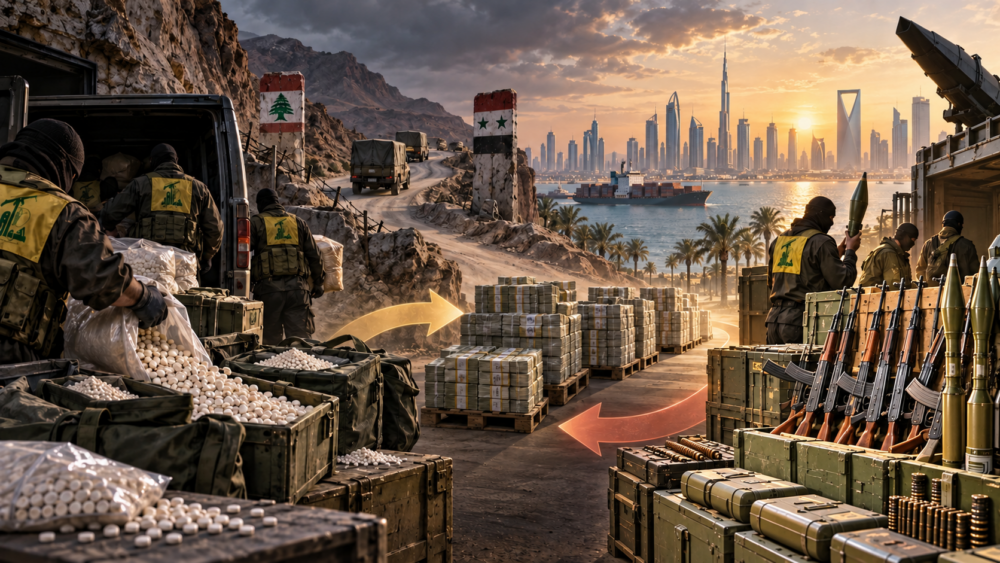
Photo illustration – Captagon flows toward the Arab Gulf, while the profits flow back to finance Hezbollah’s weapons and wars.
Nearly 450,000 Captagon pills have reportedly been seized in recent Syrian operations. The shipments have not yet been publicly tied to Hezbollah—but the group’s history, financial desperation and access to established smuggling routes demand an urgent regional investigation.
By : Ya Libnan Editorial Board, Opinion
Syrian authorities have intercepted several major narcotics shipments since the beginning of September, raising an urgent question for Lebanon, Syria and the Arab Gulf states: Is Hezbollah rebuilding the Captagon networks that once flourished under Bashar al-Assad?
According to reports citing Syria’s official SANA news agency, Syrian Arab Army border guards seized approximately 32 kilograms of hashish and 194,000 Captagon pills during separate operations along the Syrian-Lebanese border. Several smugglers were arrested and referred to the appropriate authorities.
In another operation in Al-Nabk, Syria’s Drug Enforcement Department confiscated 206,000 Captagon pills together with weapons and explosives. Two suspects were arrested. Syrian authorities also announced the seizure of another 50,000 pills from two alleged traffickers in Homs.
Together, these recent operations account for approximately 450,000 Captagon pills—and that represents only what Syrian authorities managed to intercept.
How many other shipments crossed the border undetected?
Where were the pills manufactured? Where were they going? Who supplied the weapons and explosives discovered with one of the shipments? Most importantly, who was supposed to collect the profits?
Syrian authorities have not publicly established that Hezbollah controlled these particular shipments. That distinction must be stated clearly. Suspicion is not proof, and the identities and organizational connections of the arrested smugglers have not been fully disclosed.
But the possibility of Hezbollah involvement cannot responsibly be ignored.
The Gulf has paid the heaviest price
For years, Saudi Arabia and other Gulf countries have been the principal and most profitable destinations for Captagon produced in Syria and Lebanon.
Pills manufactured for very little money could be sold for many times their production cost in Gulf markets. The enormous difference created billions of dollars in potential revenue for manufacturers, smugglers, corrupt officials and armed organizations.
The Gulf states paid for this criminal enterprise twice: first through the social destruction caused by narcotics and then through the regional aggression financed by illicit money.
Captagon damaged young lives, burdened families and law-enforcement agencies and threatened the security of entire societies. At the same time, the proceeds allegedly helped enrich the Assad regime and sustain networks connected to Hezbollah and other Iranian-backed forces.
Under Assad, Syria became the world’s leading center for the industrial-scale production of Captagon. The former regime—particularly networks associated with Maher al-Assad’s Fourth Division—was repeatedly accused of protecting factories and facilitating international trafficking.
Hezbollah’s presence on both sides of the Lebanese-Syrian border made it an alleged partner, protector or facilitator within parts of that enormous enterprise. Hezbollah has consistently denied involvement, but Western and Arab governments, sanctions authorities and independent investigations have linked party-affiliated individuals and Hezbollah-controlled territory to drug production and smuggling networks.
The fall of Assad destroyed an essential pillar of the old Captagon empire. It did not necessarily destroy the laboratories, expertise, customers, smugglers or border routes on which that empire depended.
Hezbollah desperately needs money
Hezbollah today has an additional motive to revive those networks: financial desperation.
Its war with Israel has cost it fighters, weapons, command centers and vital military infrastructure. Iran faces its own war, sanctions and severe economic pressures. Financing that once flowed more freely from Tehran has become more difficult and dangerous to move.
Hezbollah still needs enormous sums to pay fighters, acquire weapons, rebuild damaged positions, support its political machinery and maintain control over the communities upon which its power depends.
When conventional financing is disrupted, narcotics trafficking, smuggling and money laundering become tempting alternatives.
This does not prove that Hezbollah owns the drugs seized in September. But its urgent need for money, its history of operating around established smuggling corridors and the continued movement of Captagon across the Lebanese-Syrian frontier provide more than enough reason for an investigation.
The discovery of weapons and explosives alongside one of the shipments should make that investigation even more urgent. Ordinary drug traffickers may carry weapons, but such a combination also raises questions about whether narcotics and military contraband are moving through overlapping networks.
Captagon was also an instrument of pressure
The Captagon trade should not be viewed only as organized crime. Under the former Syrian regime, it also became an instrument of regional pressure.
Assad was accused of allowing—or directing—an enormous narcotics industry whose primary foreign victims were in the Arab Gulf. The regime later attempted to use cooperation against Captagon as a bargaining chip in its efforts to restore relations with Arab governments.
In effect, the same regime associated with creating the crisis sought political rewards for offering to control it.
Iran and its proxies have targeted the Gulf states for decades through missiles, drones, armed militias, sabotage and political destabilization. It is therefore reasonable to ask whether narcotics trafficking has also served the broader strategic interests of this network by harming Arab societies while financing the organizations aligned against them.
That possibility must be investigated—not dismissed merely because the captured shipment did not carry Hezbollah’s name.
The Gulf states must act now
Saudi Arabia, the United Arab Emirates and their Gulf partners should not wait for millions more pills to arrive before responding.
They should establish an intelligence task force with the governments of Syria and Lebanon to identify the laboratories, financiers, border facilitators and political protectors behind every shipment. The arrested suspects should be thoroughly questioned, and the findings—particularly any organizational affiliations—should be shared with affected Arab governments.
Investigators should follow the money. Drug shipments do not reveal their true owners merely through the people transporting them. Authorities must examine telephone records, financial transfers, property ownership, chemical suppliers, pill-manufacturing equipment and connections to armed networks on both sides of the border.
Lebanon also has a major responsibility. Hezbollah-dominated areas and border routes cannot remain beyond effective state control. The Lebanese Army and security agencies must be empowered to close illegal crossings, raid suspected laboratories and arrest traffickers regardless of their political protection.
Every Captagon shipment originating in or passing through Lebanon threatens the country’s restored commercial relations with the Gulf. Lebanon’s farmers, manufacturers and legitimate exporters must not again be punished because armed organizations and criminal networks use Lebanese territory to poison Arab markets.
The pills seized by Syrian authorities are the pills that were caught. No one knows how many passed through—or how many are already on their way.
Hezbollah must not be allowed to replace lost Iranian financing by poisoning the Arab world.
If evidence establishes that it has returned to the Captagon business to finance its war, then dismantling its narcotics network must be treated as an inseparable part of dismantling its illegal military and financial power.
The Gulf states have been warned. Now they must discover who is behind these shipments before the next ones reach their cities.
