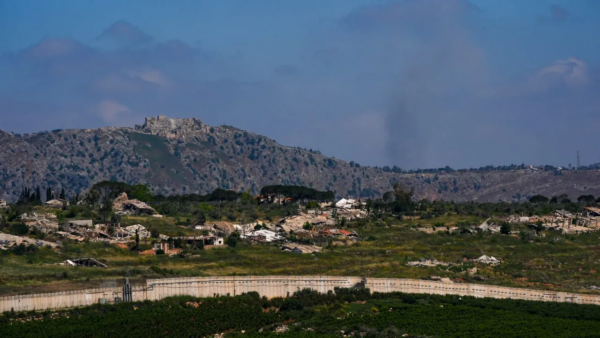
View of the Beaufort Castle and destroyed houses at a village in southern Lebanon, as it seen from the Israeli side of the border, May 31, 2026.
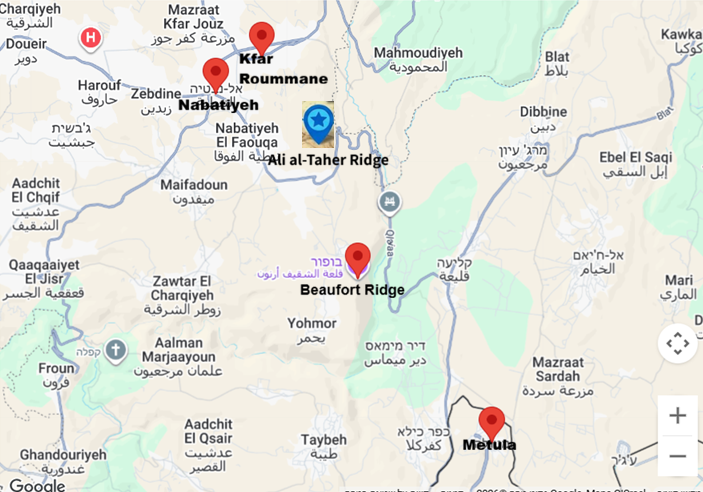
Israeli Prime Minister Benjamin Netanyahu declared on Thursday that the Israeli army has cleared the Ali al- Taher ridge in southern Lebanon, which he said Hezbollah with help and funding by Iran had developed as an extension of the Beaufort (al-Shakif) position.
According to Netanyahu, the ridge was used to threaten the northern Israeli settlements of Kiryat Shmona and Metula and was positioned as part of Hezbollah’s plans to potentially invade the Galilee.
“We instructed the IDF (Israeli army) to clear it. I congratulate the Chief of Staff, the Northern Command commander and our heroic soldiers. They did a tremendous job there,” Netanyahu said.
He said Israeli forces seized weapons and computers from the position and eliminated numerous Hezbollah fighters during the operation.
“Today we can say it: the Ali Taher ridge no longer threatens us,” Netanyahu declared
his comments come after the IDF announced on Thursday that it had completed the clearance of two Hezbollah underground infrastructures on the Ali al-Taher ridge in southern Lebanon and that forces are now working to neutralize them.
According to the military, the infrastructures were built over a period of about two decades and were planned and funded by Iran.
Forces from the IDF’s 36th Division have operated in the area in recent weeks and, according to the military, achieved operational control of the ridge both above and below ground. During the operation, the area was cleared of Hezbollah operatives who had been stationed there, with some killed and others fleeing.
Inside the underground infrastructure, the forces found command rooms, weapons storage rooms, generators, living quarters, showers, and a kitchen. The IDF said the complex allowed Hezbollah operatives to remain underground for extended periods and conduct combat operations from there.
According to the military, terrorist attack plans against Israel and IDF forces were carried out from the tunnels. Following operations conducted there in recent weeks, the ability to carry out additional attacks from the sites was neutralized. The forces’ efforts to neutralize the tunnels are ongoing, and once completed, the IDF will redeploy for defensive operations in accordance with its assessment of the situation.
The military emphasized that operations in southern Lebanon are continuing and that the IDF remains committed to the ceasefire agreement in Lebanon.
The capture of the Ali al-Taher ridge, with its peak being the Beaufort Castle, was a complex operation that lasted several months, according to Jerusalem Post
In the first stage, engineering forces mapped the upper section of the ridge and destroyed tunnels, shuttered openings aimed at Israeli communities and the border, weapons depots, long-term living quarters, command rooms, and operating rooms.
Too late for Iran action
The interesting part is that Netanyahu’s declaration comes after Iran warned the United States that it would respond forcefully to any Israeli offensive on the Ali al-Taher ridge in southern Lebanon where Iranian military personnel are holed up alongside Hezbollah fighters, three officials briefed on the message told Reuters.
The Ali al-Taher ridge in southern Lebanon, which is named after a Shi’ite Muslim scholar whose shrine sits at its summit, has become one of the most contested pieces of ground in the Israel-Hezbollah war.
The cluster of hills is not especially large. But what it overlooks in southern Lebanon — and what Hezbollah is suspected to have built beneath it — thrust it to the centre of the fight between Israel and the Iran-backed militia
Located about 15 km (10 miles) from the Israeli border, the Ali al-Taher ridge has a commanding view of a broad sweep of southeastern Lebanon. Israel held it during a 22-year occupation of south Lebanon that ended in 2000.
After the current war erupted on March 2, Israeli troops pushed deep into southern Lebanon and seized key hilltops, including the historic Beaufort Castle on the route to Ali al-Taher.
In June, Israel’s military described the ridge as one of its “primary operational focuses,” and included it in a map of an expanded, self-declared buffer zone where its troops are operating.
The ridge has effectively become a dividing point between a swathe of Lebanese territory occupied by Israeli troops to the south, and towns to the north that Israel’s air force has bombed heavily, including Nabatieh.
WHY IS IT STRATEGIC?
Hezbollah is believed to have built an underground command centre and weapons stores within the ridge itself, Lebanese security sources told Reuters in July. At 600 metres above sea level, it granted Hezbollah an advantage in launching short-range missiles and drones towards northern Israel, according to analysts.
Ali al-Taher also connects border areas in southern Lebanon to the hilly Iqlim al-Tuffah region further north, which has long served as a key logistical and operational base for Hezbollah, the Lebanese security sources said.
In June, an Israeli military official, speaking on the condition of anonymity, told Reuters that Hezbollah fighters were stuck underground without food or water. The Times of Israel, citing a military probe, said on June 20 that one Israeli soldier was killed and 13 wounded during operations to capture a major underground Hezbollah facility beneath the ridge.
Hezbollah has said that Israel has sought to advance but that its fighters still had “full control over the area and are at complete readiness to confront any attempt by the enemy forces to advance or infiltrate.”
In July, the Israeli military said it would “not allow Hezbollah terrorists to emerge from the underground terrorist infrastructure and operate in the area or pose a threat” to Israeli soldiers.
WHAT IS THE POLITICAL SIGNIFICANCE?
Ali al-Taher lies near Zawtar Al Gharbiyeh, a town from which Israeli troops withdrew in July as part of a U.S.-brokered roadmap that would see Israeli troops gradually withdraw from southern Lebanon as Lebanese troops disarm Hezbollah.
But with Hezbollah refusing to give up its weapons — and Israel saying it won’t withdraw until the group disarms — that plan has ground to a halt.
As Israeli elections planned for October draw closer, capturing Ali al-Taher could be an attractive prize for Israeli Prime Minister Benjamin Netanyahu’s government.
The big question right now is : “When will Iran tell Hezbollah to hand over its arms to the Lebanese Army”,? Ali Hussei a Lebanese analyst was quoted as saying , adding , “Ali Al Taher was a huge deal for Hezbollah chief Naim Qasse, where is he hiding now and when will he escape to Iran “
REUTERS/ YL
