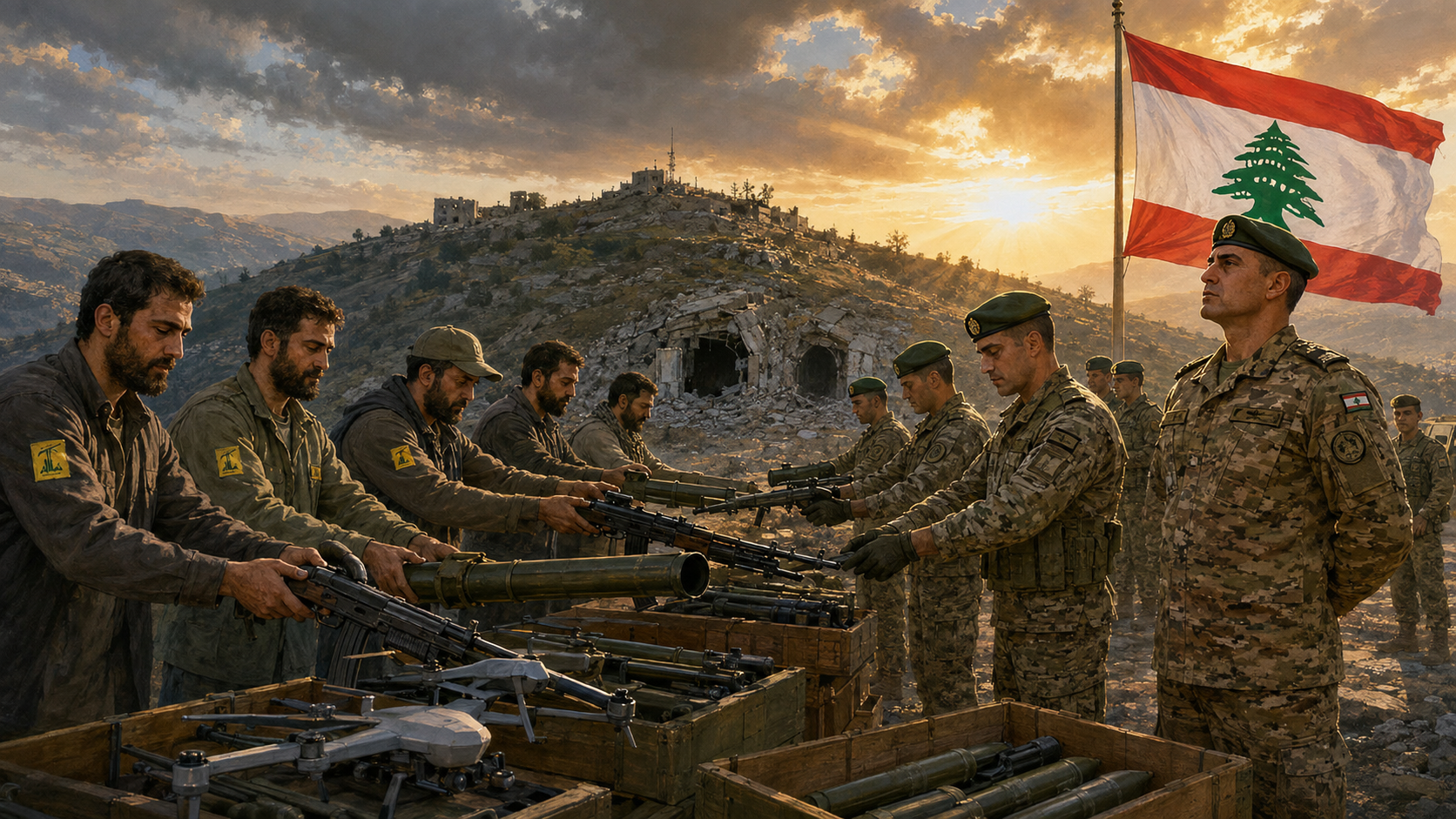
Photo illustration – After Ali al-Taher, the choice is clear: Hezbollah must hand over its weapons so that one Lebanese Army, under one flag, can defend one sovereign Lebanon.
The destruction of Hezbollah’s strategic stronghold exposes the failure of Iran’s “resistance” project. Lebanon cannot recover its occupied territory while an armed organization continues to make war independently of the state.
By : Ya Libnan Editorial Board, Opinion
Israeli Prime Minister Benjamin Netanyahu announced Thursday that the Israeli army had cleared the Ali al-Taher ridge in southern Lebanon—a strategic position that Hezbollah, with Iranian funding and assistance, had reportedly developed as an extension of the historic Beaufort, or al-Shakif, position.
According to Netanyahu and the Israeli military, Hezbollah had constructed an extensive underground complex beneath the ridge. It reportedly contained weapons depots, command centers, operational rooms, long-term living quarters and tunnel openings directed toward Israeli communities and military positions.
Israeli engineering units spent months mapping and destroying this infrastructure. The Israeli military says its work to neutralize the remaining tunnels is continuing and that its forces will eventually redeploy to defensive positions based on its assessment of the situation.
These are Israeli claims and should be identified as such. But the strategic importance of Ali al-Taher is not merely an Israeli invention.
Lebanese security sources previously told Reuters that Hezbollah had built an underground command center and weapons stores inside the ridge. Rising approximately 600 meters above sea level, Ali al-Taher provided a commanding position from which Hezbollah could launch short-range missiles and drones toward northern Israel. The ridge also connected Hezbollah’s southern positions with its operational infrastructure in the Iqlim al-Tuffah region. Reuters described it as one of the most consequential flashpoints of the war.
But Ali al-Taher is important for another reason: it demonstrates, more clearly than ever, the disastrous consequences of Hezbollah’s refusal to hand its weapons and military installations to the Lebanese Army.
Lebanon has not merely lost a Hezbollah position. It has lost another piece of Lebanese territory to Israeli occupation.
The Lebanese Army could have taken responsibility for the ridge, removed the weapons and underground infrastructure, and denied Israel any justification for advancing into the area. Instead, Hezbollah insisted on controlling it as part of its private military empire. It transformed Lebanese land into an Iranian-funded fortress—and then proved incapable of protecting it.
That is the tragedy of Hezbollah’s so-called resistance.
Hezbollah claims that its weapons defend Lebanon. Yet its independent military decisions repeatedly expose Lebanon to invasion, destruction, displacement and occupation. It starts wars without consulting the government, places military installations beneath Lebanese territory and then expects the Lebanese people to bear the consequences when Israel attacks them.
A resistance that repeatedly loses Lebanese territory is not defending Lebanon.
A resistance that answers to Iran rather than to the Lebanese state is not a national resistance.
And an organization that prevents the Lebanese Army from assuming control of strategic Lebanese territory cannot credibly claim that it is defending Lebanese sovereignty.
The most revealing part of the Ali al-Taher confrontation may be Iran’s direct intervention.
Before Netanyahu announced the ridge had been cleared, Iran reportedly warned the United States that it would respond forcefully to a major Israeli offensive there. Three officials briefed on the message told Reuters that Iranian military personnel were positioned alongside Hezbollah fighters inside the ridge. Two of those officials said more than a dozen members of the Islamic Revolutionary Guard Corps, including at least two senior officers, were present. Hezbollah neither confirmed nor denied their presence, while the Israeli military reportedly assessed that no IRGC personnel remained there. These competing accounts have not been independently verified. Reuters reported that the Iranian warning was delivered through Oman.
But Iran’s warning raises a fundamental question: What were Iranian military personnel allegedly doing inside a fortified complex on Lebanese territory?
Who invited them?
Who authorized their presence?
Certainly not the Lebanese government. Certainly not the Lebanese Parliament. And certainly not the Lebanese people.
If the reports are accurate, Ali al-Taher was not simply a Hezbollah position. It was another outpost of Iran’s Revolutionary Guard established inside Lebanon without the consent of the Lebanese state.
Iran was prepared to threaten regional escalation to protect this position—but it was apparently unwilling or unable to save it. Once again, Tehran encouraged Hezbollah to fight while Lebanon paid the price.
Lebanese analyst Ali Hussein posed the question that should now be asked throughout the country: When will Iran tell Hezbollah to surrender its weapons to the Lebanese Army?
But Lebanon should not have to wait for Iran’s permission.
The Lebanese government must demand the immediate and unconditional transfer of Hezbollah’s military positions, tunnels, weapons depots, missiles and drones to the Lebanese Armed Forces. Hezbollah’s separate military organization must then be permanently dismantled.
The fall of Ali al-Taher should also send a message to Hezbollah Secretary-General Naim Qassem. Where is he now? What did Hezbollah gain by refusing to hand this ridge peacefully to the Lebanese Army? How many more Lebanese villages must be destroyed, and how much more territory must Israel occupy, before he admits that Hezbollah’s military strategy has failed?
The Lebanese Army must now be permitted to deploy throughout the south, including at Ali al-Taher once Israeli forces withdraw. The United States and the international community should insist on a straightforward exchange: verified Lebanese Army control and the dismantling of Hezbollah’s military infrastructure in return for Israel’s complete withdrawal from Lebanese territory.
Israel must not be allowed to turn the destruction of Hezbollah’s position into permanent occupation. But Lebanon will be in a far stronger position to demand Israeli withdrawal when it can guarantee that vacated territory will be controlled exclusively by its national army.
Ali al-Taher should be the last Lebanese mountain sacrificed to Iran’s regional ambitions.
Hezbollah has lost its leaders, much of its arsenal, its freedom of movement and now one of its most important military positions. Continuing along the same path will produce only more destruction and additional Israeli occupation.
The time has come for Hezbollah to stop pretending that its separate army protects Lebanon.
Hand over the weapons. Place every military position under the authority of the Lebanese government.
Lebanon needs one state, one army and one flag.
After Ali al-Taher, there can be no credible excuse for anything less.
