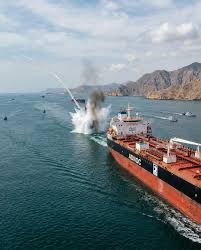
Iranian missile targets UAE oil giant ADNOC vessel in the Strait of Hormuz despite the negotiations with Oman.
Iran targeted a vessel owned by the Abu Dhabi National Oil Company in the Strait of Hormuz on Saturday, despite ongoing talks with Oman over how to manage the disputed waterway.
Iranian Foreign Minister Abbas Araghchi has been saying for days that talks with Oman were “approaching the final stages,” but cautioned that “this is not a sign of the reopening of the Strait of Hormuz.”
The Supreme National Security Council of Iran issued a list of highly unlikely demands from the U.S. in order to fully reopen the Strait of Hormuz, saying the U.S. must never threaten Iran again, end the blockade, withdraw all military assets from the region, lift sanctions, unfreeze assets and compensate Iran for war damages.
U.S. blockade has redirected 53 ships in Strait of Hormuz, military says
The renewed U.S. blockade on the Strait of Hormuz has redirected 53 ships trying to enter or exit Iranian ports, according to U.S. Central Command.
The total is an increase of two ships since yesterday. The blockade was reinstated on July 14 after Iran targeted ships in the strait and a ceasefire between the two sides fell apart. The first blockade had redirected over 140 ships from April 14 to June 18.
Central Command also noted it has let through more than 30 ships carrying humanitarian aid, a number it does not regularly release.
On Saturday, Mohammad Bagher Zolghadr, a member of Iran’s Supreme National Security Council, issued a string of demands for the strait to be reopened to traffic, one of which was for the U.S. to rescind the blockade.
Egypt could join Mecca defense agreement in next phase of deal: Turkish foreign minister
The defense agreement between Turkey, Saudi Arabia and Pakistan may not be done adding countries, according to Turkey’s foreign minister.
Hakan Fidan told Anadolu Agency’s “Editors’ Desk” show on Saturday that Egypt may join the defense pact in the next phase of the deal.
The deal states an attack on any of the three countries will be considered an attack on all three and merit a response — similar to Article 5 of the NATO agreement. Like the other three countries, Egypt is also a majority Sunni Muslim country, unlike Iran. Egypt is one of the most heavily Sunni countries in the region.
Fidan said Turkish President Recep Tayyip Erdoğan’s vision is to widen the pact to other countries in the region, however, it will only be a defensive arrangement, and they have no expansionist ambitions.
While Turkey and Pakistan have not faced strikes during the widening war, both Saudi Arabia and Egypt have come under fire. The Saudis have been attacked by both Iran and the Houthi rebel group, an Iranian proxy, in Yemen.
The port of Damietta on Egypt’s Mediterranean coast was struck in a drone attack on July 29, igniting two oil tankers on fire. No one claimed responsibility for the attack and it’s not clear a drone launched from Iran could even reach that distance, meaning it could have been one of their proxies.
Iranian lawmakers warn Saudi Arabia against new defense pact
Iranian officials warned Saudi Arabia that its new defense pact with Turkey and Pakistan won’t guarantee the country’s security.
In a social media post on Friday, Mahmoud Nabavian, a member of the Iranian Parliament, said: “Saudi rulers must know that just as America’s bases could not bring them security, clinging to America’s lackeys will not bring them security either.”
Another lawmaker, Ebrahim Razaei, echoed the message in a separate post where he argued the defense pact is a “paper agreement” which would not bring security “just as years of one-sided nursing to the Americans did not bring [Turkey and Pakistan] security.”
Negotiations ongoing despite Iranian attack on ship in Strait of Hormuz, Oman says
Despite a missile attack on an oil tanker in the Strait of Hormuz on Saturday, Oman said it is continuing talks with Iran over management of the strait and they are going well.
Oman condemned the strike, but said “the ongoing negotiations regarding arrangements related to navigation in the Strait of Hormuz are proceeding in a positive and constructive atmosphere, and emphasizes the importance of avoiding any actions that could affect these negotiations and the progress achieved, which takes into account the interests of all parties.”
Iran launched a missile strike on a tanker belonging to the state-owned Abu Dhabi National Oil Company while it was transiting the Strait of Hormuz. The ship owner said no one was injured, though a fire was reported and later extinguished.
While Iran has also said the talks are going well, the Iranian Foreign Ministry downplayed their significance and said the U.S. would need to stop its aggression for the Strait of Hormuz to be opened freely to traffic like before the war.
