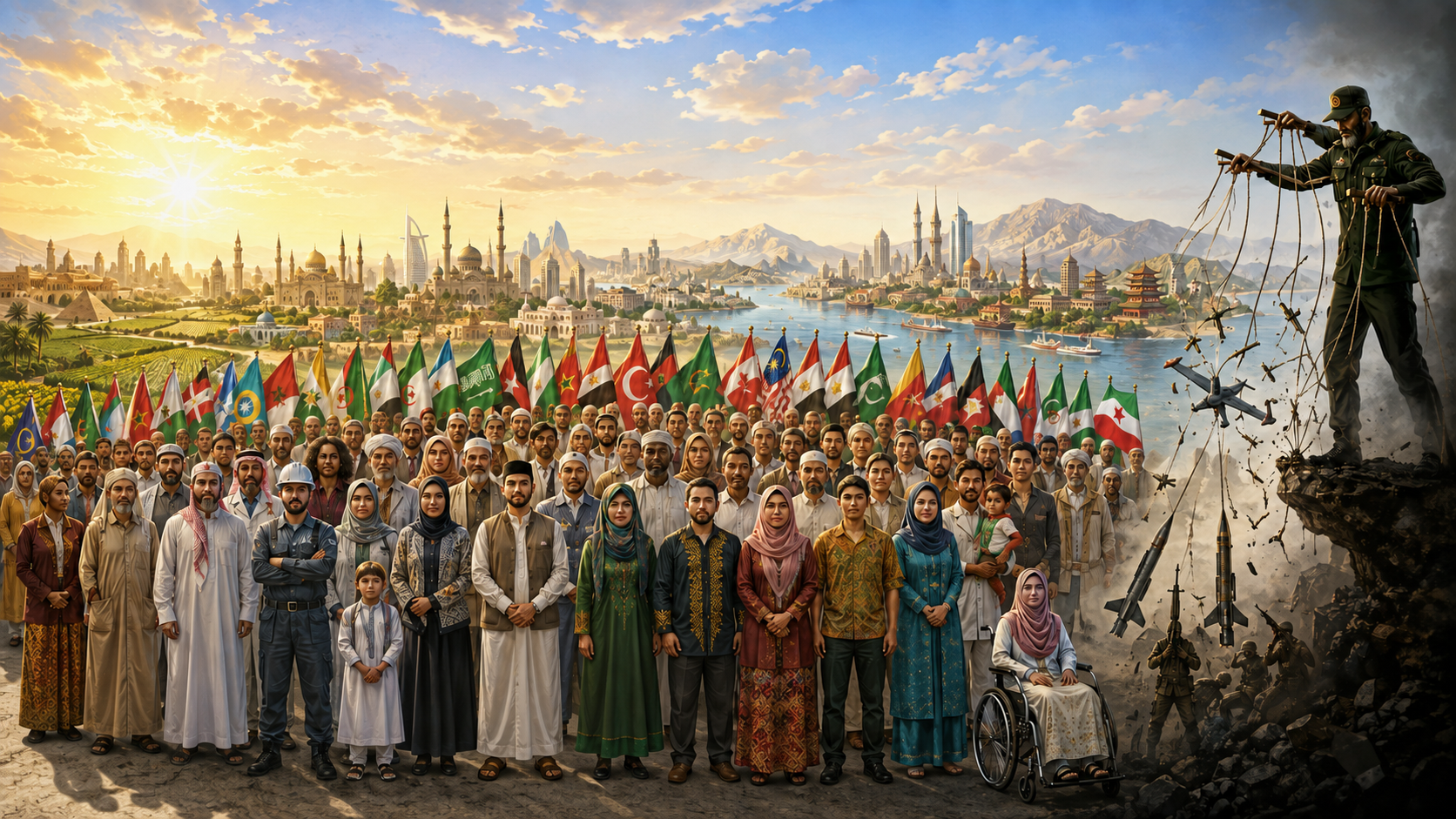
Illustration- The Islamic world is far larger than the Iranian regime. Its future cannot be dictated by the IRGC, and its security must no longer remain hostage to Tehran’s ambitions.
The Mecca defense pact should become the foundation of an inclusive alliance protecting Muslim nations—Sunni and Shiite alike—from the IRGC’s threats, proxies and expansionist agenda.
By: Ya Libnan Editorial Board , Opinion
The Iranian regime is behaving as though it alone has the right to determine how Muslim nations defend themselves, whom they may cooperate with and what role they may play in shaping the future of the Islamic world.
Its angry reaction to the newly formed Mecca Joint Defense Agreement between Saudi Arabia, Turkey and Pakistan exposes that arrogance.
The agreement establishes a collective-defense commitment under which an armed attack against any one of its three members will be considered an attack against all. Turkish Foreign Minister Hakan Fidan described the provision as technically comparable to NATO’s Article 5, while emphasizing that the alliance is defensive and is not directed against Iran or any other particular country.
That explanation did not satisfy Tehran.
Iranian lawmaker Mahmoud Nabavian warned Saudi leaders that American military bases had failed to provide security and claimed that “clinging to America’s lackeys” would fail as well. Another parliamentarian, Ebrahim Razaei, dismissed the alliance as a “paper agreement” that would not protect its members.
Such language is more than a diplomatic objection. It is an attempt to intimidate three sovereign Muslim nations and ridicule their right to defend themselves.
Iran is free to build its defenses and enter alliances of its own. But it has no authority to dictate whether Saudi Arabia, Turkey and Pakistan may cooperate for their mutual security—especially after years of Iranian threats, proxy warfare, missile and drone attacks and disruption of international shipping.
Rather than ridiculing the Mecca pact, Tehran should ask why three major Muslim powers concluded that a collective-defense arrangement had become necessary.
Each member brings considerable strength. Saudi Arabia contributes economic and political influence as well as its strategic position at the heart of the Arab and Islamic worlds. Turkey possesses one of NATO’s largest militaries and an increasingly sophisticated defense industry. Pakistan is a nuclear-armed nation with extensive military experience and longstanding security ties with Saudi Arabia.
Together, they represent hundreds of millions of Muslims and possess the resources to become a stabilizing force far beyond their borders.
But this alliance must never be permitted to become—or to be portrayed as—a Sunni front against Shiites.
That is precisely the sectarian trap the Iranian regime would like the Muslim world to enter. Tehran has repeatedly presented itself as the defender of Shiites, while exploiting Shiite communities in Lebanon, Iraq, Yemen and elsewhere to advance the IRGC’s strategic ambitions.
Ordinary Shiites have frequently paid the highest price.
In Lebanon, Hezbollah subordinated national interests to Iran’s regional agenda and dragged the country into destructive conflicts. In Iraq, Iran-backed militias weakened the state’s authority and challenged its legitimate institutions. In Yemen, the Houthis became another instrument through which Tehran could threaten neighboring countries and international shipping.
These organizations do not represent Shiism. They represent a political and military project directed by the Iranian regime.
Shiites are citizens, not Iranian assets. Their communities should not be treated as recruiting grounds, human shields or bargaining chips in Tehran’s confrontation with the rest of the world.
The struggle therefore is not Sunni versus Shiite. It is sovereign Muslim nations and responsible citizens against a desperate revolutionary regime that has weaponized religion, exploited sectarian identity and destabilized its neighbors to preserve its power.
That distinction must be written into the Mecca alliance’s identity from its beginning.
The agreement should remain defensive, inclusive and open to every Muslim nation willing to respect the sovereignty of its neighbors, reject proxy warfare and contribute to regional stability. Egypt and other Arab and Islamic countries should be encouraged to participate. Shiite-majority nations and communities that accept these principles must never be excluded.
Even a future peaceful Iran should have a place in a cooperative Islamic security structure once it abandons the export of revolution, dismantles its proxy networks and begins treating neighboring countries as equals rather than targets.
The door should remain open to Iran—but not to IRGC domination.
The Mecca pact should also become more than a promise on paper. Its members should develop joint planning, intelligence sharing, integrated air and missile defenses, maritime-security operations, counterterrorism coordination and regular military exercises.
They should cooperate in protecting energy infrastructure, commercial shipping and international waterways. An attack on a Saudi oil installation, a Turkish strategic asset, a Pakistani vessel or the infrastructure of any future member must produce a coordinated response rather than another round of isolated condemnations.
Collective defense succeeds when an aggressor knows that it cannot intimidate countries individually.
Iranian lawmakers may call the agreement meaningless, but Tehran’s reaction suggests that it recognizes its potential. A credible alliance would deprive the IRGC of one of its favorite strategies: threatening one neighbor, dividing the others and then presenting itself as the region’s indispensable power.
The Muslim world should no longer allow Iran’s revolutionary regime to define Islamic strength as the ability to fire missiles, finance militias, close waterways and terrorize neighboring societies.
Real strength lies in protecting citizens, building capable states, respecting borders and enabling different Muslim communities to coexist as equals.
Iran does not speak for Islam. Neither does any single country, government or sect.
Islam belongs neither to Tehran nor to Riyadh. It belongs to nearly two billion people representing different nations, cultures, traditions and schools of thought. No regime—especially one struggling to preserve itself through intimidation—has the right to hijack their faith or claim an exclusive right to speak in their name.
The Mecca Joint Defense Agreement offers Saudi Arabia, Turkey and Pakistan an important opportunity. They can create another narrow military bloc, or they can begin building an inclusive framework through which Muslim nations defend one another without dividing themselves along sectarian lines.
They should choose the larger vision.
The Muslim world must unite—not against Iran’s people, not against Shiites and not in support of another sectarian conflict, but against the IRGC’s attempt to control Muslim societies through fear, proxies and religious manipulation.
Iran’s people should ultimately be liberated from that project as well.
The Islamic world is far larger than the Iranian regime. Its future cannot be dictated by the IRGC, and its security must no longer remain hostage to Tehran’s ambitions.
