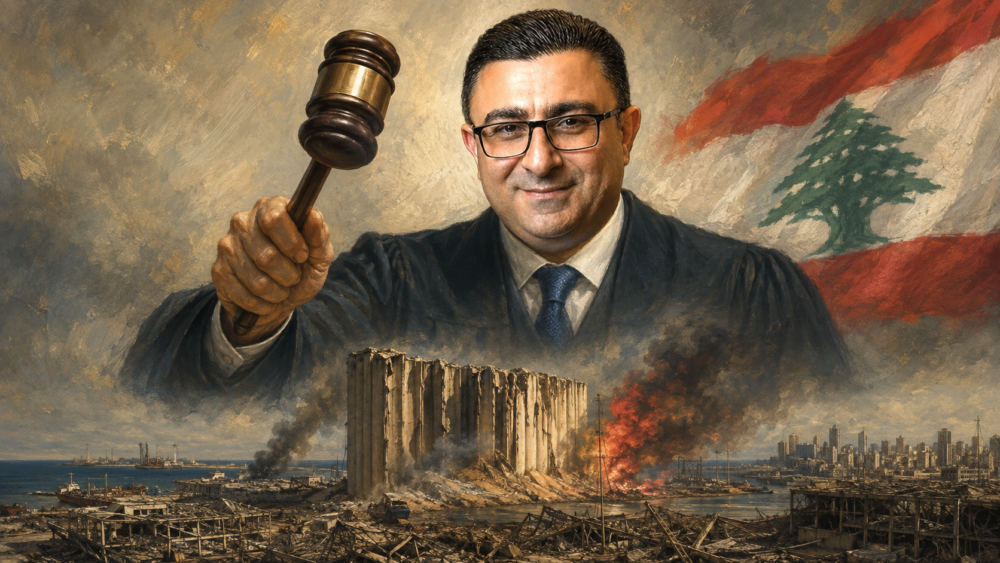
illustration: The evidence is assembled. The victims are waiting. When more than 220 lives are lost and accountability is obstructed, silence ceases to be neutrality—it becomes complicity. Justice must now bring down the gavel.
Judge Tarek Bitar has completed his investigation. The prosecutor’s opinion is the final procedural step—not a license to bury the truth or surrender to political intimidation.
By: Ya Libnan Editorial Board, Opinion
Six years have passed since Beirut was shattered by one of the largest non-nuclear explosions in history. More than 220 people were killed, over 6,500 were injured, and entire neighborhoods of the capital were devastated.
Yet not one senior official has been tried. Nobody is currently in custody in Lebanon over the catastrophe.
On Tuesday, families of the victims returned to the port carrying photographs of those they lost and repeating the same demand they have made for six painful years: truth, justice and accountability.
“Until now, we haven’t gotten justice,” said Hiyam al-Bikai, whose son Ahmad was killed in the explosion. “There has been no accountability and nobody has been arrested.”
Her words constitute an indictment of the Lebanese state itself.
The families are not demanding revenge. They are demanding answers to the most elementary questions: Who brought the ammonium nitrate into Lebanon? Who authorized or facilitated its entry? Who allowed it to remain at the port for years despite repeated warnings? Who knew of the danger? Who failed to act? And what precisely caused the material to explode?
These questions cannot remain unanswered simply because the answers may implicate powerful political, security or military figures.
The investigation is finished
Judge Tarek Bitar completed his investigation on March 30 and transferred the file—reportedly involving accusations against approximately 70 people—to the Office of the Public Prosecutor at the Court of Cassation.
The next procedural step rests with Public Prosecutor Judge Ahmad Rami al-Hajj. According to Lebanese reporting, al-Hajj assigned Attorney General Mohammad Saab to review the file and prepare the prosecution’s opinion, including its observations, requests and assessment of responsibility.
That opinion must be submitted before Bitar can issue his indictment. But one legal point must be made absolutely clear: Bitar does not need the prosecutor’s “approval.” The prosecutor’s opinion is procedurally required, but it is not binding on the investigating judge. Bitar remains free to accept or reject its recommendations and reach his own conclusions. L’Orient Today
The prosecutor’s office therefore does not have the legal authority to rewrite Bitar’s investigation—but its unfinished review is preventing the case from reaching the indictment and trial stage.
That makes further unexplained delay unacceptable.
Justice Minister Adel Nassar said during Tuesday’s commemoration that the prosecutor was preparing his response and expected the file to be returned within 60 to 90 days. That is now a public commitment. It must be treated as a deadline, not another vague promise destined to disappear into Lebanon’s judicial bureaucracy.
The file has already been in the prosecutor’s office since late March. The families have waited six years. Lebanon must not ask them to accept another open-ended postponement.
President Aoun is right—but words must produce action
President Joseph Aoun has called the explosion “a tragedy unparalleled in our modern history” and urged the judiciary to issue the long-awaited indictment.
“The issuing of the indictment by the investigating judge has become a necessity that can no longer be delayed,” Aoun declared.
He is right. But Bitar cannot complete the final procedural stage until the prosecution submits its opinion and returns the file.
If the president, prime minister and justice minister truly support judicial independence, they must ensure that the prosecutor’s office is free to complete its work without political interference, intimidation or threats. They must not dictate its conclusions, but they must insist that the legal process move forward promptly.
Judicial independence cannot mean institutional paralysis.
The intimidation has already begun
The political pressure surrounding the case has never disappeared.
Hezbollah MP Ali Berro accused Judge Ahmad Rami al-Hajj of making “treasonous” accusations, while the pro-Hezbollah newspaper Al-Akhbar claimed that the prosecutor was targeting Hezbollah as a political faction. Al-Hajj reportedly remained committed to pursuing the case despite those attacks. LBCI
Such accusations appear designed to establish a dangerous equation: investigating Hezbollah or its allies is treason, while obstructing justice is somehow patriotism.
That equation must be rejected.
No political party, religious community, security institution or armed organization can be placed beyond judicial scrutiny. If the evidence clears an individual or organization, the judicial process should say so. If the evidence establishes criminal responsibility, charges must follow.
The facts—not threats, sectarian pressure or political allegiance—must determine the outcome.
Lebanon has already witnessed the cost of speaking publicly about the port explosion. Researcher and activist Lokman Slim, who accused Hezbollah of responsibility, was found murdered in his car on February 4, 2021. Hezbollah denied involvement, and no court has established who killed him. Five years later, his assassination remains unresolved.
That history makes the attacks against judges especially alarming. The state must protect every judge, prosecutor, witness and investigator connected to this case.
This is Lebanon’s test
Judge Bitar has endured lawsuits, institutional rebellion, political attacks and years of obstruction. The previous public prosecutor, Ghassan Oueidat, went so far as to challenge Bitar’s authority, order the release of detainees and initiate proceedings against the investigating judge after Bitar attempted to revive the case. Associated Press
Lebanon cannot allow that shameful chapter to repeat itself.
Judge Ahmad Rami al-Hajj took office promising independence from political parties and pledging to prioritize sensitive cases of national importance. The Beirut port investigation is the defining test of that promise.
He must ensure that the prosecution’s legal opinion is completed professionally and returned to Judge Bitar within the announced timeframe—or sooner. Once it is returned, Bitar must issue the indictment without further delay. The accused will retain their right to defend themselves in court, but they cannot be permitted to use political power to prevent a court from ever hearing the case.
The indictment will not by itself deliver justice. It will, however, finally tell the Lebanese people whom the investigation accuses, what offenses are alleged and what evidence must be tested at trial.
Six years of mourning are enough. Six years of obstruction are enough. Six years of treating powerful officials as untouchable are enough.
Whatever the political consequences, the truth must come out.
Judge Ahmad Rami al-Hajj must resist intimidation, complete the required prosecutorial review and return the file to Judge Tarek Bitar.
Lebanon’s public prosecutor must act—because justice delayed for six years is not merely delayed. It is being denied.
