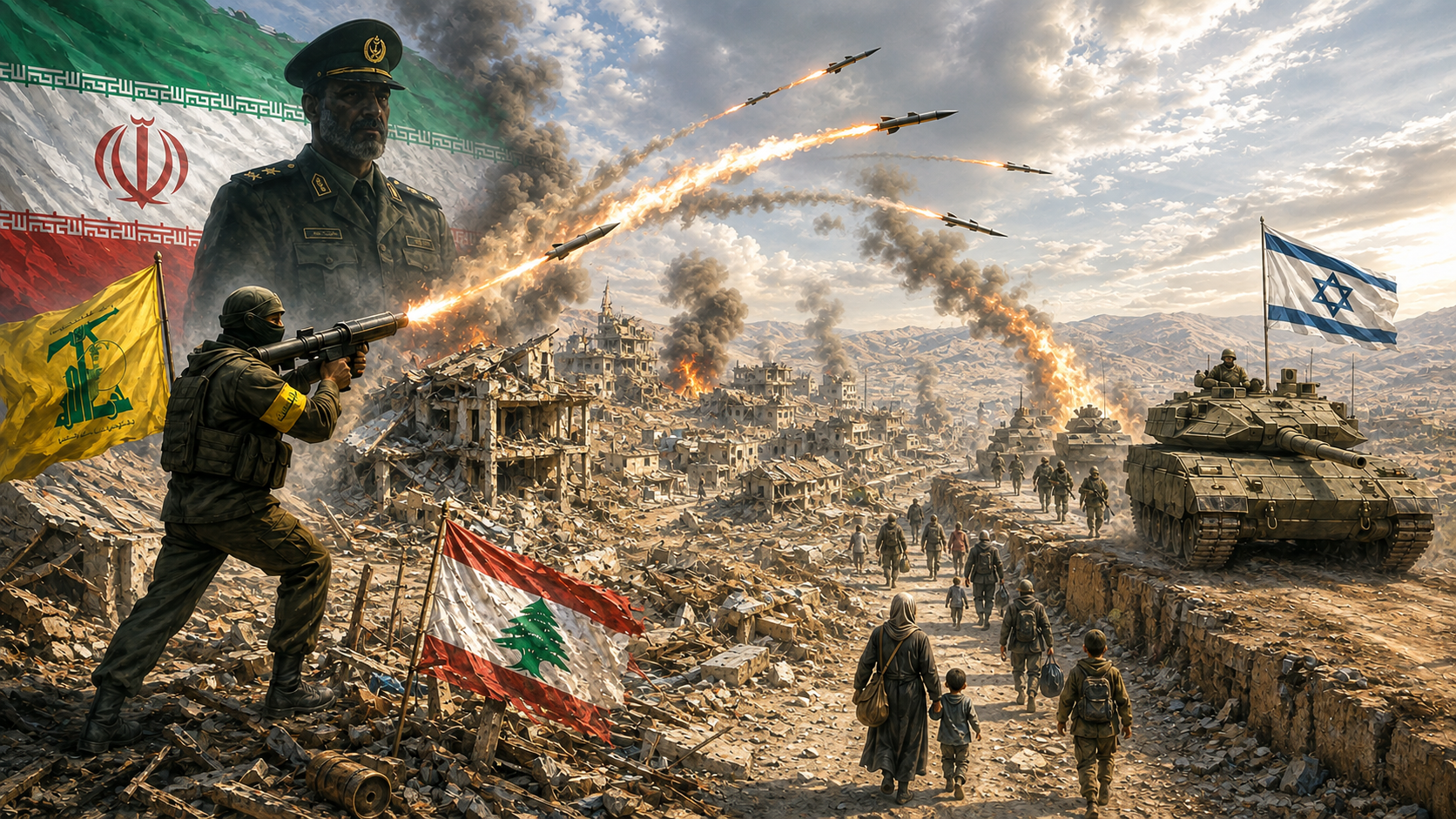
illustration- Hezbollah fought for Iran, opened Lebanon’s door to Israel, and left its own country in ruins —and devastated the very community it claimed to protect.
Nawaf Salam is right: the greatest gift to Israel came not from diplomacy, but from Hezbollah’s unilateral decision to drag Lebanon into a war fought in service of Iran.
By: Ya Libnan Editorial Board, Opinion
Hezbollah Secretary-General Naim Qassem and other party officials have intensified their attacks on Prime Minister Nawaf Salam and the Lebanese government over the direct negotiations taking place between Lebanon and Israel.
They portray diplomacy as humiliation and accuse its supporters of betraying Lebanon.
But Salam has now answered with a truth that Hezbollah has spent years trying to conceal: the greatest assistance Israel received did not come from Lebanese negotiators. It came from the armed organization that unilaterally seized Lebanon’s authority to decide between war and peace, opened fire on Israel, and gave the Israeli government the pretext it needed to wage a devastating war on Lebanese territory.
“The greatest aid to Israel,” Salam declared, “was actually provided by those who unilaterally dragged Lebanon into futile ‘support’ war adventures, handing Israel the pretexts to attack our country, trample its sovereignty, destroy its cities and villages, and kill or displace hundreds of thousands of its people.”
The prime minister was referring unmistakably to Hezbollah.
He is right.
Hezbollah made the decision—Lebanon paid the price
On March 2, Hezbollah launched projectiles at Israel without authorization from the Lebanese government, Parliament or Army. Lebanon’s elected institutions were neither consulted nor asked to approve a declaration of war.
The timing was hardly coincidental. Hezbollah entered the confrontation as Iran was under attack, confirming once again that the organization’s strategic priorities are tied to Tehran’s regional agenda rather than exclusively to Lebanon’s national interests.
Hezbollah publicly claimed that its attack was connected to Lebanese territory and Israeli aggression, not to the war involving Iran. But its decades-long ideological, military and financial relationship with Tehran makes that distinction difficult to accept at face value.
The consequences were catastrophic.
Israeli forces responded with a massive military campaign. More than one million people were displaced during the escalation, thousands were killed, bridges and infrastructure were attacked, and towns and villages across southern Lebanon and the Bekaa were devastated. Subsequent reporting described 24 villages as destroyed and as many as 20,000 homes damaged or rendered uninhabitable. Reuters, Associated Press
Israel eventually occupied extensive areas of southern Lebanon, while the Lebanese state was left struggling to negotiate an Israeli withdrawal, arrange the return of prisoners, restore displaced communities and finance reconstruction.
Hezbollah made the decision. Lebanon paid the price.
Worse still, much of the destruction fell upon Hezbollah’s own Shiite constituency—the very people the organization claims to protect. Families lost their sons, their homes, their farms, their businesses and entire villages because an armed party made a decision of war over which they had no voice.
That is not resistance. It is the political exploitation of a community Hezbollah treats as both a recruiting ground and a human shield for Iran’s regional strategy.
Who betrayed Lebanon?
Salam correctly declared that those who usurped the state’s decision-making power and tethered Lebanon to foreign agendas are “in no position to hand out certificates of patriotism, let alone sovereignty.”
That is the central issue.
Hezbollah accuses those conducting negotiations of betraying Lebanon. But what constitutes the greater betrayal?
Is it treason for the Lebanese government to negotiate the withdrawal of Israeli forces, the return of prisoners, the restoration of Lebanese sovereignty and the safe return of displaced citizens?
Or is it treason for an armed organization to start a war without the consent of the Lebanese people, in alignment with a foreign power, and then leave the state to recover the land and rebuild the country afterward?
Diplomacy conducted by the constitutional government is not treason. Usurping the government’s exclusive war-making authority is the true assault on sovereignty.
Negotiations do not mean surrendering Lebanon’s rights. On the contrary, Lebanon’s delegation must insist on a complete Israeli withdrawal, the return of all Lebanese prisoners, respect for Lebanon’s internationally recognized borders and an end to attacks on Lebanese territory.
Those are national objectives.
Hezbollah’s objective is different: it wants to retain an independent military apparatus capable of imposing its decisions upon the state. Its opposition to negotiations is therefore not principally about protecting Lebanese sovereignty. It is about protecting Hezbollah’s power to operate outside that sovereignty.
Hezbollah was built by Iran
Iran’s Islamic Revolutionary Guard Corps played a decisive role in establishing, training and organizing Hezbollah after deploying forces to Lebanon’s Bekaa Valley in 1982. The relationship has continued through financing, weaponry, training and strategic coordination. PBS, Council on Foreign Relations
Hezbollah officials have repeatedly affirmed their ideological allegiance to Iran’s supreme leader and the doctrine of wilayat al-faqih.
For historical accuracy, Hezbollah was not created “as a member of the Quds Force.” The IRGC helped create Hezbollah in 1982; the Quds Force was institutionalized later as the Revolutionary Guards’ external-operations branch. Hezbollah subsequently became its most important regional partner and model.
This history matters because Hezbollah’s weapons have never been merely a Lebanese defense arrangement. They are part of an Iranian regional military network.
As long as Hezbollah retains an independent arsenal and answers strategically to a foreign leadership, Lebanon cannot exercise genuine sovereignty.
One country cannot have two war rooms
Salam offered the only viable definition of sovereignty: “a single, independent decision-making authority within a state possessing one army.”
No serious country can tolerate two governments, two armies and two foreign policies.
Lebanon cannot have a constitutional government negotiating peace while an armed party reserves the right to restart the war. It cannot ask Israel to withdraw while Hezbollah maintains a parallel military structure that Israel will cite as justification for remaining. It cannot attract investment or rebuild the south while every future decision depends upon calculations made in Tehran.
The Lebanese Army must become the sole armed authority throughout the country. The decision to fight, negotiate, sign an agreement or enforce a ceasefire must belong exclusively to the Lebanese state.
That is not a concession to Israel. It is the most basic requirement of Lebanese independence.
Negotiations are intended to recover what war lost
Hezbollah went to war claiming it could protect Lebanon. Instead, Lebanon lost lives, villages, homes, infrastructure and territory.
Now the Lebanese government is attempting through negotiations to recover what Hezbollah’s war failed to protect.
The direct talks in Rome are seeking long-term security, the restoration of Lebanese state authority in the south, the removal of security threats and arrangements that could facilitate an Israeli withdrawal. Reuters
Negotiations may fail. Israel may make unreasonable demands or attempt to retain Lebanese land. Lebanon must therefore negotiate firmly and refuse any arrangement that compromises its territory or sovereignty.
But refusing even to negotiate would condemn Lebanon to permanent occupation, recurring warfare and endless reconstruction.
Hezbollah has already demonstrated what its military strategy produces. Lebanon has the ruins to prove it.
The rhetoric of treason must end
Salam concluded by calling for an end to accusations of treason and for an honest national dialogue based upon acknowledging bitter facts and accepting responsibility.
That is the responsible position of a statesman.
But dialogue cannot begin with historical falsification. Hezbollah must first acknowledge that it took Lebanon into war without national consent, that its decision served Iran’s strategic interests, and that the Lebanese people—particularly the Shiite community—paid an unbearable price.
It must also accept that weapons outside the authority of the state are not a guarantee of sovereignty. They are a continuing negation of it.
Nawaf Salam is not betraying Lebanon by attempting to end Israeli occupation and prevent another war. He is performing the duty Hezbollah abandoned when it placed Iran’s regional agenda above Lebanon’s survival.
The greatest gift to Israel was not the negotiating table.
It was Hezbollah’s decision to start a war Lebanon never authorized, could not control and was forced to endure.
Now the state must recover Lebanon—its territory, its prisoners, its constitutional authority and, above all, its sovereign right to decide its own future.
