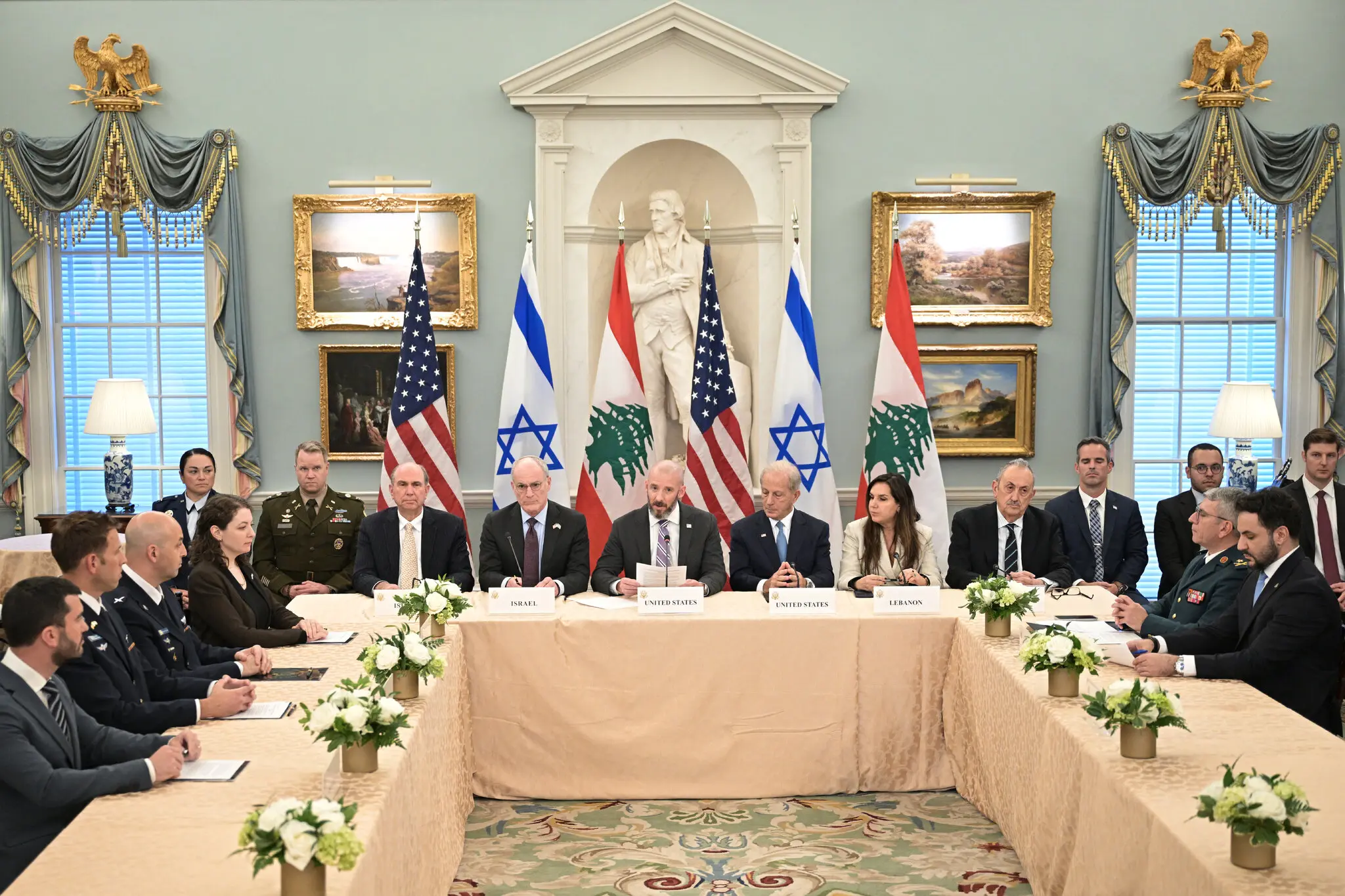
The State Department on Wednesday announced that Israel and Lebanon had agreed to a cease-fire following two days of high-level meetings held in Washington.Credit…Oliver Contreras/Agence France-Presse — Getty Images
The U.S.-brokered agreement called for “a complete cessation” of fire from Hezbollah, an Iranian-backed militia that operates in southern Lebanon. A previous cease-fire has largely been ignored.
Here’s the latest.
Israel and Lebanon have agreed to renew their cease-fire, the two nations announced in a joint statement with the United States on Wednesday, potentially clearing an obstacle for ending the war in Iran.
The agreement, which was confirmed by the U.S. State Department, came after Israeli and Lebanese officials met in Washington for U.S.-mediated talks. It calls for “a complete cessation of Hezbollah fire and the evacuation of all Hezbollah operatives” in southern Lebanon and the creation of “pilot zones” of which the Lebanese Armed Forces would “take exclusive control.” All “non-state actors” would be barred, it said.
The joint statement attributed to the U.S., Lebanon and Israel “reaffirmed that the future of the relationship between Israel and Lebanon must be decided by the two sovereign governments,” and “rejected any attempt, by any state or non-state actor, to hold Lebanon’s future hostage.” The delegations discussed a security framework, including “the dismantlement” of armed groups, and “Lebanon committed to enhancing the capacity of the Lebanese Armed Forces, with U.S. support,” the statement said.
Lebanon and Israel “reaffirmed that they have no hostile intent toward one another and committed to continuing direct negotiations to build confidence, resolve all outstanding issues, and work toward a comprehensive agreement,” it said. They will reconvene on June 22.
The U.S. State Department on Wednesday evening released a joint statement by Israel and Lebanon announcing the two countries had agreed to renew their cease-fire after two days of high-level meetings in Washington. The statement said the truce was “contingent on a complete cessation” of fire from Hezbollah, the Lebanese Iranian-backed militant group at war with Israel, and the evacuation of all its operatives from southern Lebanon in an area bordering Israel.
The two sides agreed to “the creation of pilot zones in which the Lebanese Armed Forces will take exclusive control” and that will exclude “all non-state actors,” the statement said.
Trump says the war in Iran is ‘not a big thing’ for the U.S.

President Trump said on Wednesday that the war in Iran was “not a big thing” for the United States in his latest attempt to play down the effects of the war by pointing to the economy.
Speaking to reporters in the Oval Office, Mr. Trump asserted that the conflict, which has killed at least 13 U.S. service members and an estimated 1,700 Iranian civilians, drained military stockpiles, and inflicted financial pain on working-class Americans, was going better than expected. He maintained he was “very proud” of what he called a “detour” to Iran.
Secretary of State Marco Rubio told lawmakers on Wednesday that the Trump administration would try to negotiate with Iran to get it to commit to a long-term agreement to not enrich uranium. Rubio did not deny that the agreement might have a “sunset clause,” but said the administration would try to get an agreement that is better than the one President Barack Obama had negotiated. The Obama-era agreement, which President Trump left in his first term, had a “sunset clause” of up to 15 years on certain limits to uranium enrichment, but connected to the idea that sanctions would be reimposed on Iran if enrichment restarted. “If we can get 20 years of zero-enrichment, that’s substantially better than what the JCPOA was,” Rubio said, using initials referring to the Obama-era agreement.
Speaking to reporters, President Trump did not directly answer the question when he was asked if the United States’ cease-fire with Iran was still holding. He instead offered a meandering answer that appeared to explore the two countries’ perspectives. “There is a reason for certain things, and there’s usually a reason that sometimes makes sense,” he said. “We got it, we nipped it in the bud very quickly, as we do with the greatest military in the world, but some people would say they were slightly provoked because we took a strong action for a different reason. So they were reciprocating.”
In an interview with the pro Hezbollah Lebanese broadcaster Al Mayadeen, Iran’s foreign minister, Abbas Araghchi, said while Iran’s communication with the Americans had not been cut off, no progress had been made in negotiations toward an agreement on a permanent cease-fire. He added that resumption of talks would depend on securing the end of the war in Iran, Lebanon and the region, as well as what he called the “rights of the Iranian people.”
Brigadier General Hossein Mohibi, a spokesman for Iran’s Islamic Revolutionary Guards Corps, claimed on Wednesday that damage to Kuwait airport’s terminal was caused by U.S. Patriot air-defense systems, according to IRIB, Iran’s official state broadcaster.
The spokesman said that the Guards’ Aerospace Force had not fired at the terminal and the damage was caused when U.S. Patriot systems failed to intercept Iranian missiles and fell on the terminal.
The U.S. Central Command on Wednesday denied the accusation, calling it “Totally FALSE,” in a statement on social media, adding that Iran had “struck the civilian airport with drones.”
Secretary of State Marco Rubio was pressed by Rep. Joaquin Castro, Democrat of Texas, at a Congressional hearing on whether the United States knows that Israel has a nuclear weapon. Rubio avoided answering the question directly. “I think most of the world assesses that they do, but we’ve never, they’ve never acknowledged that publicly, and as a feature of our foreign policy, for a variety of reasons, we don’t discuss it in that way either,” he said.
Secretary of State Marco Rubio told Congress that sanctions relief for Iran would be part of talks over the country’s nuclear program and that any end to U.S. sanctions would be “conditions-based.” Critics of President Barack Obama’s earlier nuclear agreement with Iran denounced the terms because they allowed for the lifting some sanctions. Rubio said the Trump administration would continue to press Iran to address the issue of “disposition” of its highly enriched uranium, without providing any details about what he meant by “disposition.” On a recent trip to India, Rubio had said that nuclear talks would come after an initial cease-fire agreement, which is still being negotiated.
Prime Minister Benjamin Netanyahu of Israel said Wednesday that he had had “tactical disagreements” with President Trump, after the president confirmed that he had used expletives in a Monday call with Netanyahu. Trump had described the tense call, owing to his frustration over Israel’s fighting in Lebanon, in an interview with the New York Post earlier on Wednesday. Hours later, Mr. Netanyahu declined to comment on the content of the conversation in an interview with CNBC, but said the two leaders had a habit of resolving their differences. “We can disagree in the morning, and by the afternoon, we have common action,” he said.
Trump confirms he called Netanyahu ‘crazy’ in a phone call.
with Prime Minister Benjamin Netanyahu on Wednesday, suggesting that the two men had a broadly positive rapport but that recent disagreements had prompted the president to call the Israeli leader “crazy.”
“We’ve worked very well together,” Mr. Trump said in an interview with The New York Post, summarizing their working relationship as close and constructive.
Secretary of State Marco Rubio told Congress that the Israel-Lebanon conflict was “complex” and rooted in a decades-old history going back to the last century, but that the United States remained invested in diplomacy to try to bring about a settlement. He said that the Israeli military was continuing to strike in southern Lebanon when it saw activity by Hezbollah, and was increasingly taking Lebanese territory to ensure the Iranian-backed militia has fewer missile launch sites in the region.
The attack on Kuwait’s airport further upends travel in the Middle East.

Iranian forces targeted Kuwait’s primary airport with a wave of attack drones that killed one person and injured more than 60 others, including passengers and airport workers, Kuwaiti authorities said on Wednesday.
The attack also closed a terminal that had only just reopened, the latest example of the war in the Middle East upending aviation.
Kuwait has summoned the interim chargé d’affaires of the Iranian embassy on Wednesday to lodge an official protest against Iranian attacks on the country and declared two Iranian diplomats persona non grata, demanding that they leave the country within 24 hours.
The Kuwaiti foreign ministry said in a statement on social media that a senior official had also told the chargé d’affaires that Kuwait had refused to allow its land or airspace to be used “for any act of aggression against any country.” Iran has said that it targeted sites where American attacks against it were launched. Kuwait hosts a U.S. military base.
The Kuwaiti authorities said that the person who was killed in an Iranian strike on the country’s international airport on Wednesday was an Indian resident of the country. The attack on the country included 13 ballistic missiles and 17 drones, the Kuwaiti authorities added in a statement published on social media.
THE NEW YORK TIMES
