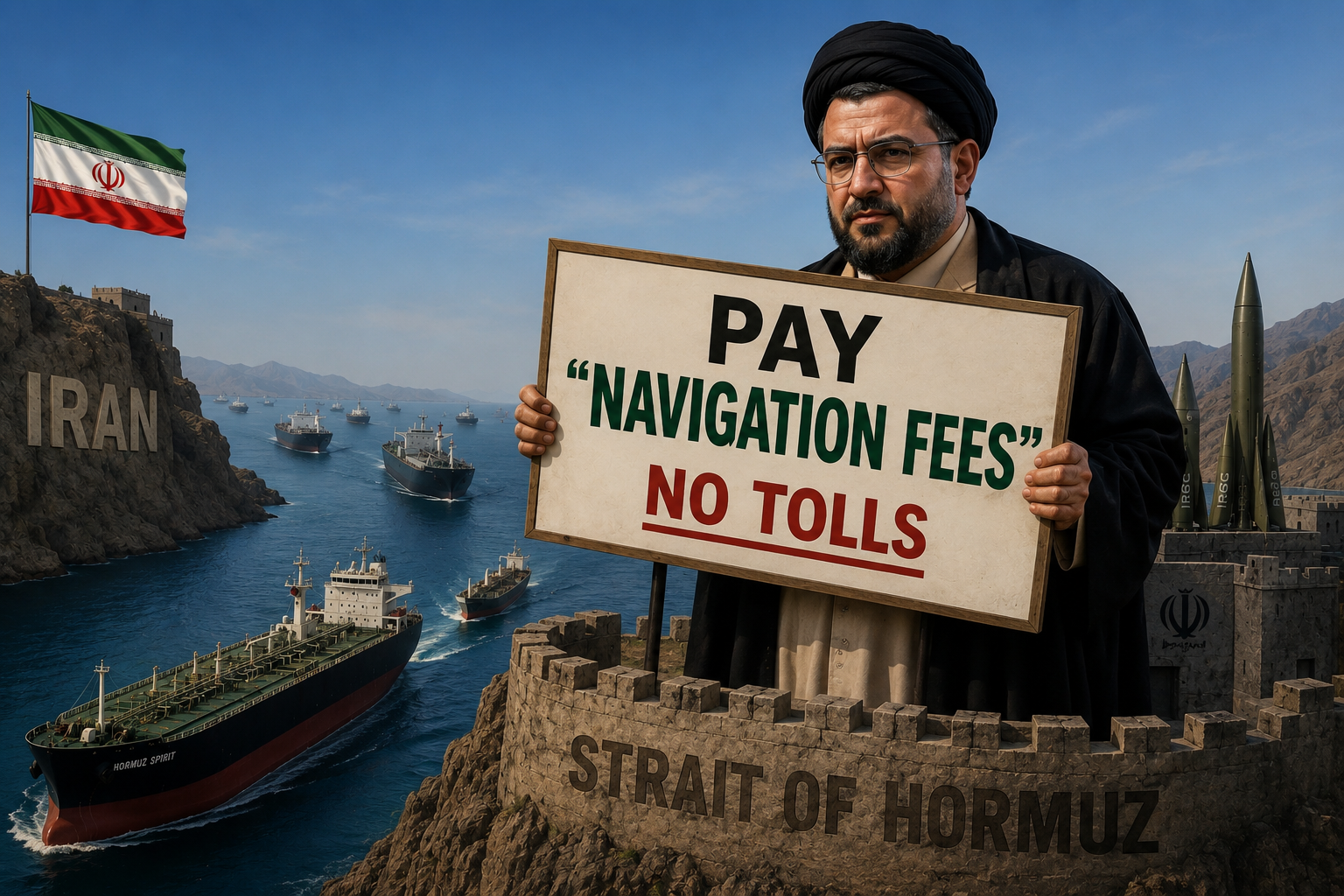
Iran charged the name of the fees being imposed on vessels crossing the strait of Hormuz. Instead of tolls its now calling them Navigation fees
The world does not need another temporary ceasefire. It needs a lasting settlement where Iran abandons both nuclear ambitions and the weaponization of Hormuz.
By: The Editorial Board, Opinion
Nobody likes wars. But unfinished wars are often even more dangerous than wars that reach a decisive conclusion. An unresolved conflict becomes a permanent fuse waiting to ignite again — at a time and place nobody can predict.
That is exactly where the United States and Iran now stand.
For months, Washington and Tehran have been circling around the idea of a negotiated settlement. Yet the deeper problem has become increasingly obvious: there does not appear to be one unified Iranian decision-maker capable of committing the country to a durable agreement.
The civilian leadership speaks the language of diplomacy. But the real center of gravity remains the Islamic Revolutionary Guard Corps — the IRGC — whose strategic culture is built around leverage, confrontation, proxy warfare, and regional pressure tactics rather than compromise.
As a result, negotiations have turned into a cycle of mixed messages, tactical delays, contradictory statements, and calculated ambiguity.
Nowhere is this clearer than in the Strait of Hormuz.
Iran understands that Hormuz is not merely a waterway. It is one of the world’s most critical economic arteries. Roughly a fifth of global oil and enormous LNG volumes pass through it. That gives Tehran a pressure point over the global economy — and especially over Europe and Asia.
The dispute over “navigation fees” exposes the broader strategy.
Iran avoids using the word “tolls” because formal tolls on international transit through such a strategic maritime chokepoint would trigger enormous international backlash and legal scrutiny. Instead, Tehran presents the charges as “navigational services,” “security coordination,” or technical maritime assistance.
But the distinction is largely semantic.
When a country helps create the security crisis, then charges others money to navigate safely through the danger zone, the world does not see a service. It sees coercion.
Now reports suggest attempts to bring Oman more directly into Hormuz arrangements, despite the fact that United Arab Emirates controls significant territory and infrastructure on the opposite side of the strait. The geopolitical maneuvering is becoming increasingly complex, and increasingly dangerous.
Meanwhile, President Donald Trump has escalated his rhetoric sharply, warning Iran that continued stalling and maritime pressure tactics could lead to a far broader military response.
Critics will say escalation risks a wider regional war.
That concern is legitimate.
But endless hesitation also carries enormous risks. History repeatedly shows that unresolved confrontations with unclear red lines often produce recurring crises, repeated brinkmanship, market instability, and eventually larger conflicts under worse conditions.
The current situation increasingly resembles a dangerous gray zone: neither peace nor war, neither diplomacy nor deterrence, neither settlement nor surrender.
That ambiguity benefits the IRGC far more than it benefits global stability.
If Washington truly believes that Iran’s leadership is unwilling or unable to permanently abandon coercive maritime blackmail and regional destabilization, then prolonging the confrontation indefinitely may simply guarantee future eruptions.
At some point, nations must decide whether they are negotiating toward peace — or merely managing the countdown to the next crisis.
And the longer the hesitation continues, the higher the eventual cost may become.
