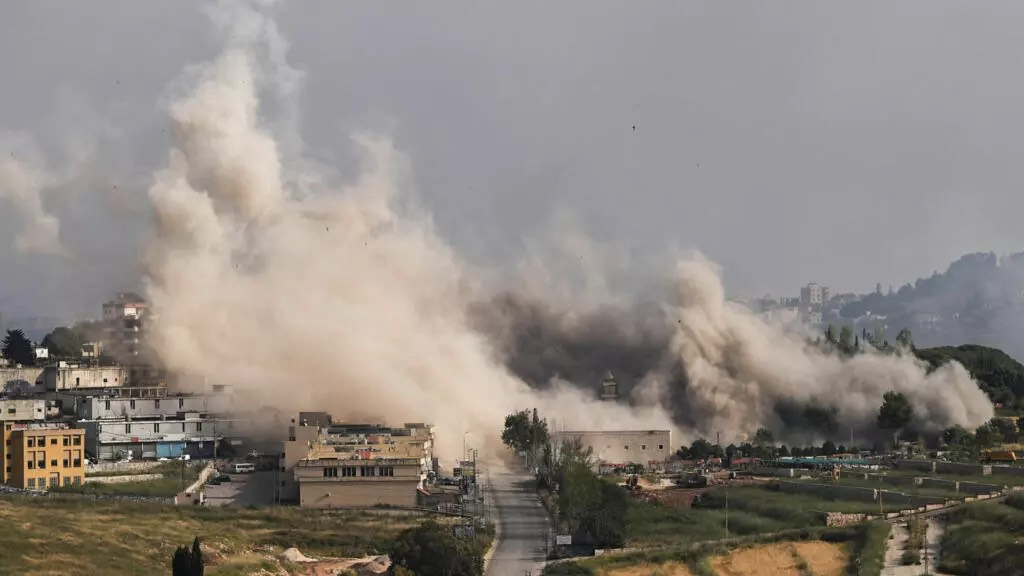
Smoke billows following an Israeli strike in Nabatieh, Lebanon May 26, 2026. © Stringer – Reuters
Here is is the latest on the war in the Middle East
- A senior official with Iran’s powerful Revolutionary Guard says renewed fighting with the U.S. seems unlikely but, just as President Trump has done, he stresses that his country is prepared for any outcome as negotiations continue.
- Lebanese officials say Israeli strikes killed more than 30 people on Tuesday alone as Israel intensifies its attacks on Iranian-backed Hezbollah, escalating hostilities on the other front in the wider Middle East war — where Iran says fighting must also end as part of any peace deal.
- President Trump will convene his Cabinet today at the White House to discuss the Iran war and other topics. Mr. Trump has said indirect talks with Iran are going “nicely,” but he’s faced criticism as the agreement taking shape may leave big issues, including Iran’s nuclear program, on the table for further negotiation.
Iranian state TV’s reporting on memorandum draft is “not true,” White House says
The White House has rebuffed a report by Iran’s IRIB state TV network after the outlet said it had a draft of the “Islamabad Framework” memorandum of understanding, saying what Iranian state media claimed is “not true.”
Iranian state TV claimed a draft of the initial framework claimed all shipping traffic would be managed by Iran, along with other points that appear contrary to the Trump administration’s stated positions. The Trump administration has made it clear they won’t allow Iran to control the strait or impose tolls.
“This report from Iranian controlled media is not true and the MOU they ‘released’ is a complete fabrication,” an official White House account wrote on X. “Nobody should believe what Iranian state media is putting out. FACTS MATTER.”
109 vessels have been redirected by U.S. blockade on Strait of Hormuz
The U.S. blockade on the Strait of Hormuz has turned around 109 commercial vessels heading into or leaving ports in Iran, according to U.S. Central Command.
That total is an increase by one vessel since Tuesday’s update.
Lifting the blockade on the strait has been a key condition of negotiations between the U.S. and Iran.
Iran agreed in principle to a deal over the weekend that will be a two-step process, with the immediate opening of the Strait of Hormuz in exchange for lifting the U.S. blockade, followed by negotiations on a mechanism for Iran to give up various parts of its nuclear program, the official said.
Israel issues more warnings for Tyre, nearby residents to evacuate
Israel is issuing evacuation orders to the ancient city of Tyre in Lebanon, as well as 11 camps in the area.
Among those camps are Shabriha, Hammadiya, Jal al-Bahr, Zoqoq al-Mafdi, Al-Bass, Al-Maashouk, Burj al-Shamali, Nabaa, Al-Housh, Rashidieh and Ain Baal.
“In light of the terrorist Hezbollah’s violation of the ceasefire agreement and its targeting of Israeli territory, the IDF is forced to act strongly against it,” the Israel Defense Forces said. “The IDF does not intend to harm you.
“For your safety, you must evacuate your homes immediately according to the area shown on the map and move north of the Zahrani River.”
Residents of the city of Nabatieh were warned to evacuate earlier in the day ahead of a bombing campaign.
Iran state TV claims “Islamabad Framework” draft with U.S. includes reopening Strait of Hormuz, but with fees
Iran’s IRIB state TV network reported Wednesday that it had “obtained” a draft of the “Islamabad Framework” – a memorandum of understanding taking shape with the U.S. that would see the countries agree to extend their ceasefire and reopen the Strait of Hormuz, while also launching direct negotiations on more contentious matters.
IRIB called the version it obtained an “unofficial preliminary document outlining a 14-point draft of the agreement,” which it cast as a potential step toward ending the war that was still being revised and negotiated between the two countries.
The White House later rejected the reporting, writing, “This report from Iranian controlled media is not true and the MOU they ‘released’ is a complete fabrication. Nobody should believe what Iranian state media is putting out.”
IRIB said the draft includes a commitment from the U.S. to lift its blockade of Iranian ports and vessels. In return, Iran would restore the flow of commercial shipping through the Persian Gulf and the Sea of Oman, through the Strait of Hormuz, to pre-war levels within one month.
IRIB said military vessels would be excluded from Iran’s lifting of restrictions in the strait and that commercial traffic — including vessel inspections and the imposition of service “fees” — would remain under the authority of Iran in coordination with neighbor Oman.
“The Strait of Hormuz, between us and Oman as coastal countries, must have a defined mechanism,” Esmail Baqaei, spokesman for both Iran’s Foreign Ministry and its team negotiating with the U.S., told IRIB.
The IRIB report said the draft agreement included the U.S. accepting “an obligation” to withdraw American forces from the Mideast, but it noted that specifics, including whether the withdrawal would apply only to recently added forces or also long-standing troop deployments, remained subject to negotiation.
The draft envisions, per the report, that if direct talks between Iran and the U.S. yield a final agreement on a wider peace deal within the provisioned 60 days, that deal would be enshrined as a binding United Nations Security Council resolution.
The report concluded by stressing that the Islamabad Framework remained unfinalized – and noting a significant possibility that the two sides could still fail to resolve their differences on terms to even begin direct negotiations on contentious issues such as Iran’s nuclear material.
CBS
