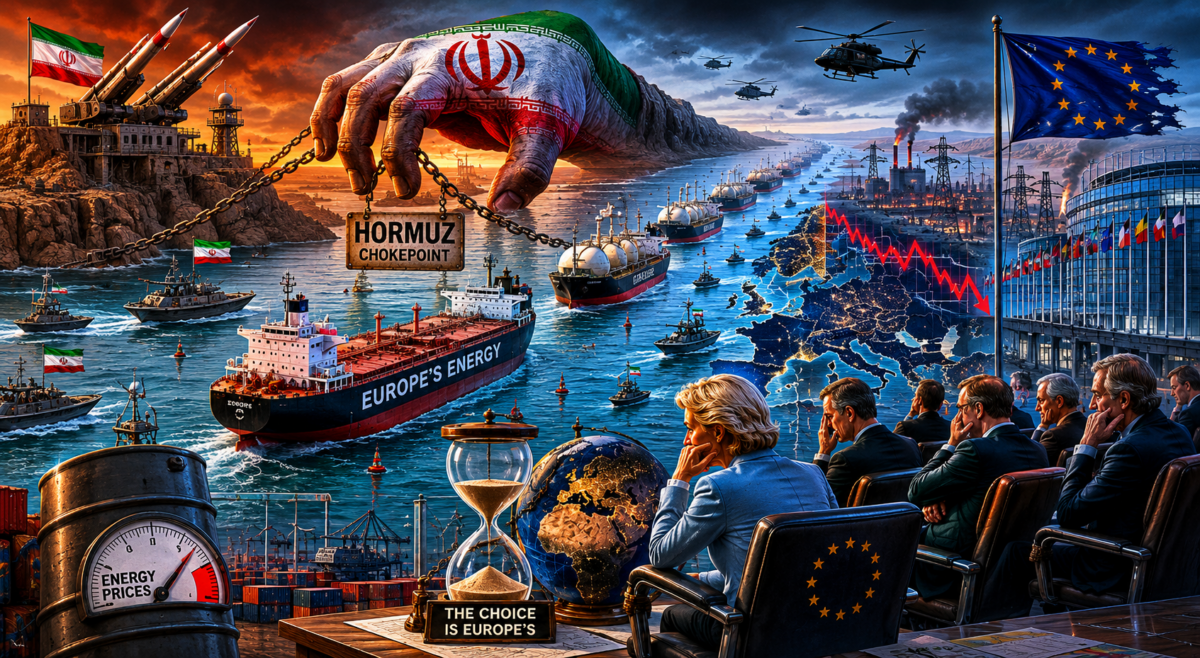
Friends and allies may disagree politically. But when freedom of navigation and global energy security are threatened, common strategic interests must come before political resentment.
By: The Editorial Board, Opinion
For months, the world has watched the growing crisis surrounding the Strait of Hormuz with increasing concern. Commercial shipping has been disrupted, maritime insurance costs have surged, energy markets remain on edge, and Iran has openly moved toward imposing so-called “navigational service fees” on vessels transiting one of the world’s most vital waterways.
Yet amid all this, one absence has become impossible to ignore: Europe.
This is no longer primarily an American problem. Nor is it simply about President Donald Trump, Israel, or even Iran alone. This is increasingly about whether Europe is willing to defend the maritime routes that sustain its own economy and strategic independence.
Europe needs Hormuz far more than the United States does.
A substantial share of Europe’s imported energy, industrial supply chains, and global trade flows depend directly or indirectly on the uninterrupted movement of ships through the Gulf. If Hormuz becomes permanently vulnerable to intimidation, blackmail, or politically motivated disruption, Europe will pay a far heavier long-term price than America.
Yet instead of stepping forward decisively to defend freedom of navigation, many European governments appear content to sit on the sidelines, issue statements, and distance themselves from the crisis.
Yes, Europe has legitimate grievances with Trump. His treatment of NATO allies, tariffs, diplomatic confrontations, and repeated political insults damaged trust across the Atlantic alliance. Many European leaders clearly do not like him personally or politically.
But alliances are not built on affection.
Friends disagree. Allies disagree. Democracies argue constantly. That is normal. What matters is whether nations can still unite when core strategic interests are threatened.
During the Cold War, Western allies frequently clashed over policy, trade, and military strategy. Yet they still understood that protecting common economic and security infrastructure was essential to collective survival.
Today, Europe risks sending the opposite message: that political resentment matters more than strategic reality.
The current crisis also exposes another dangerous illusion—the belief that regime change can be engineered quickly through external military pressure alone. Some in Washington and Israel appeared to assume that eliminating senior Iranian leadership figures could trigger internal collapse or mass uprisings against the regime.
But history rarely works that way.
Wars often strengthen nationalist sentiment, even among dissatisfied populations. Since the conflict began, there have been no major nationwide uprisings threatening the survival of the Iranian regime. Instead, external pressure appears to have reinforced internal cohesion, at least temporarily.
That does not mean Iran’s leadership is strong. It means that complex societies are not transformed through simplistic assumptions or wishful thinking.
Meanwhile, Tehran is learning another lesson: Europe may lack both the political unity and the strategic will to defend the very waterways upon which its own prosperity depends.
That perception alone is dangerous.
If Iran succeeds in normalizing coercive control over Hormuz—whether through intimidation, “fees,” selective disruption, or maritime threats—other actors around the world will take notice. Critical chokepoints from the Red Sea to the South China Sea could increasingly become instruments of geopolitical leverage.
The consequences would extend far beyond oil prices.
Europe’s industries would face higher energy costs. Inflationary pressure would intensify. Strategic dependence on external powers would deepen. Investor confidence would weaken. Insurance and shipping costs would rise permanently. Economic vulnerability would become embedded into the European system.
Most importantly, Europe’s credibility as a geopolitical power would continue to erode.
An economic superpower cannot remain strategically passive forever.
Freedom of navigation is not an American favor to Europe. It is a pillar of modern global civilization. If Europe refuses to help defend the maritime arteries that sustain its own economies, it should not be surprised when others begin dictating the price of its energy, its trade, and ultimately its sovereignty.
History has repeatedly shown that vacuums of power do not remain empty for long. Someone eventually fills them.
The question facing Europe today is simple:
Will it help shape the future of global security—or merely wait for others to shape it on its behalf?
