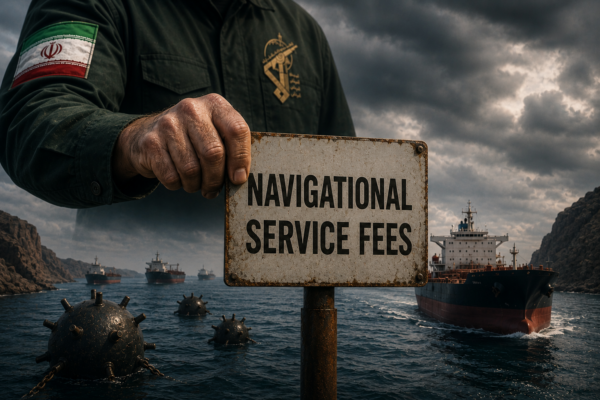
Iran claims it is charging for “navigational services” in the Strait of Hormuz. But when a regime helps create the danger and then charges others to avoid it, that is not a service — it is ransom.
By: The Editorial Board, Opinion
Iran’s foreign ministry insists that Tehran is not imposing tolls on ships transiting the Strait of Hormuz, only charging fees for what it calls “navigational services.” But the world should not be distracted by semantics.
The real question is simple: why are such services suddenly necessary in one of the world’s most strategic waterways?
The answer is increasingly obvious. Iran helped transform the Strait of Hormuz into a militarized danger zone through mines, threats, drone attacks, IRGC intimidation, and political coercion. Now Tehran wants the international community to pay for navigating safely through the crisis it helped create.
That is not maritime management.
That is organized geopolitical blackmail.
The Strait of Hormuz is not merely a regional shipping lane. It is one of the world’s most vital economic arteries, carrying a substantial share of global oil and LNG supplies every day. The stability of energy markets, industrial production, transportation costs, and global inflation all depend heavily on uninterrupted passage through these waters.
No country should be allowed to weaponize such a chokepoint for political or financial gain.
Yet that is exactly what Iran appears to be doing.
Reports indicate that ships are being guided through designated corridors to avoid dangerous areas while Tehran collects fees tied to “safe navigation.” Whether Iran formally calls these charges tolls, transit fees, service charges, or security payments is irrelevant.
When a regime helps create the danger and then profits from helping others avoid it, the payment becomes something entirely different.
It becomes ransom.
The implications extend far beyond Iran.
If the international community accepts this precedent in Hormuz, every strategic maritime chokepoint on earth becomes vulnerable to the same model:
- create instability,
- threaten global commerce,
- then charge for “protection.”
Tomorrow another state or armed group could attempt the same strategy in the Bab el-Mandeb, the Red Sea, the South China Sea, or elsewhere. The Houthis could demand “security fees” in the Red Sea. Militias could threaten pipelines and demand compensation for “safe operations.” Maritime blackmail could become normalized as a profitable geopolitical weapon.
This is why the issue cannot be dismissed as a temporary regional dispute.
It is a direct challenge to the principle of freedom of navigation that underpins the modern global economy.
History offers dangerous lessons. Piracy has always thrived when weakness, hesitation, and appeasement replaced deterrence. The international community spent decades fighting maritime piracy off Somalia because allowing commercial blackmail at sea threatened the foundation of global trade itself.
What is unfolding in Hormuz is potentially far more dangerous because it involves a state actor controlling one of the world’s most strategic energy corridors.
The world must not legitimize this behavior by quietly adapting to it.
The United States, Europe, Asia, Gulf nations, and every country dependent on global trade should make clear that no nation has the right to militarize international waters and then monetize the fear and instability it created.
Freedom of navigation is not negotiable.
The Strait of Hormuz cannot become Tehran’s toll booth.
Because once the world accepts ransom in Hormuz, it will invite blackmail across every major sea lane on earth.
