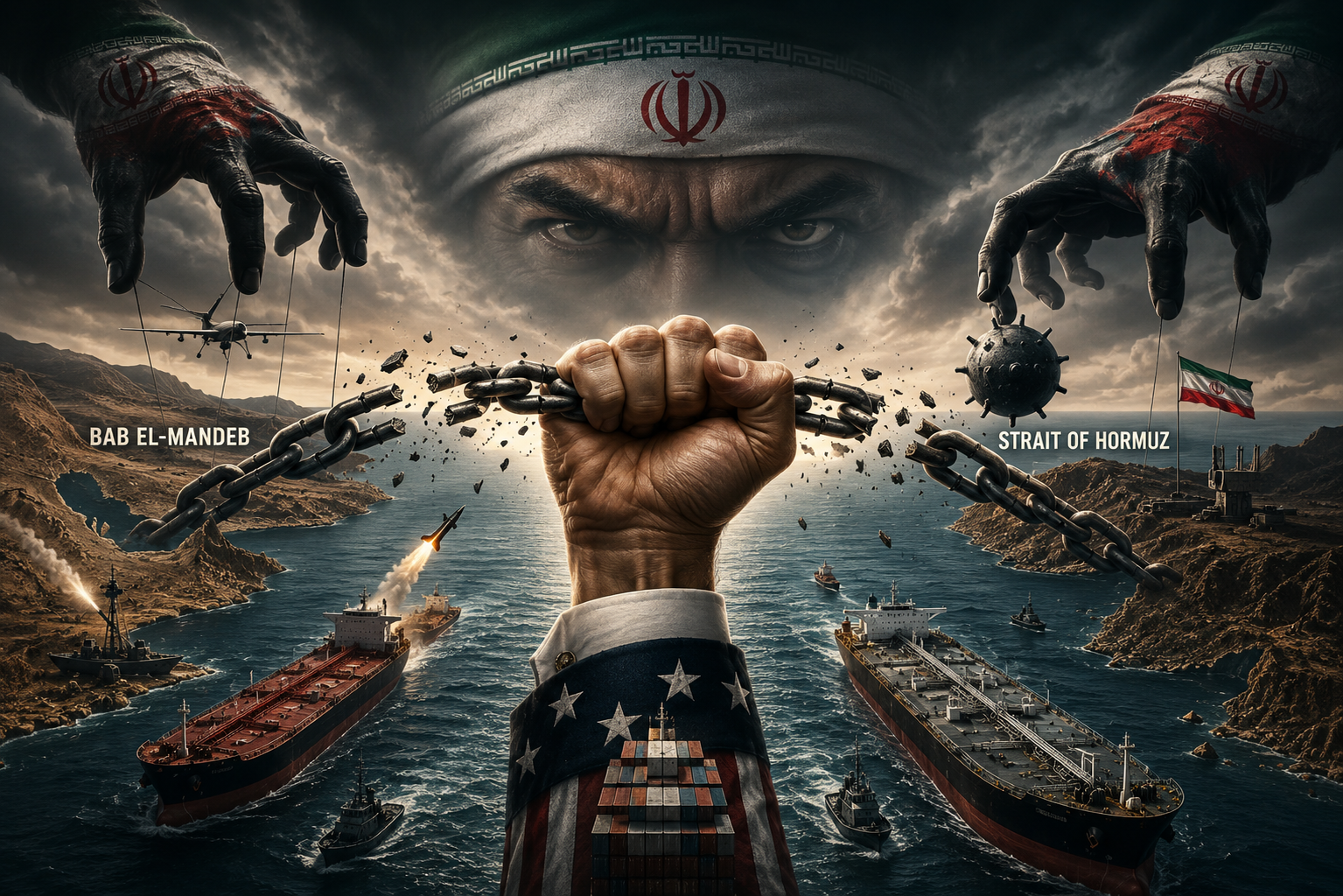
Illustration: Hormuz Today. Bab el-Mandeb tomorrow. Reagan broke the chains in 1987. America must do it again. Maritime blackmail must never become the new world order
Reagan Protected Hormuz in 1987. Trump Must Do the Same Today. Bab el-Mandeb will be next—and the global economy will pay the price.
By: The Editorial Board, Opinion
The warning signs are no longer hypothetical.
The warning signs are no longer hypothetical.
Iran’s strategy is becoming increasingly clear: weaponize the world’s most critical maritime chokepoints through direct pressure in the Strait of Hormuz and proxy intimidation in Bab el-Mandeb.
What began as threats has evolved into a broader campaign of maritime coercion, disruption, and what many around the world increasingly view as state-backed piracy.
Recent maritime security reports indicate growing suspicious activity in the Gulf of Aden and renewed threats by Iran-aligned Houthis against commercial shipping. The Houthis, who control much of Yemen’s Red Sea coastline, have repeatedly demonstrated their ability to disrupt global shipping routes with drones, missiles, mines, and attacks on civilian vessels.
This is no longer simply about oil.
It is about whether the international community will allow strategic waterways to become armed toll booths controlled by militias, drones, mines, and intimidation.
If Iran succeeds in establishing de facto control over Hormuz, rest assured Bab el-Mandeb will be next. The precedent alone would be catastrophic.
Global trade may appear decentralized, but maritime geography still shapes how goods move around the world.
A handful of narrow waterways control enormous volumes of global energy, commodities, and container traffic. The Strait of Hormuz, Bab el-Mandeb, Strait of Malacca, Suez Canal, and Panama Canal form the arteries of the global economy. A disruption in any one of them can send shockwaves through energy markets, manufacturing supply chains, inflation, and food prices worldwide.
If one chokepoint falls under coercive control, the danger extends far beyond the Middle East.
The precedent itself becomes contagious.
If Iran succeeds in using intimidation, proxies, mines, drones, and maritime disruption to establish effective control over Hormuz, other powers and non-state actors may conclude that strategic waterways can be weaponized for political and economic gain.
China could intensify pressure around Asian shipping corridors. Militias and pirate networks could expand operations near Bab el-Mandeb. Future geopolitical conflicts could place other strategic corridors under increasing pressure.
The world would enter a dangerous era in which maritime blackmail becomes normalized.
That is why this issue is much larger than Iran.
This is about preserving one of the foundational principles of the modern international order: international waterways must remain open to all nations and free from coercion.
President Donald Trump now appears to be considering a possible “Plan B” involving new military strikes against Iran. But military strikes alone will not solve the underlying strategic problem if Iran continues to believe it can intimidate the world into accepting its growing influence over critical trade routes.
The objective should not be endless war.
The objective should be unmistakable deterrence.
This is where Ronald Reagan’s example becomes highly relevant.
During the late 1980s Tanker War, Reagan understood that protecting freedom of navigation was not optional—it was essential to the stability of the global economy. Under Operation Earnest Will, the United States escorted tankers through the Gulf to ensure maritime commerce continued despite Iranian threats. When Iran escalated further, the United States launched Operation Praying Mantis, severely damaging Iran’s naval capabilities and restoring deterrence.
The lesson was simple: credibility matters.
Reagan demonstrated that freedom of navigation was not merely an American interest—it was the backbone of global economic stability.
Today, the world is watching to see whether America still has the will to defend that principle.
Repeated warnings without decisive enforcement risk creating the impression that maritime coercion works. That perception alone could embolden not only Iran and its proxies, but future adversaries around the world.
Europe and Asia, which depend heavily on these shipping lanes, also face a defining test. They cannot continue benefiting from the global trading system while relying almost entirely on the United States to protect it.
The stakes are enormous.
If maritime blackmail succeeds in Hormuz and Bab el-Mandeb, insurance costs, shipping disruptions, energy inflation, and geopolitical instability could become permanent features of the global economy.
And once the world accepts coercion in one strategic waterway, every other chokepoint becomes vulnerable.
The moment tolls, threats, drones, and proxy intimidation are normalized in Hormuz, every strategic waterway on earth becomes negotiable.
That is why Iran must not be allowed to control Hormuz.
