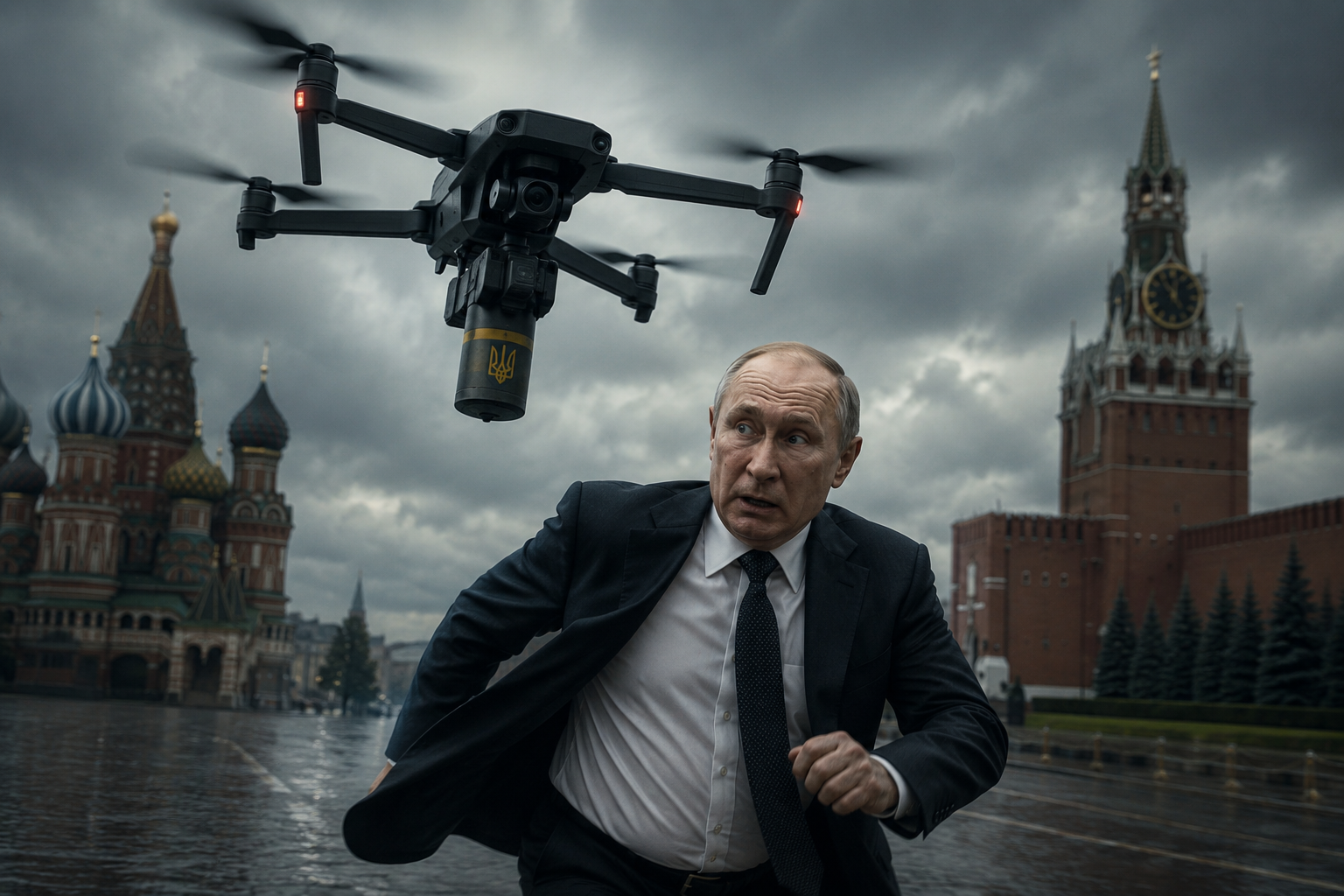
Illustration: Putin’s war has finally reached home. The sky above Russia Is no longer safe”
Cheap drones are reshaping modern warfare, exposing the vulnerability of even the world’s largest military powers
By : The Editorial Board
When Vladimir Putin launched the invasion of Ukraine, the expectation in the Kremlin was clear: overwhelming military power would quickly crush resistance, topple Kyiv, and reestablish Russian dominance.
Instead, the war has evolved into something few military planners fully anticipated. While the front lines remain heavily contested and often deadlocked, the battlefield itself has fundamentally changed. The war is no longer defined only by tanks crossing borders or artillery duels along trenches. Increasingly, it is being shaped by swarms of low-cost drones capable of striking deep inside Russian territory, disrupting logistics, damaging critical infrastructure, and bringing the war directly into Russia’s economic heartland.
Ukraine may not be rapidly advancing on the map, but it is steadily transforming the nature of warfare.
What makes this moment historic is not simply the use of drones. Drones have existed for years. What is revolutionary is how Ukraine has integrated mass-produced, relatively inexpensive drones into a strategic weapon capable of challenging one of the world’s largest military powers.
Cheap first-person-view drones, long-range attack drones, and AI-assisted targeting systems are now destroying assets worth millions—or even billions—of dollars. Fuel depots, oil refineries, rail hubs, ammunition warehouses, airfields, and military logistics centers deep inside Russia are increasingly vulnerable. A drone that costs a few thousand dollars can now cripple infrastructure worth hundreds of millions.
This is changing military calculations around the world.
For decades, major powers believed geography provided strategic depth. Countries assumed that vital infrastructure far from the front lines remained relatively safe. That assumption is collapsing. In modern warfare, distance no longer guarantees protection. Small drones can travel hundreds of miles, evade expensive air defense systems, and strike targets previously considered untouchable.
The implications extend far beyond Russia and Ukraine.
Military planners in United States, China, NATO countries, and across the Middle East are studying this war intensely because it is rewriting military doctrine in real time. Future conflicts may rely less on massive armored formations and more on autonomous systems, electronic warfare, cyber integration, and swarms of intelligent low-cost drones.
The economic dimension is equally important.
Ukraine’s growing ability to strike Russian oil infrastructure and logistics hubs is increasing the economic pressure on Moscow. Wars are not sustained by ideology alone. They require fuel, transportation, industrial output, and public tolerance. By targeting infrastructure tied to Russia’s energy sector and military supply chains, Ukraine is forcing the Kremlin to spend enormous resources defending territory far beyond the front lines.
More importantly, the war is increasingly reaching ordinary Russians.
For much of the conflict, many Russians experienced the war as a distant military operation. That perception is changing as drone strikes disrupt airports, damage refineries, force evacuations, and expose weaknesses in Russia’s security apparatus. Psychological pressure matters in prolonged wars. A conflict that touches daily life becomes harder to ignore.
At the same time, Russia still retains significant advantages in manpower, industrial capacity, and military production. This remains a dangerous and unpredictable war. But the assumption that overwhelming size alone guarantees military superiority has been badly shaken.
History may ultimately remember this conflict not only for its geopolitical consequences, but for marking the beginning of a new era in warfare.
The age when only superpowers could project meaningful force across long distances is fading. Technology is rapidly democratizing military power. Smaller nations, non-state actors, and even loosely organized groups can increasingly threaten strategic infrastructure once protected by geography and enormous defense budgets.
That reality should concern every government in the world.
