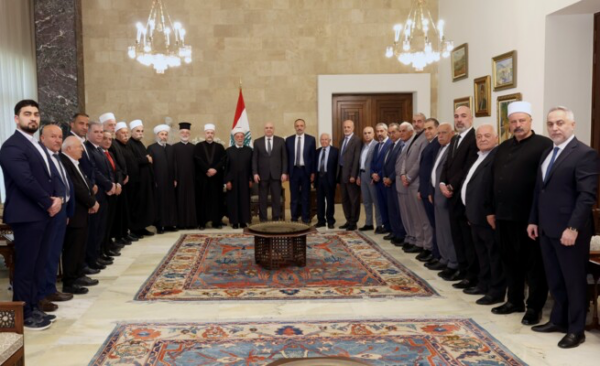
President Aoun Is shown with a delegation from Hasbaya and Arqoub of South Lebanon at the Baabda Palace.
President Joseph Aoun announced, before a delegation from Hasbaya and Arqoub, that “we informed the American side—which is graciously undertaking mediation efforts—from the very first moment that a ceasefire is a necessary initial step for any subsequent negotiations. This is a point we reiterated during the two sessions held at the ambassadorial level on April 14 and 23. It was also clearly articulated in the statement issued by the U.S. Department of State following the first session—a statement we emphasized and which stipulated, in its third paragraph, that Israel would not conduct any offensive military operations against Lebanese targets, including civilian, military, and other state assets within Lebanese territory, whether by land, sea, or air.”
Aoun emphasized that “this constitutes the official position of the Lebanese State regarding developments occurring in Lebanon or in Washington. We are not concerned with any rhetoric to the contrary, nor does it enjoy any official Lebanese endorsement.” He further noted, “Some hold us accountable for the decision to enter into negotiations, citing a lack of national consensus. To them, I ask: When you yourselves embarked upon war, did you first secure national consensus?”
He affirmed that “even before negotiations had begun, some individuals started directing arrows of criticism and accusations of treason against us, alleging that we were entering these negotiations in a state of capitulation.” He added, “To those individuals, we say: Wait for the negotiations to commence, and then judge the outcome.”
He further asked, “For how long must the people of the South continue to pay the price for the wars of others being waged on our soil—the most recent examples being the war in support of Gaza and the war in support of Iran? Had this war been waged for the sake of Lebanon, we would have supported it wholeheartedly; however, when the objective of a war is merely to serve the interests of others, I reject such a war absolutely.” He emphasized that “what we are doing is not an act of betrayal; rather, betrayal is committed by those who drag their country into war to serve foreign interests.” He further noted, “My duty is to shoulder the responsibility for my decision and lead my country toward salvation, in accordance with the fundamental principles I have affirmed. My objective is to bring about an end to the state of war with Israel—much like the Armistice Agreement. Was the Armistice Agreement an act of humiliation? I, for one, will never accept reaching an agreement that entails humiliation.”
Aoun was responding to Hezbollah’s accusation. Hezbollah has been claiming that it entered the war to defend Lebanon , but no one is buying this in Lebanon including the silent majority of the Shiite community which has suffered the most as a result of both wars and others.
On March 2, 2026, Hezbollah officially entered the conflict by launching rocket and drone attacks at northern Israel, acting in support of Iran following U.S.-Israeli strikes that killed Supreme Leader Ali Khamenei. This move, marking a major escalation, prompted immediate and intense Israeli retaliatory strikes against Hezbollah targets in Beirut and Southern Lebanon.
The majority of the Lebanese are against the war and accused Hezbollah of betraying Lebanon when it entered the war since they all realize that Hezbollah’s action had nothing to do with Lebanon, it was strictly aimed at increasing Iran’s influence in the region. ” After all this is precisely why Hezbollah was created by the Iranian Revolutionary Guard (IRGC) in 1982 ” Ahmed Hussein, a Lebanese analyst told Ya Libnan, adding : “Think of Hezbollah as IRGC’s mercenary army in Lebanon, it owns it”.
