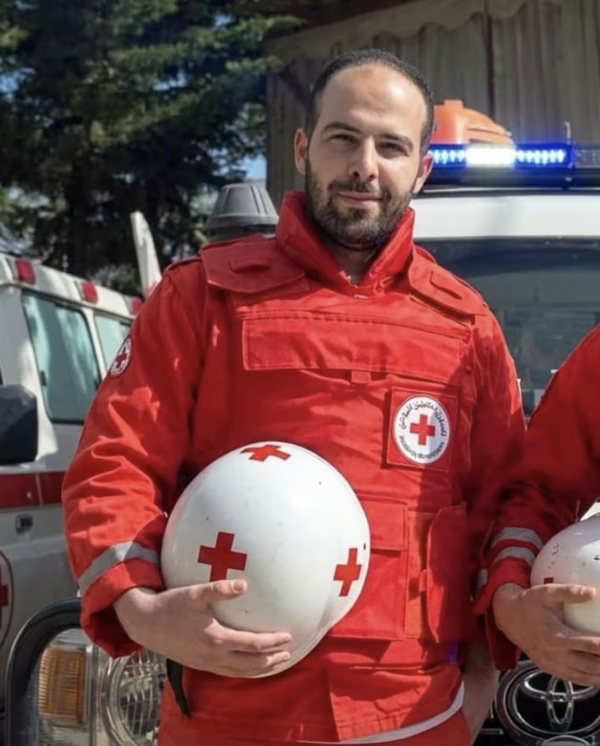
Paramedic Hasan Badawi.@RedCrossLebanon / via X
By Chantal Da Silva and Zoya Awky, NBC
It was Hasan Badawi’s job to race toward the location of military strikes in southern Lebanon, where, as a paramedic, he tended to the maimed and dead. He was killed earlier this month while en route to his latest assignment — allegedly cut down by an Israeli drone.
As a first responder, he is not alone.
Badawi, 31, a father of one with a baby on the way, was a volunteer medic with the Lebanese Red Cross. It is dangerous work helping others in this conflict.
On April 12, as Israeli forces moved toward the key Hezbollah stronghold of Bint Jbeil, so did Badawi.
His team wore the standard Lebanese Red Cross uniform — a bright-red jumpsuit bearing the organization’s insignia, with a large cross on the back and on the shoulders — and their ambulance was also clearly marked, according to the Lebanese Red Cross. Still, they were “directly targeted,” the organization said. One of Badawi’s colleagues was wounded.
The Red Cross said it had coordinated safe passage for the mission. The Israeli military said it had been targeting a Hezbollah member in a strike but was aware of reports of a Red Cross team being “affected” and that the strike was under review.
Badawi joined what aid groups say is a growing list of front-line medics and other health workers killed since Israel invaded Lebanon more than six weeks ago. According to the Lebanese health ministry, at least 100 health workers have died since the U.S. and Israel attacked Iran on Feb. 28, setting off a wider war across the Middle East.
At least 95 emergency medical services workers and volunteers, mainly paramedics, are among those killed, with scores more injured since Israeli forces launched its ground and aerial assault in Lebanon after Hezbollah attacked Israel in support of Iran, according to the health ministry.
Aid groups warn that this reflects regional and worldwide trends of health and humanitarian workers being killed in recent years, with hundreds dying in Israeli operations in the Middle East.
A spokesperson for the International Federation of Red Cross and Red Crescent Societies, said the growing toll on humanitarians, including first responders with the IFRC, around the world was undeniable.
“It is a matter of numbers,” said Tommaso Della Longa of the number of humanitarian workers killed, which he said had “skyrocketed” in recent years.
While paramedics are considered health workers, they are also often counted as humanitarians, particularly since many volunteer paramedics work with organizations like the IFRC, Della Longa said. International law, including the Geneva conventions, seeks to protect non-combatants like health workers as well as aid workers and civilians.
In a recent statement to the United Nations Security Council, Tom Fletcher, the undersecretary-general for humanitarian affairs and emergency relief coordinator, warned of a chilling pattern of humanitarians being killed in conflicts.
In 2025 alone, at least 326 aid workers died in 21 countries, bringing the total number of humanitarians killed in three years to over 1,010, he said. Of those killed across that three-year period, more than 560 died in the Gaza Strip and the Israel-occupied West Bank during Israeli operations, Fletcher said. At least 130 were killed in Sudan, 60 in South Sudan, 25 in Ukraine and 25 in the Democratic Republic of the Congo.
The rise has not been an “accidental escalation,” he said, but instead marked a “collapse of protection” for humanitarians around the world amid a “broader attack on the U.N. Charter and on international humanitarian law.”
While Fletcher warned of a marked rise in humanitarians being killed in conflicts around the world, it is not the first time that aid workers have been at risk. During the war in Afghanistan, for example, an estimated 444 humanitarian workers were killed from October 2001 to April 2021, according to Brown University’s Costs of War Project.
Attacks ‘must stop’
Governments around the world have sounded the alarm over the growing number of humanitarian workers being killed in Lebanon. Canada issued a joint statement alongside the United Kingdom, Australia, Japan, Jordan and other nations warning that attacks on aid workers “must stop” and calling for international law to be upheld.
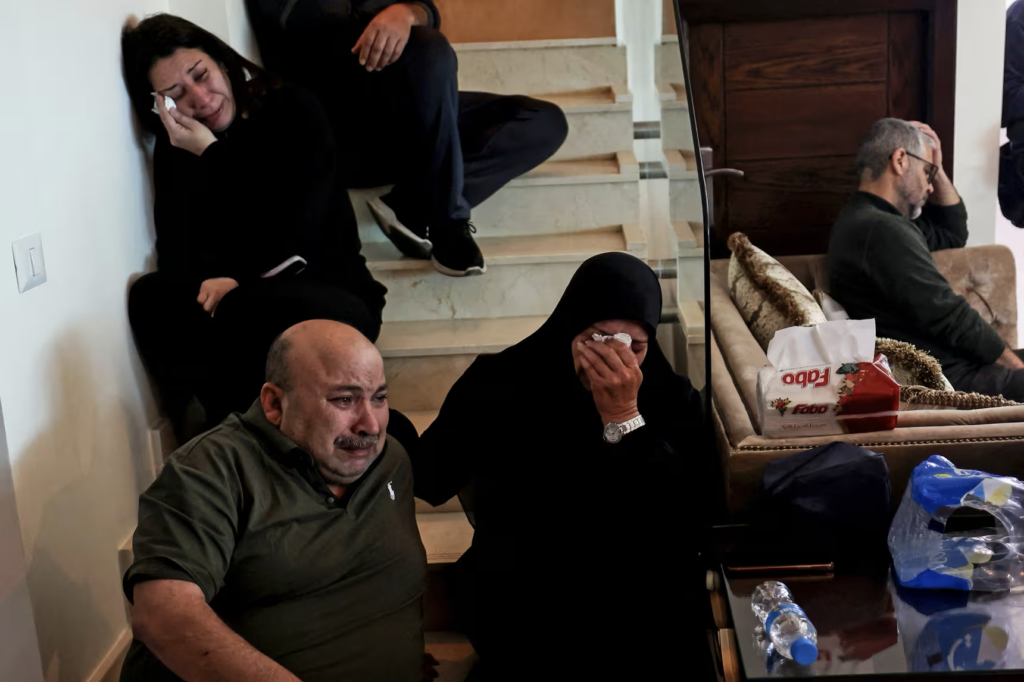
Relatives of Hasan Badawi mourn as the family receives condolences at their home in the Bechamoun area south of Beirut.Anwar Amro / AFP via Getty Images
The countries did not name Israel as the perpetrator of the attacks. But after the deaths of hundreds of health personnel during Israel’s assault on the Gaza Strip following the Oct. 7, 2023, Hamas-led attacks, some aid groups say the incidents in Lebanon are part of a trend.
“It’s not about paramedics doing what they have to do to be recognizable or protected under international law,” said Aseel Baidoun, deputy director of advocacy and campaigns at Medical Aid for Palestinians.
“It’s about facing an army that does not recognize international law or any protected persons under international law,” she said in a phone interview.
Kenneth Roth, human rights expert and the former executive director of Human Rights Watch, agreed, saying he believed Israel “has a history of targeting healthcare and rescue workers, using the thin pretext of some enemy military presence, as part of its efforts to make broad swathes of territory unlivable — first Gaza, now southern Lebanon — to drive out the civilian population.”
The IDF says it operates according to international law, does not target civilians and takes “all feasible precautions to mitigate harm to civilian infrastructure.”
Meanwhile, Hezbollah “systematically embeds military infrastructure and assets within civilian population centers,” all while using civilians as human shields, it says.
It accused the group of the “systematic use of ambulances and civilian infrastructure for terrorist purposes,” although it has not made that allegation in the incident that killed Badawi.
Israel also accuses Hamas of using hospitals as command and control centers, as well as ambulances to disguise its activities —something the militant group denies.
Overall, more than 2,200 people have been killed in Lebanon, with over a million displaced, since the U.S. and Israel launched their war against Iran. Soon after that conflict began, Tehran-backed Hezbollah launched strikes on Israel, where 23 people have died.
While President Donald Trump announced on April 16 that Israel and Lebanon had agreed to a 10-day ceasefire, which was extended on Thursday, the Israeli military continues to operate in the far south of Lebanon as it seeks to establish a buffer zone.
Under immense strain
A death like Badawi’s can be especially traumatic in a country like Lebanon, where emergency systems are under immense strain due to compounding economic and security crises, said Dr. Shawky Amine Eddine, the humanitarian affairs coordinator for the International Committee of the Red Cross in Lebanon.
“The loss of even one ambulance can deprive entire communities from lifesaving care,” he said.
Hassan Ali Saad, who worked alongside Badawi, said he was “devastated.”
“Hasan is not only a colleague, he is a brother to us,” Ali Saad said. “We are on a humanitarian mission, and by all international laws, we are not a target.”
The Israeli military said in a statement on April 14 that it was aware of reports that a Red Cross team had been “affected” by a strike launched on April 12 targeting a Hezbollah member who was “in proximity” to its troops in the area of Bint Jbeil.
The Israel Defense Forces has said the incident was still under review and repeated that statement when asked whether they had been aware that a Red Cross team would be operating in the area around the time of the strike.
If Israeli forces were aware or directly targeted the team, the attack could potentially constitute a war crime because medics are protected under international law, with limited exceptions, Roth said.
Like all civilians, rescue workers are protected from military attack, so the “mere fact that there might be a fighter nearby doesn’t justify killing them,” he said.
On April 15, three days after Badawi was killed, back-to-back-to-back strikes killed four more paramedics in another southern Lebanese village, according to the Islamic Health Association and the Nabatieh Ambulance Service.
They were reacting to reports of an Israeli raid in the area of Mayfadoun in the Nabatieh district when the first team was hit, killing two, said Hajj Mahmoud, a spokesperson for Hezbollah-affiliated Islamic Health Association
When teams of paramedics from the Risala Scout Association and the Nabatieh Ambulance Service also rushed to the site, Israeli forces launched two more attacks, killing a further two first responders.
NBC News
