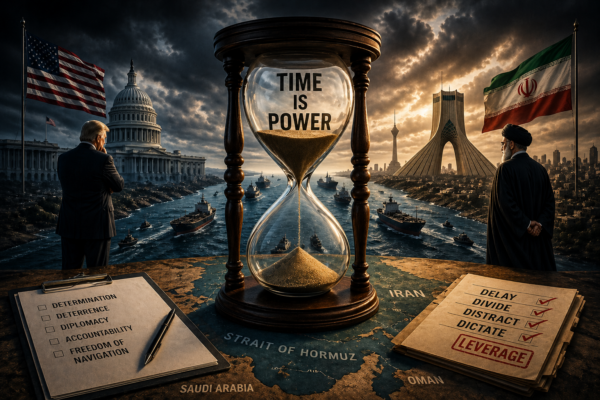
Iran is setting the pace—while Washington risks surrendering control of time, cost, and outcome
By : The Editorial Board, Opinion
The choreography is no accident. While Washington signals openness, Iran signals motion—Oman, Pakistan, Russia—everywhere and nowhere at once. Its foreign minister, Abbas Araghchi, leaves one capital only to reappear in another, while parts of his delegation shuttle back to Tehran for “consultations.” The message is unmistakable: nothing happens on America’s timeline.
This is not diplomacy as most Americans understand it. It is time warfare—a strategy refined over decades by Tehran to stretch negotiations, multiply channels, and avoid decisive commitments while conditions on the ground shift in its favor.
And right now, those conditions favor Iran.
The Strait of Hormuz—the world’s most critical energy artery—has been turned into a pressure valve. Ships wait. Insurance costs spike. Global markets hold their breath. Iran doesn’t need to win a war to gain leverage; it only needs to prolong uncertainty.
Meanwhile, Washington hesitates.
President Donald Trump called off a U.S. delegation that was expected to engage Iran indirectly in Pakistan, opening the door to direct talks—but without a defined framework or deadline. At the same time, Defense Secretary Pete Hegsethinsists, “we have all the time in the world.”
That statement may sound calm. In reality, it hands Iran its greatest advantage.
Because in this contest, time is power.
Tehran’s Playbook: Control the Clock, Control the Outcome
Iran’s approach is disciplined and deliberate:
- Delay decisions by referring key issues back to Tehran
- Expand the arena by engaging multiple capitals simultaneously
- Test resolve by probing whether U.S. warnings carry consequences
Every move serves one purpose: keep Washington reacting, never leading.
By stretching diplomacy across Oman, Pakistan, and Russia, Iran transforms a bilateral negotiation into a geopolitical web—one where pressure dissipates and accountability blurs.
And by publicly questioning whether the United States is “serious,” Tehran flips the narrative—casting itself as cautious, even reasonable, while portraying Washington as inconsistent.
It is a familiar tactic. And it works—when the other side allows it.
Washington’s Dilemma: Wait or Act
The United States now faces a narrowing set of choices:
Wait
Let diplomacy play out across multiple channels.
Accept prolonged disruption in global energy flows.
Hope Iran eventually agrees to terms it has already shown it can delay indefinitely.
Act
Reassert control over maritime security.
Enforce freedom of navigation.
Risk escalation—but restore deterrence.
There is no neutral path. Indecision is itself a decision—and it favors Tehran.
The Strategic Cost of Drift
History offers a clear warning.
In 1987, under President Reagan, the United States did not wait for permission to secure the Strait of Hormuz. It acted—decisively—escorting tankers and restoring confidence in global shipping.
Today, the contrast is stark.
Back then, America defined the timeline.
Today, it risks negotiating within one defined by Iran.
The longer this continues, the higher the cost:
- Energy markets recalibrate around instability
- Allies question U.S. reliability
- Adversaries learn that delay defeats pressure
And perhaps most dangerously, a precedent is set—that critical global chokepoints can be weaponized without immediate consequence.
The Bottom Line: Time Must Be Reclaimed
This is not simply a diplomatic standoff. It is a contest over control—over pace, pressure, and ultimately, outcome.
Iran understands this. It is acting accordingly.
The question is whether Washington does.
Will the United States finally define the timeline—set clear terms, clear deadlines, and clear consequences?
And the longer Washington hesitates, the more Tehran defines the cost.
Or will it continue reacting, meeting movement with hesitation, and allowing Tehran to dictate the rhythm of events?
Because in this crisis, one truth stands above all:
The side that controls time controls the outcome.
“The world is no longer watching the crisis—it is paying for it.
And the longer Washington hesitates, the more Tehran defines the cost.”
